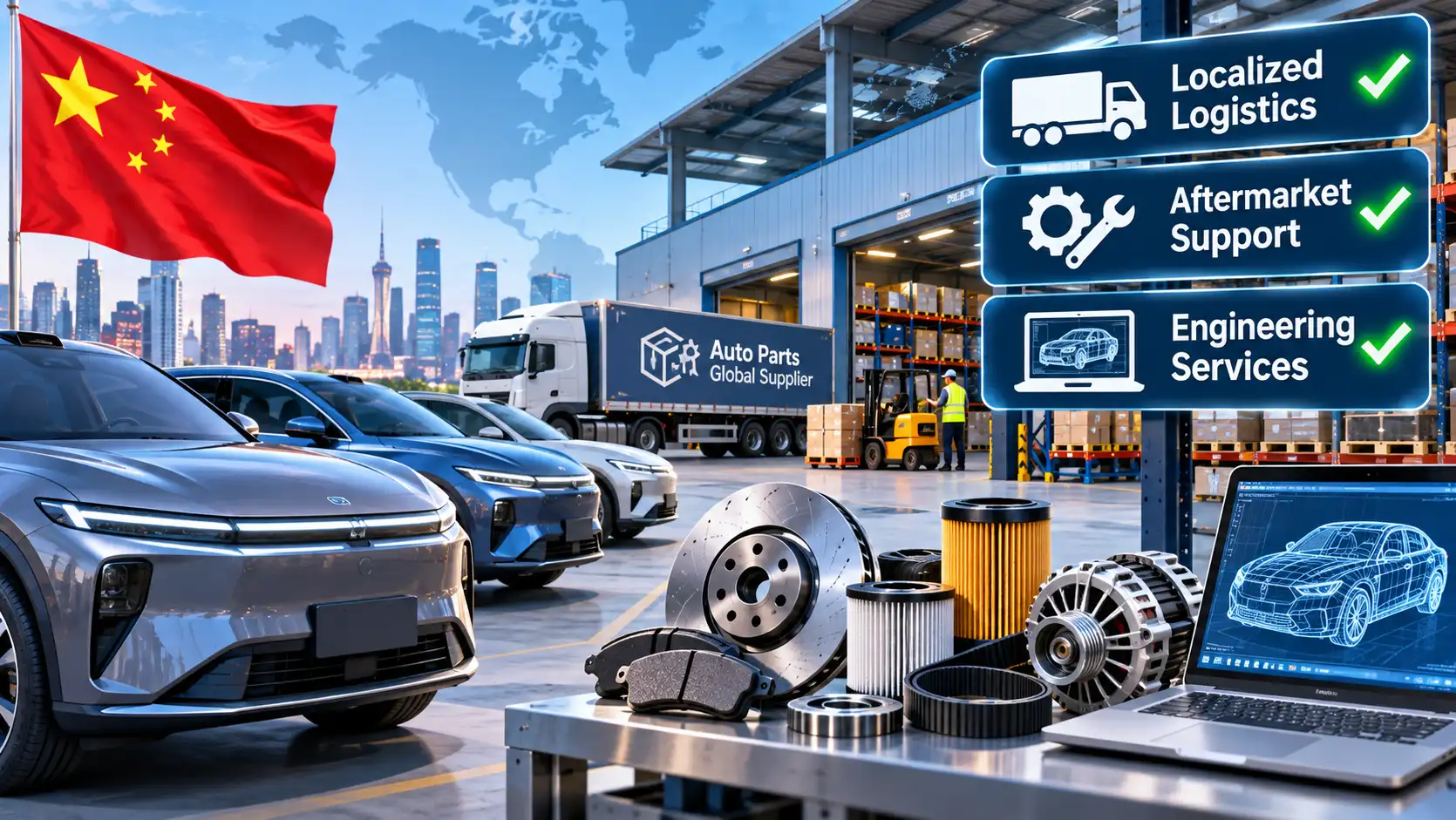
Chinese automotive original equipment manufacturers (OEMs) accelerating their export and overseas assembly operations are restructuring supplier contracts. They now require automotive component manufacturers to provide localized engineering, regional warehousing, and aftersales field service rather than relying on pure cross-border parts delivery.
Reported Industry Shift: From Port-to-Port Delivery to In-Market Integration
The report confirms that as Chinese automakers (including passenger car and commercial vehicle producers) establish assembly hubs and distribution networks across Europe, Southeast Asia, Latin America, and the Middle East, standard port-to-port component delivery is no longer sufficient. Automakers face critical operational hurdles abroad, including long lead times for replacement parts, complex local homologation procedures, and strict consumer protection mandates regarding warranty turnaround times.
To mitigate these bottlenecks, Chinese OEMs are directly pressing component suppliers to adopt three core operational functions in destination markets:
- Regional Warehousing and Buffer Stocking: Establishing localized parts hubs within target markets to shorten delivery lead times for warranty claims, crash repair, and regular maintenance from weeks to under 48 hours.
- Technical Homologation and Engineering Support: Assisting vehicle manufacturers with regional compliance verification (such as ECE homologation in the European Union, GSO conformity in the GCC, and INMETRO standards in Brazil).
- Localized Reverse Logistics: Implementing rapid diagnostic, return, and recycling systems for complex powertrain assemblies, power electronics, and battery sub-components.
Comparative Operational Requirements: Traditional Export vs. Integrated Support
The operational divide between traditional component export contracts and the emerging localized support model highlights significant changes for commercial supply chains:
| Operational Dimension | Traditional Component Export Model | Mandated In-Market Supplier Model |
|---|---|---|
| Inventory Location | Consolidated at origin (China/domestic factory) | Regional hubs within destination trade zones (e.g., EU, ASEAN, GCC) |
| Aftermarket Lead Time | 30 to 60 days via ocean freight container transit | 24 to 72 hours via localized intermediate distribution |
| Customs & Logistics Handling | Handled by importer or distributor via EX-1 / standard import clearance | Supplier-managed bonded storage, clearance, and localized distribution |
| Warranty & Defect Handling | Credit notes or container-load returns to factory of origin | In-country diagnostic facilities and authorized remanufacturing networks |
| Technical Support | Remote engineering support from OEM headquarters | On-site application engineers and authorized technician training hubs |
REIFTEIL Analysis: Commercial Implications for Importers and Parts Distributors
While Gasgoo's reporting reflects the operational challenges reported by Chinese OEMs, REIFTEIL's trade evaluation points to concrete commercial shifts for independent parts distributors, tire importers, and commercial fleet operators across overseas markets.
Pressure on Independent Aftermarket Channels
Until recently, independent aftermarket (IAM) distributors in Europe and the Middle East faced chronic shortages of genuine service items for newly introduced Chinese vehicle models. Independent repairers have struggled to access basic maintenance components, from cabin air filters and steering linkages to model-specific Brake Pads for Different Vehicles: A Practical Guide" class="internal-link font-semibold text-blue-600 hover:text-blue-800 hover:underline decoration-blue-300 decoration-2 underline-offset-2 transition-colors" data-inlink="true">Brake Pads Need Replacing" class="internal-link font-semibold text-blue-600 hover:text-blue-800 hover:underline decoration-blue-300 decoration-2 underline-offset-2 transition-colors" data-inlink="true">brake pads and suspension arms.
By requiring OE suppliers to store inventory inside regional bonded warehouses, the flow of genuine OEM-specified replacement components into independent distribution channels is expected to stabilize over the next 12 to 18 months, reducing dependence on ad-hoc air-freight sourcing.
Lubricant and Chemical Fluid Specification Clarity
A persistent friction point for fleet operators deploying Chinese-manufactured light commercial vehicles and heavy trucks has been the lack of clear cross-referencing between Chinese domestic fluid standards (such as GB specifications) and Western equivalents (such as ACEA E7/E9 for heavy-duty diesels or API SP / ILSAC GF-6 for turbocharged gasoline engines).
As tier-1 suppliers build out localized service programs, standardized OE lubricant and coolant cross-referencing is being formalized, allowing regional lubricant blenders and fleet maintenance directors to select compliant 5W-30, 0W-20, and 15W-40 grades without voiding factory warranties.
Customs Clearance, Buffer Stocking, and Working Capital
For logistics operators and European trade clearing agents, the transition increases demand for customs warehousing (Type II customs warehouses) and inward processing relief.
Rather than clearing entire shipments through standard customs declarations (e.g., EU Single Administrative Document / EX-1 handling), suppliers are maintaining duty-suspended buffer stock near major transit hubs (such as Rotterdam, Antwerp, or Hamburg) to quickly service localized assembly and aftersales channels as orders trigger release.
Procurement Takeaway for Commercial Fleet Operators
Fleet directors evaluating the total cost of ownership (TCO) for Chinese commercial vehicles, buses, or municipal fleets should verify whether the vehicle manufacturer has established localized tier-1 parts partnerships or continues to rely on direct ex-works shipment models.
Purchasing decisions should explicitly factor in local spare parts availability and contractually guaranteed lead times for mission-critical components, rather than vehicle acquisition price alone.