In modern automotive engineering, there is no single "universal" brake pad material. A brake pad ideal for an ultra-quiet luxury Electric Vehicle (EV) will fail rapidly under high-temperature Autobahn driving or heavy commercial truck towing.
This in-depth engineering guide analyzes the 4 primary friction formulations, decodes SAE J866 friction edge codes (`FF`, `GG`), explains ECE R90 European safety standards, details copper-free environmental regulations, and provides an actionable decision framework for B2B Auto Parts for Your Market" class="internal-link font-semibold text-blue-600 hover:text-blue-800 hover:underline decoration-blue-300 decoration-2 underline-offset-2 transition-colors" data-inlink="true">auto parts buyers, distributors, and workshops. Source wholesale brake pads on the REIFTEIL Wholesale Auto Spare Parts Portal.
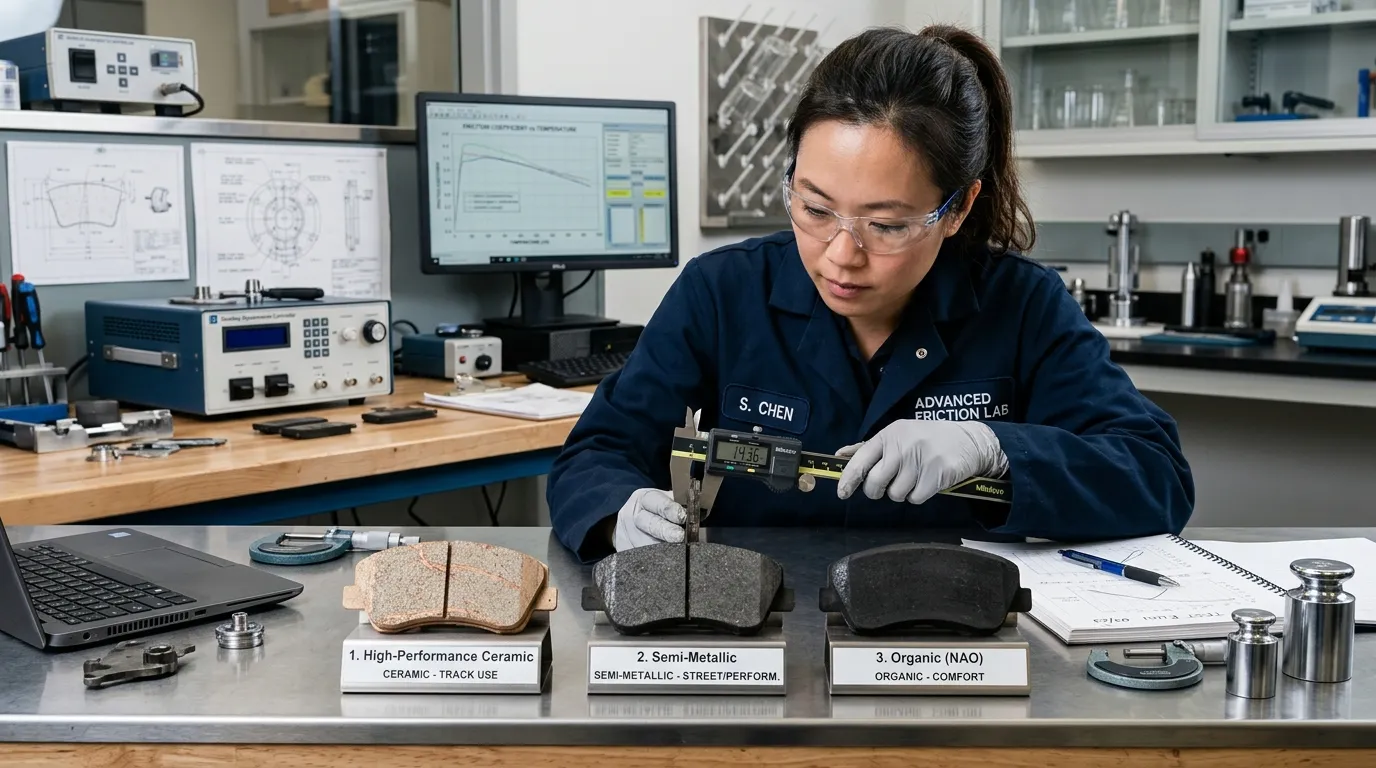
Friction Formulation Array: Ceramic, Low-Metallic NAO, and Semi-Metallic brake pads featuring multi-layer anti-squeal shims, chamfers, and wear sensors.
Quick Answer: Comparing the 4 Primary Friction Materials
Smooth, quiet, low rotor wear, high dark dust output. Thermal limit ~300°C. Best for Asian economy city cars.
10–30% steel/copper. Aggressive pedal bite, high fade resistance (~500°C), moderate squeal. OEM standard for European cars (BMW, VW, MB).
30–65% metal fibers. Maximum thermal fade resistance (~650°C), heavy metallic dust, higher rotor wear. Best for commercial trucks & towing.
Ceramic fibers & non-ferrous fill. Ultra-clean light dust, silent operation, stable friction ($\mu = 0.38 - 0.45$). Best for luxury sedans & EVs.
The Friction Science — How Brake Pads Work
When a driver depresses the brake pedal, hydraulic fluid pressure forces the caliper pistons to press the brake pads against the spinning cast iron brake rotor (disc). The pad-rotor interface operates on two fundamental physical friction mechanisms:
Abrasive Friction
Mechanical shearing of hard abrasive particles in the pad (silicates, iron oxides, metal wool) directly against the softer cast iron rotor face. Generates aggressive bite but increases rotor wear and creates dark dust.
Adhesive Friction (Transfer Layer)
Friction material deposits a microscopic layer ($1.0 - 2.0\text{ }\mu\text{m}$) of pad material onto the rotor surface. Braking occurs as pad material bonds and breaks against the matching film on the rotor. Smoother, quieter, and extends rotor lifespan (characteristic of Ceramic formulations).
When temperatures exceed the pad's thermal operating window, phenolic resin binders begin to outgas—creating a cushion of hot gas between the pad and rotor. This condition is known as thermal brake fade, causing a spongy pedal and loss of stopping force. To learn about rotor metallurgy, read Brake Discs vs Brake Rotors: What You Need to Know.
Anatomy of a Modern Brake Pad Assembly
A high-quality replacement brake pad is an integrated assembly comprising 5 engineered layers:
In-Depth Breakdown of the 4 Friction Formulations
| Engineering Metric | Organic NAO | Low-Metallic NAO | Semi-Metallic | Premium Ceramic |
|---|---|---|---|---|
| Metallic Fiber Content | 0% (Non-ferrous) | 10% – 30% (Steel/Cu) | 30% – 65% (Iron/Steel) | 0% – 5% (Non-ferrous) |
| Friction Coeff ($\mu$) Range | 0.32 – 0.38 (EF) | 0.38 – 0.48 (FF/GG) | 0.40 – 0.55 (GG/HH) | 0.38 – 0.45 (FF) |
| Thermal Fade Limit | 250°C – 300°C | 450°C – 500°C | 600°C – 650°C | 400°C – 450°C |
| Initial Cold Bite | Moderate | Very High (Autobahn) | Low (Needs heat) | Immediate & Consistent |
| Rotor Wear Rate | Very Low | Moderate to High | High (Scouring) | Ultra-Low |
| Dust Color & Visibility | Heavy Dark Dust | Medium Dark Dust | Heavy Metallic Dust | Minimal Light-Grey Dust |
| Acoustic Squeal Risk | Very Low | Moderate (High pitch) | High | Whisper Quiet |
| Target Vehicle Segment | Asian Economy Cars | European OE (BMW, VW) | Commercial Trucks/Towing | Luxury Sedans, EVs, US SUVs |
For insights on diagnosing worn friction linings, read How to Know When Brake Pads Need Replacing.
Decoding SAE J866 Friction Edge Codes ($\mu$)
Look closely at the edge stamp on a quality brake pad backing plate. You will see codes such as `TEXTAR T4146 FF` or `BREMBO P85020 GG`. The two-letter code defined by SAE J866 measures the friction coefficient ($\mu$) across two temperature points:
First Letter = Cold Friction Coefficient
Measured at low temperature ($250^\circ\text{F} / 121^\circ\text{C}$). Indicates initial pedal bite during normal city driving.
Second Letter = Hot Friction Coefficient
Measured at elevated temperature ($600^\circ\text{F} / 315^\circ\text{C}$). Indicates resistance to thermal fade during emergency high-speed stops.
| Edge Letter Code | Friction Coefficient Range ($\mu$) | Friction Level Description |
|---|---|---|
| C | ≤ 0.15 | Extremely low friction (Not used in automotive) |
| D | 0.15 – 0.25 | Low friction (Light industrial/agricultural) |
| E | 0.25 – 0.35 | Moderate friction (Standard economy NAO pads) |
| F | 0.35 – 0.45 | High friction (Standard OEM Ceramic & NAO pads) |
| G | 0.45 – 0.55 | Very High friction (European Low-Metallic & Heavy Duty) |
| H | > 0.55 | Ultra-High friction (Track racing & heavy commercial) |
Example Interpretation: An "FF" pad maintains a stable friction coefficient between 0.35 and 0.45 under both cold city driving and hot highway braking. An "FG" pad provides higher bite as temperatures rise.
ECE R90 European Safety Certification Protocol
In Europe, all aftermarket replacement brake pads sold for vehicles manufactured after 1999 must legally comply with ECE Regulation 90 (ECE R90). ECE R90 guarantees that an aftermarket pad performs within $\pm 15\%$ of original equipment (OEM) performance.
ECE R90 Laboratory Testing Protocol:
- • Cold Performance Test: Stopping distance at 70 km/h with cold brakes ($<100^\circ\text{C}$).
- • High-Speed Thermal Fade Test: Repeated high-energy stops from 160 km/h to measure friction stability under extreme heat.
- • Pad Shear Strength Test: Physical hydraulic press testing ensuring the friction puck bonding withstands at least $2.5\text{ N/mm}^2$ shear force before separating from the steel backing plate.
- • Speed Sensitivity & Compressibility: Verifying pedal travel consistency across low and high hydraulic pressure lines.
Look for the official approval mark stamped on the backing plate—a circle enclosing an "E" followed by a country code (e.g., `E1` for Germany, `E9` for Spain, `E11` for UK) and the approval certificate number (`90R-xxxxxxx`).
Environmental Regulations — Copper-Free Friction (NSF LeafMark)
Historically, copper was used in up to 15% of brake pad formulations due to its excellent thermal conductivity and quiet engagement. However, brake dust washes into storm drains, releasing copper ions toxic to aquatic life (disrupting salmon olfactory navigation).
Cadmium, chromium, lead, mercury, and asbestos reduced to $<0.1\%$. Copper allowed.
All A-level restrictions PLUS copper content reduced to $<5\%$ by weight.
All A-level restrictions PLUS copper reduced to $<0.5\%$ by weight (Fully Copper-Free certified).
Modern friction engineers substitute copper with synthetic titanates, iron-free metallic matrix structures, Kevlar aramid fibers, and high-purity synthetic graphite to achieve equal thermal transfer without environmental toxicity.
Electric Vehicles (EVs) & Regenerative Braking Pad Requirements
Electric Vehicles (Tesla, VW ID.4, Hyundai Ioniq) present unique challenges for brake pad engineers:
The EV Friction Paradox:
Because EVs use electric motor regenerative braking for over 80% of routine deceleration, the hydraulic disc brakes remain idle for long periods. This under-use leads to rotor surface rust, friction pad surface glazing, and corrosion seizure in caliper slides.
How to Choose the Right Brake Pads — Decision Framework
Select the optimal friction formulation based on vehicle platform, driver behavior, and regional vehicle parc:
European Vehicles (BMW, VW, Audi, Mercedes, Volvo)
Require high cold bite and Autobahn fade resistance ($>450^\circ\text{C}$).
Recommended: Low-Metallic NAO or High-Friction ECE R90 Ceramic (`FF`/`GG`).
Asian & American Passenger Cars (Toyota, Honda, Ford)
Prioritize dust-free wheels, silent operation, and long rotor life.
Recommended: Premium Ceramic (`FF` rating).
Heavy Commercial Vans & Towing SUVs (Sprinter, Transit, Pickups)
Require extreme thermal capacity ($>600^\circ\text{C}$) under heavy load.
Recommended: Heavy-Duty Semi-Metallic (`GG`/`HH` rating).
Electric Vehicles & Hybrids (Tesla, Nissan Leaf, VW ID)
Require corrosion-resistant mechanical backing plates and quiet ceramic friction.
Recommended: EV-Specific Galvanized Ceramic (`FF` rating).
For cross-referencing part numbers across OE and aftermarket brands, explore OE Number vs OEM Number vs Aftermarket Part Number Explained and How to Identify Correct Auto Spare Parts by VIN.
Common Brake Noise & Wear Diagnostics
High-Pitch Squeal
Caused by micro-vibrations between backing plate and caliper piston. Fix: Install RSR shims and apply high-temp silicone grease to pad ears.
Low-Frequency Groan
Glazed friction material or improper bed-in procedure. Fix: Re-bed pads with 10 moderate stops from 80 km/h or resurface rotors.
Tapered / Inner Pad Wear
Seized caliper guide pins or stuck piston. Fix: Service caliper guide pins, replace boots, and flush brake fluid.
REIFTEIL B2B Friction Supply Partnership
Choosing the correct brake pads requires balancing friction formulations, temperature capabilities, rotor wear rates, and environmental standards. For auto parts distributors and workshops, stocking ECE R90 certified Ceramic and Low-Metallic formulations ensures customer safety, quiet operation, and zero warranty returns.
Source Wholesale Premium Brake Pads with REIFTEIL
Supply your auto parts inventory with ECE R90 certified Ceramic, Low-Metallic, and Semi-Metallic brake pads complete with anti-rattle hardware shims and wear sensors.
Frequently Asked Questions
What are the four primary types of automotive brake pad friction materials?
The four friction material categories are: 1. Non-Asbestos Organic (NAO), 2. Low-Metallic NAO, 3. Semi-Metallic, and 4. Premium Ceramic.
What are the key advantages of Premium Ceramic brake pads?
Ceramic brake pads produce minimal light-colored dust, operate silently across wide temperatures, cause low rotor surface wear, and maintain a stable friction coefficient ($\mu = 0.38 - 0.45$).
Why are Low-Metallic NAO brake pads preferred by European car manufacturers?
Low-Metallic NAO pads contain 10% to 30% steel wool and copper. They deliver aggressive initial brake pedal bite and high thermal fade resistance up to 500°C required for Autobahn speeds.
What is the ECE R90 approval standard for brake pads?
ECE R90 is a mandatory European safety certification ensuring aftermarket replacement brake pads perform within $\pm 15\%$ of the original equipment (OEM) friction levels under cold bite, high-speed fade, and shear strength tests.
How do SAE J866 friction edge codes (e.g., 'FF', 'GG') work?
Edge codes consist of two letters printed on the pad backing plate. The first letter represents cold friction (at 250°F / 121°C) and the second letter represents hot friction (at 600°F / 315°C). 'FF' signifies a coefficient of 0.35 to 0.45.
What is Copper-Free friction legislation (NSF B-Level / N-Level)?
Environmental regulations mandate reducing copper content in brake friction materials to less than 0.5% by weight (NSF N-Level) to prevent copper runoff toxicity in streams and rivers.
Why do Semi-Metallic brake pads cause more rotor wear than Ceramic pads?
Semi-Metallic pads contain 30% to 65% abrasive metallic fibers (steel wool, iron powders) which aggressively scour the cast iron rotor face, creating dark metallic dust and higher rotor wear.
What special friction characteristics do Electric Vehicles (EVs) require?
EVs use regenerative braking for 80%+ of deceleration, leaving friction brakes unused for long periods. EV pads require galvanized backing plates to prevent rust, anti-glazing friction materials, and silent operation.
What do chamfers and center expansion slots do on brake pads?
Chamfers prevent pad edge biting against worn rotor ridges to eliminate squeal. Center slots allow thermal expansion and vent gas and dust away from the friction contact surface.
Does REIFTEIL supply ECE R90 certified Ceramic and Semi-Metallic brake pads in bulk?
Yes. REIFTEIL supplies wholesale ECE R90 certified Ceramic, Low-Metallic, and Semi-Metallic brake pads with hardware shims for all major vehicle platforms.