A wholesale quotation of $18.00 per ventilated brake disc may look attractive. But the supplier's price is only one part of the total cost of importing automotive components.
International freight, cargo insurance, customs duties, port handling, customs clearance and inland transport can all increase the amount you pay before the goods reach your warehouse. Storage, financing and inventory obsolescence can add further costs after arrival.
For automotive wholesalers, importers and distributors, understanding these expenses is essential to setting competitive selling prices, protecting margins and deciding whether a bulk purchase is commercially viable.
This is where Total Landed Cost (TLC) becomes useful. It estimates the full cost of acquiring imported goods and delivering them to a specified destination, using a consistent set of cost assumptions.
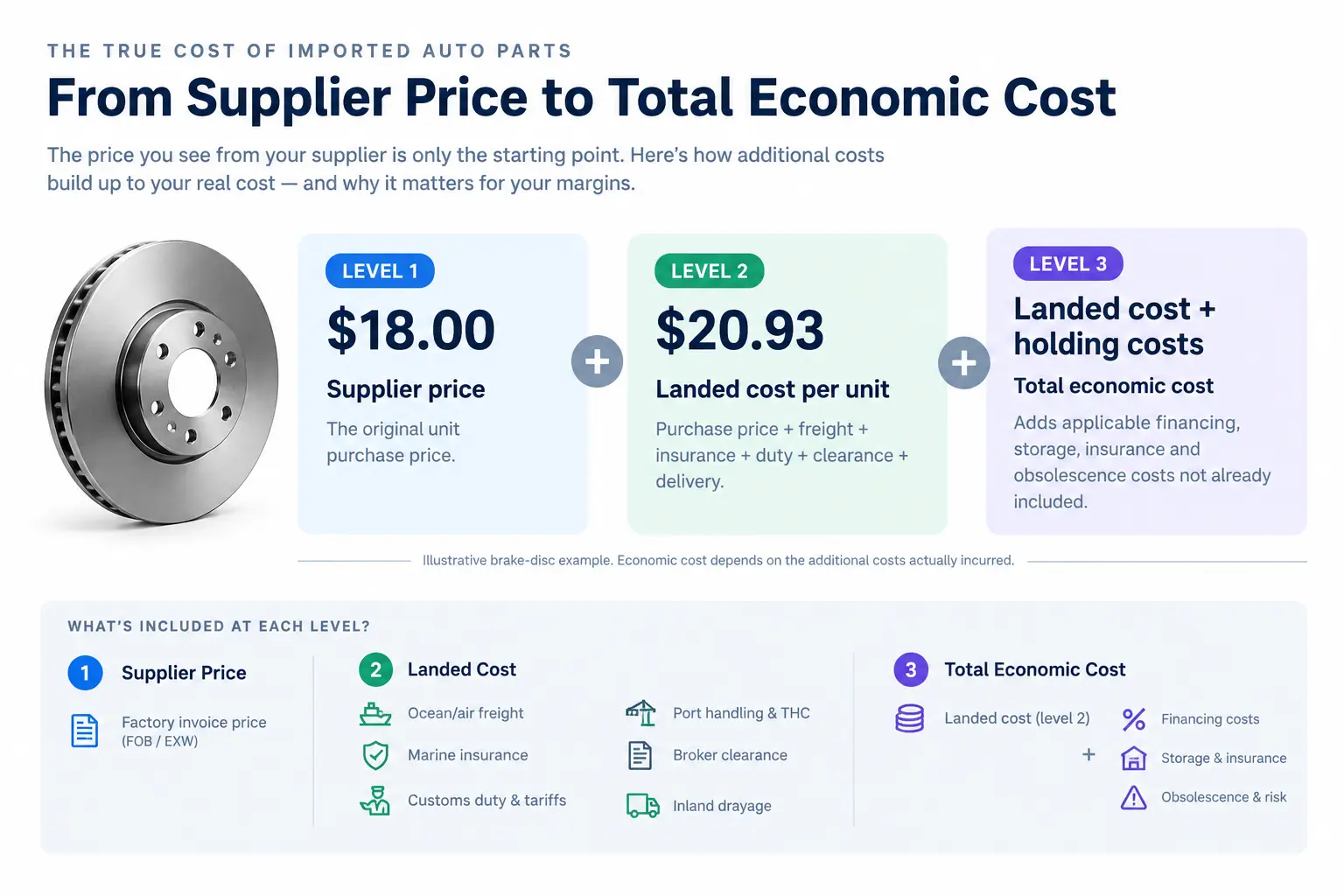
In this guide, you will learn how to calculate landed cost per unit, understand the main import expenses, evaluate a worked brake-disc example and identify practical ways to control procurement costs.
Quick Summary: What Is Included in Total Landed Cost?
Total landed cost is the combined cost of purchasing imported goods and bringing them to a defined destination, such as your warehouse.
| Cost component | What it covers |
|---|---|
| Purchase price | The supplier's price under the agreed Incoterm |
| International freight | Ocean, air, road or rail transportation |
| Cargo insurance | Insurance covering eligible transport risks |
| Customs duties | Import duties determined by classification, origin and destination rules |
| Port and terminal charges | Applicable terminal handling and port-related fees |
| Customs clearance | Broker fees, declarations and related administrative charges |
| Inland transportation | Delivery from the port or terminal to the warehouse |
| Other import costs | Inspection, documentation, handling and other applicable charges |
Important: Inventory carrying costs—such as financing, warehouse storage and obsolescence—should also be evaluated when calculating the total economic cost of holding stock. Keep them separate from the physical landed cost where necessary, so that you do not mix different cost definitions.
1. The Total Landed Cost Formula
The correct formula depends on your purchasing terms, shipping arrangements, destination country and the costs included in your analysis.
A practical starting formula is:
Landed Cost per Unit = Total Import and Delivery Costs ÷ Number of Units Received
For a shipment purchased on FOB terms, the cost model can be expressed as:
Total Landed Cost = Purchase Price + International Freight + Cargo Insurance + Import Duty + Port Charges + Customs Clearance + Inland Transport + Other Applicable Costs
Then:
Landed Cost per Unit = Total Landed Cost ÷ Quantity Received
For a more complete profitability analysis, calculate inventory carrying costs separately:
Economic Cost per Unit = Landed Cost per Unit + Allocated Inventory Carrying Cost per Unit
This distinction matters. Landed cost tells you what it costs to acquire and deliver the goods to your chosen destination. Economic cost can also account for the cost of holding the goods until they are sold.
Which costs should you include?
-
Purchase price: Use the price applicable to your agreed Incoterm. Avoid adding freight again if it is already included in the supplier's price.
-
Freight and insurance: Include the transport and insurance costs that you are responsible for paying.
-
Customs duty: Use the applicable tariff rate and customs valuation rules for the importing country.
-
Taxes: Include non-recoverable import taxes in your economic cost. Recoverable VAT or similar taxes may affect cash flow without necessarily becoming a final expense.
-
Port, broker and delivery fees: Include the charges applicable to the specific shipment.
-
Inventory costs: Account for storage, financing and obsolescence when evaluating the profitability of holding the stock.
For a breakdown of how purchasing terms affect your costs, see FOB vs. CIF vs. DDP vs. EXW Explained.
2. Understanding Customs Duties and HS Codes for Auto Parts
Customs classification is a key part of import cost planning. The wrong tariff classification can lead to incorrect duty estimates, clearance delays, additional assessments or penalties.
The Harmonized System (HS) provides an internationally used structure for classifying traded products. Countries may extend the international six-digit codes with additional digits for their own tariff schedules.
The applicable code and duty rate depend on the product's precise characteristics, the destination country's tariff rules and the origin of the goods.
Illustrative HS headings for automotive components
| HS heading | General product description | What importers should verify |
|---|---|---|
| 8708.30 | Brakes and servo-brakes; parts thereof | Whether the specific disc, pad, caliper or component falls under the relevant subheading |
| 8708.80 | Suspension systems and parts | Classification of the specific shock absorber, strut or suspension component |
| 8708.93 | Clutches and parts thereof | Whether the imported product meets the relevant classification |
| 8421.23 | Oil or petrol filters for internal combustion engines | Product design and intended function |
| 8421.31 | Intake air filters for internal combustion engines | Whether the product meets the heading's technical description |
These are indicative headings, not definitive import classifications. Confirm the full tariff code and applicable duty rate using the importing country's official customs tariff database before placing an order.
Why should you avoid relying on a generic tariff percentage?
Two seemingly similar products may be treated differently under a country's tariff schedule. Duty rates can also differ depending on the declared origin and whether an eligible preferential trade arrangement applies.
In addition, customs valuation is not universally identical to CIF. The rules governing which freight, insurance and other costs enter the customs value depend on the importing jurisdiction.
Before estimating your import duty, establish:
-
The correct tariff classification.
-
The customs value under the destination country's rules.
-
The product's country of origin.
-
The applicable standard or preferential tariff rate.
-
Whether a valid origin claim and supporting documents are available.
For a step-by-step breakdown, see How to Calculate Landed Cost When Importing Auto Parts.
3. Worked Example: Calculating the Landed Cost of a 20-Foot Container of Brake Discs
Consider a hypothetical shipment of 2,400 ventilated brake discs imported under FOB terms.
The supplier charges $18.00 per unit. The shipment is delivered to the importer's warehouse after international freight, insurance, customs clearance and inland transportation.
The figures below illustrate the calculation; they are not a live freight quote or a verified tariff assessment for a particular trade route.
Shipment assumptions
| Item | Assumption |
|---|---|
| Quantity | 2,400 brake discs |
| FOB unit price | $18.00 |
| FOB invoice value | $43,200.00 |
| Ocean freight and surcharges | $3,400.00 |
| Cargo insurance | $186.00 |
| Illustrative customs duty rate | 4.5% |
| Port handling and clearance | $750.00 |
| Inland transportation | $600.00 |
Step 1: Calculate the customs value used in this example
For illustration, assume the applicable customs valuation basis includes the stated FOB value, freight and insurance.
Customs value:
$43,200 + $3,400 + $186 = $46,786
Step 2: Calculate import duty
Assuming a 4.5% duty rate applies to this customs value:
$46,786 × 4.5% = $2,105.37
The actual duty rate and valuation basis must be confirmed for the destination country and product.
Step 3: Add the import and delivery costs
| Cost component | Shipment cost | Cost per unit |
|---|---|---|
| FOB purchase invoice | $43,200.00 | $18.0000 |
| Ocean freight and surcharges | $3,400.00 | $1.4167 |
| Cargo insurance | $186.00 | $0.0775 |
| Customs duty | $2,105.37 | $0.8772 |
| Port handling and clearance | $750.00 | $0.3125 |
| Inland transportation | $600.00 | $0.2500 |
| Total | $50,241.37 | $20.9339 |
The resulting landed cost is approximately $20.93 per brake disc, before inventory carrying costs and any other unlisted charges.
That is an increase of approximately 16.3% over the $18.00 FOB purchase price.
Step 4: Estimate the selling margin
Suppose the importer plans to sell each brake disc wholesale for $32.00.
| Metric | Amount |
|---|---|
| Wholesale selling price | $32.00 |
| Landed cost per unit | $20.9339 |
| Gross profit before other selling costs | $11.0661 |
| Gross margin before other selling costs | Approximately 34.6% |
The gross margin is calculated as:
Gross Margin = (Selling Price − Cost of Goods Sold) ÷ Selling Price × 100
This is not the same as markup, which measures profit relative to cost.
The example also excludes sales-related expenses, financing, warehouse storage, returns, warranty claims and other overheads. Your final operating profit will depend on these additional costs.
The procurement lesson: A supplier quotation alone is not enough to determine a profitable selling price. Calculate the full cost basis first, then set your target margin.
Tyre Import Landed Cost & Tariff Calculator
Calculate the true all-inclusive landed cost per imported tyre. Computes CIF valuation, customs tariffs, anti-dumping duties (ADD), terminal handling charges (THC), and wholesale markup targets.
4. Hidden Costs That Can Reduce Auto Parts Import Margins
A quotation may appear profitable while leaving out costs that emerge during shipping, clearance or storage. Build these risks into your procurement checklist.
4.1 Demurrage and detention
Demurrage and detention charges can arise when containers remain at port or outside the terminal beyond the applicable free time.
The amount depends on the carrier, port, equipment, contract and duration of the delay. There is no universal daily charge or guaranteed free-time period.
How to manage the risk:
-
Confirm the free-time allowance before booking.
-
Prepare commercial invoices, packing lists and other clearance documents early.
-
Coordinate customs clearance and final delivery before the vessel arrives where possible.
-
Track container availability, terminal deadlines and return dates.
4.2 Currency exchange movements and payment fees
If you purchase in USD but sell in EUR or another currency, exchange-rate movements can change your effective purchase cost. Bank charges and transfer fees may add further expense.
How to manage the risk:
-
Model the exchange rate and payment fees before accepting a quotation.
-
Set a currency-risk allowance in your cost model.
-
Confirm payment dates, currencies and bank charges with your supplier.
-
Consider whether a suitable currency-risk management arrangement is appropriate for your business.
4.3 Volumetric air freight
Air freight may be charged using the greater of actual gross weight and volumetric weight, subject to the carrier's rules and rate structure.
A commonly used volumetric-weight calculation is:
Volumetric Weight (kg) = Length × Width × Height (cm) ÷ Divisor
A divisor of 6,000 is commonly used in some air-freight pricing arrangements, but the applicable divisor must be confirmed with the carrier or forwarder.
This can make bulky products—such as certain filters, body panels and plastic components—expensive to ship by air even when they weigh relatively little.
How to manage the risk: Compare chargeable weight, packed dimensions, transit time and the total delivery cost before choosing air or sea freight.
4.4 Slow-moving and obsolete inventory
Inventory can consume working capital long after the shipment has arrived. Storage, financing, insurance, handling and obsolescence all affect the economics of a bulk purchase.
For vehicle-specific components, the risk can be especially important when demand is limited or vehicle applications change.
How to manage the risk:
-
Review historical sales and expected demand.
-
Check vehicle fitment and OE references carefully.
-
Compare bulk discounts with expected stock turnover.
-
Include a realistic holding-cost allowance in the profitability model.
Read The Hidden Traps When Buying Auto Parts Wholesale for more procurement risks.
5. How to Reduce Total Landed Cost Without Increasing Risk
The objective is not simply to find the lowest freight rate or the cheapest supplier. It is to reduce the complete cost of acquiring saleable inventory while protecting compliance, product quality and delivery reliability.
Strategy 1: Verify eligibility for preferential customs treatment
Some trade agreements allow reduced or zero customs duty for eligible goods that meet their rules of origin.
However, buying from a supplier located in Europe does not automatically mean the goods qualify as originating in Europe. The product must satisfy the applicable origin rules, and the required proof must be valid.
EUR.1 movement certificates and statements on origin under the Registered Exporter (REX) system serve different purposes in specific trade arrangements. They are not interchangeable documents, and neither guarantees a reduced tariff in every destination.
Action: Check the relevant trade agreement, product-specific origin rules and accepted proof-of-origin requirements with the importing country's customs authority before including a tariff saving in your forecast.
Strategy 2: Optimize container utilization
Container space, payload and packing configuration affect the freight cost allocated to each unit.
A well-planned shipment can improve utilization, but it must respect maximum payload, container dimensions, packaging constraints and safe load distribution.
Action:
-
Obtain packed dimensions and gross weights for each SKU.
-
Compare container capacity by both volume and weight.
-
Plan pallet dimensions and loading arrangements before dispatch.
-
Consider mixed-SKU consolidation when it reduces the overall cost without creating handling or delivery problems.
Heavy brake discs and lightweight filters have different density profiles. Combining them may improve container utilization, but the actual benefit depends on the packaging and the container's remaining volume and payload capacity.
Strategy 3: Negotiate logistics terms before shipping
Freight and port-related charges can vary substantially by route, carrier, season and service agreement.
Action: Request a written quotation that clearly identifies:
-
Freight and applicable surcharges.
-
Origin and destination handling charges.
-
Customs clearance responsibilities.
-
Delivery terms and final delivery point.
-
Free time, demurrage and detention terms.
-
Excluded services and potential additional charges.
Compare the total shipment cost, not only the headline ocean-freight rate.
Strategy 4: Prioritize inventory turnover
A lower unit purchase price does not necessarily create a better investment if the stock takes too long to sell.
Action: Prioritize SKUs supported by reliable demand data, appropriate fitment information and realistic sales forecasts. Compare the savings from larger orders with the extra working capital and holding costs they require.
Read How to Build a Profitable Auto Parts Inventory for more guidance on procurement planning.
6. Landed Cost vs. Markup vs. Gross Margin
These measures answer different questions and should not be used interchangeably.
| Metric | Calculation | What it tells you |
|---|---|---|
| Landed cost per unit | Total landed costs ÷ units received | Cost to bring each unit to the defined destination |
| Markup | Gross profit ÷ cost × 100 | Profit relative to cost |
| Gross margin | Gross profit ÷ selling price × 100 | Share of sales revenue remaining after the cost of goods sold |
For example, if a component costs $20.93 landed and sells for $32.00:
-
Gross profit before other selling costs: approximately $11.07.
-
Markup on landed cost: approximately 52.9%.
-
Gross margin: approximately 34.6%.
The margin available to cover operating expenses and contribute to net profit will be lower if the business incurs additional costs not included in the cost of goods sold.
For wholesale distributors, calculating these metrics consistently makes supplier comparisons and pricing decisions more reliable.
7. A Practical Landed Cost Checklist for Wholesale Buyers
Before confirming a bulk auto parts order, review the following:
-
Confirm the supplier price and the Incoterm version and named place.
-
Check whether the quotation includes packaging, freight, insurance and export charges.
-
Confirm the correct HS classification for the importing country.
-
Verify the customs valuation method and applicable duty rate.
-
Confirm the product's origin and any preferential-duty eligibility.
-
Obtain a written freight quotation, including surcharges and destination charges.
-
Budget for customs clearance, terminal handling and inland delivery.
-
Check container payload, packed dimensions and load configuration.
-
Estimate inventory carrying costs and likely stock turnover.
-
Calculate the landed cost per unit and target gross margin.
-
Include a reasonable allowance for risks and unquoted expenses.
Completing this review before placing the order makes it easier to compare supplier offers on a like-for-like basis.
8. Source Wholesale Auto Parts With REIFTEIL
For automotive wholesalers, importers and distributors, a reliable procurement decision begins with a clear understanding of product pricing, shipping arrangements and the documentation required for the intended market.
REIFTEIL supports B2B auto parts sourcing and procurement planning for businesses evaluating wholesale orders and international shipments.
Before confirming an order, establish the product specifications, quantities, delivery terms and destination-specific import requirements. Request a quotation that clearly distinguishes the product price from freight, insurance, clearance and other charges wherever applicable.
Explore the REIFTEIL Auto Spare Parts Wholesale: A B2B Buyer's Guide" class="internal-link font-semibold text-blue-600 hover:text-blue-800 hover:underline decoration-blue-300 decoration-2 underline-offset-2 transition-colors" data-inlink="true">Wholesale Auto Parts Catalog to review sourcing options, or request a quotation to discuss your requirements.
Import duties, taxes, product eligibility and shipping costs depend on the destination, origin, classification and shipment terms. Confirm the applicable requirements and charges before placing an order.
Frequently Asked Questions
What is total landed cost in auto parts importing?
Total landed cost is the combined cost of purchasing imported automotive components and bringing them to a defined destination. It typically includes the purchase price, applicable freight and insurance, import duties, port charges, customs clearance and inland transportation. The precise components depend on the transaction and the cost definition being used.
How do I calculate landed cost per auto part?
Add the relevant purchase, transport, insurance, customs, clearance and delivery costs for the shipment, then divide the total by the number of saleable units received. Allocate shared costs consistently and account separately for inventory carrying costs when calculating the broader economic cost of holding stock.
How are customs duties calculated on imported auto parts?
The duty depends on the applicable tariff classification, customs valuation rules, origin and destination country. Some jurisdictions use customs valuation methods that include freight and insurance; the exact basis must be verified under the importing country's rules. Use its official tariff database rather than relying on a generic percentage.
What are common HS codes for automotive spare parts?
Examples include HS headings 8708.30 for brakes and parts, 8708.80 for suspension systems and parts, 8708.93 for clutches and parts, 8421.23 for certain engine oil or fuel filters, and 8421.31 for certain engine intake air filters. The exact classification should be confirmed against the product's specifications and the importing country's full tariff schedule.
Does the lowest supplier price always provide the best deal?
No. Freight, duties, handling, quality issues, delays and slow stock turnover can outweigh a lower invoice price. Compare suppliers using the total expected cost per saleable unit and assess delivery reliability, product specifications and documentation as well as price.
What is the difference between landed cost and inventory carrying cost?
Landed cost measures the cost of acquiring and delivering goods to a specified destination. Inventory carrying cost accounts for expenses associated with holding stock, such as financing, storage, insurance and obsolescence. Businesses may combine these measures for profitability analysis, but should identify them separately to avoid double-counting.
Can EUR.1 or REX documentation reduce customs duties?
Potentially, where the applicable trade arrangement provides preferential treatment, the goods meet the relevant rules of origin and the required proof is valid. EUR.1 certificates and REX-related statements are used under different arrangements. Neither automatically entitles every product to reduced or zero duty.
How can I reduce shipping costs for wholesale auto parts?
Compare complete freight quotations, optimize packing and container utilization, assess shipment consolidation and select a shipping method suited to the products' dimensions, weight, value and delivery requirements. Evaluate the total logistics cost rather than the headline freight rate alone.
How do I calculate gross margin after importing auto parts?
Subtract the relevant cost of goods sold from the selling price, then divide the result by the selling price and multiply by 100. For a meaningful profitability estimate, make sure the cost basis is consistent and consider any additional expenses not included in the cost of goods sold.
What can a container loading calculator tell me?
A container loading calculator can help estimate whether products fit within a container's usable dimensions and weight limits. It is useful for preliminary planning, but actual loading must account for packaging, pallet sizes, weight distribution, securing requirements and the container's rated limits.