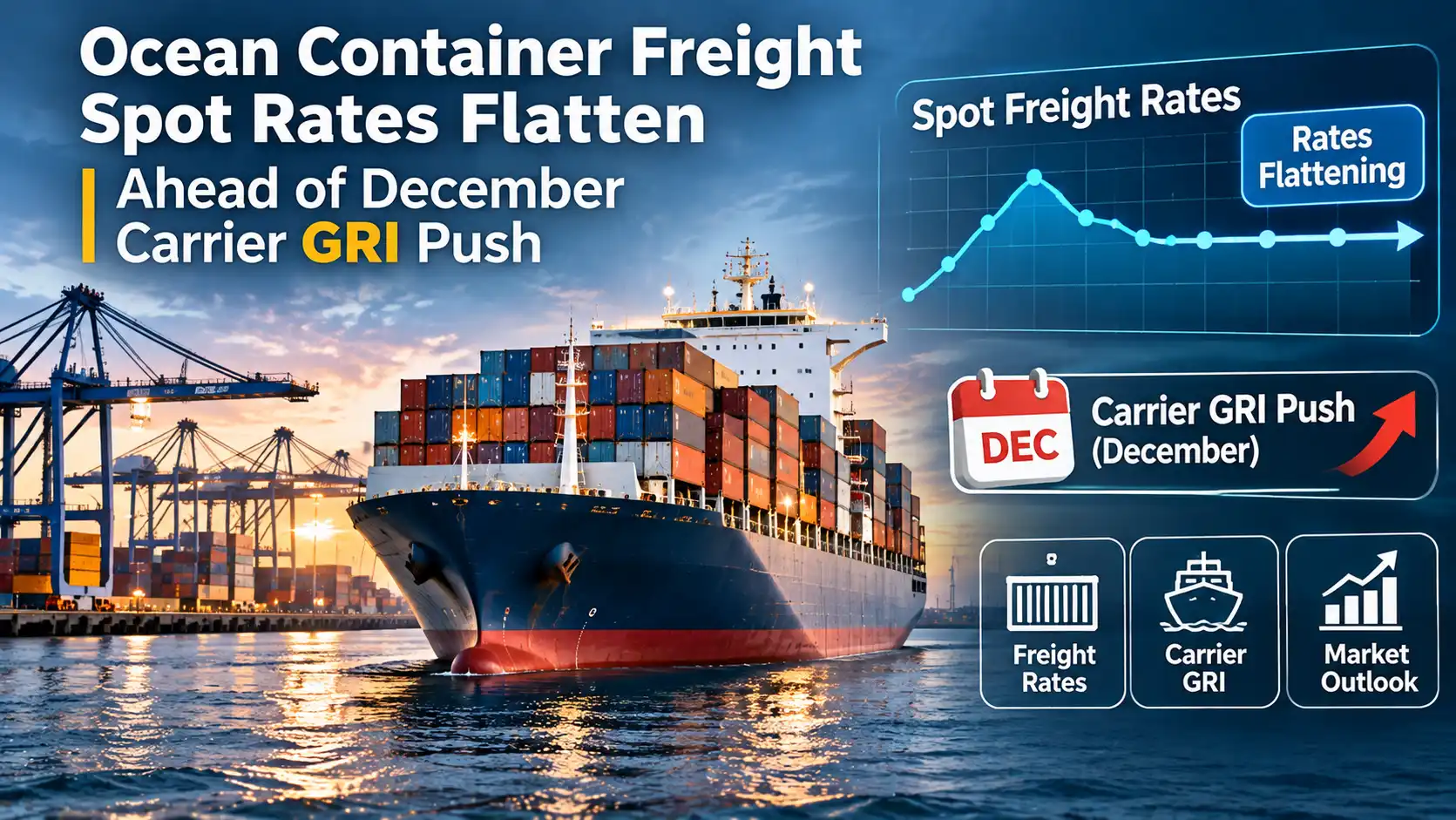
Ocean freight container spot benchmarks across primary east-west corridors halted their multi-week decline in the week ending 20 November, as shipping lines introduced blank sailings and signaled substantial mid-tier and month-end General Rate Increases (GRIs) ahead of December.
Data released by ocean freight intelligence platform Xeneta confirms that average spot rates from the Far East to North Europe and the Mediterranean have stabilized after consistent post-Golden Week erosion, holding at elevated levels compared to 2023 baselines due to ongoing vessel diversions around the Cape of Good Hope.
While short-term capacity additions previously dampened spot momentum, carriers are actively pulling capacity through coordinated blank sailings to defend floor prices ahead of annual contract negotiations with European and North American volume shippers.
Reported Rate Benchmarks and Trade Lane Performance
According to Xeneta’s weekly freight market assessments, key trade lanes exhibited the following spot pricing and capacity developments as of 20 November:
- Far East to North Europe: Spot rates stabilized within the range of $4,100 to $4,400 per forty-foot equivalent unit (FEU). Multiple carriers have filed GRIs for 1 December aiming to lift rates toward the $4,800 to $5,200/FEU threshold, though realization rates remain uncertain.
- Far East to Mediterranean: Spot pricing closed the week averaging $4,450 to $4,700 per FEU, supported by longer sailing schedules around southern Africa and persistent transshipment hub congestion at western Mediterranean ports such as Valencia and Barcelona.
- Transpacific (Far East to US West Coast): Average spot pricing tracked near $4,900 to $5,200 per FEU, showing minor softening from earlier November highs, with US East Coast corridors hovering at $5,900 to $6,300 per FEU amid cautious inventory buildup and potential labor renegotiation concerns.
What remains unconfirmed by carrier data is the exact acceptance rate of announced early December GRIs. Shippers and non-vessel operating common carriers (NVOCCs) report active resistance, with spot booking demand moderating as traditional pre-holiday import surges reach European and North American distribution centers.
REIFTEIL Trade Analysis: Impact on Tyre and Lubricant Landed Costs
From the practical trading desk at REIFTEIL, container freight volatility cannot be viewed in isolation; it directly governs the viable import margin and procurement velocity of high-cube, lower-density automotive cargo such as tyres and bulk fluids.
Commercial Vehicle Tyres (TBR) Landed Unit Surcharge
Unlike high-value, compact auto components, commercial truck and bus radial (TBR) tyres—such as standard long-haul steer/drive fitments (315/80R22.5 and 385/65R22.5)—occupy substantial volume. A standard 40-foot High Cube (40HC) container typically accommodates between 210 and 240 units of uncompressed 315/80R22.5 casings or finished tyres.
At an ocean rate of $4,400/FEU, the ocean freight burden alone stands at approximately $18.30 to $20.95 per tyre. Should carriers successfully enforce a $600 to $800 GRI on 1 December, the freight allocation climbs by $2.50 to $3.80 per casing.
For wholesale tyre distributors operating on net commercial margins between 4% and 7%, this variance directly dictates whether imported Tier-2 and Tier-3 commercial tyres remain price-competitive against regional retreads and domestic warehouse stocks.
Lubricants and Finished Fluids Logistics
For importers and blenders moving base oils, hydraulic fluids, and OEM-spec motor oils (e.g., 5W-30 synthetic or heavy-duty 15W-40 in 208-liter steel drums or 24,000-liter flexitanks), weight limitations restrict container utilization before cubic capacity is reached. Standard 20-foot dry containers (TEUs) are constrained to roughly 80 standard drums (approx. 16.6 metric tonnes net fluid) or a single flexitank.
Because ocean freight on weight-heavy fluid cargo is subject to heavy-weight surcharges on specific corridors, base ocean rate stability provides predictability for blending schedules, but carrier-imposed inland haulage adjustments and bunker adjustment factors (BAF) tied to extended voyages around Africa continue to add frictional landed costs.
Operational Guidance for Fleet Buyers and Logistics Operators
Given the current standoff between carrier GRIs and plateauing consumer demand, REIFTEIL recommends the following concrete procurement measures:
- Advance Booking Horizons: Secure shipping orders a minimum of 21 to 28 days ahead of vessel Estimated Time of Departure (ETD) to bypass rolled cargo risks triggered by blank sailings on Asia-to-Europe routes.
- Customs and Documentation Discipline: Ensure Export Declarations (EX-1/ABD for European transit), certificates of conformity (such as SONCAP for West African transshipments), and EUR.1 origin proofs are aligned prior to vessel docking. Delays at transshipment ports compound demurrage and detention charges, which escalate daily under revised carrier tariff policies.
- Dual-Track Contracting: Avoid locking entire import allocations into full-term annual fixed contracts while rate benchmarks remain double their 2023 historical averages. Maintain a 60/40 blend of index-linked and quarterly floating allocations to preserve pricing elasticity.