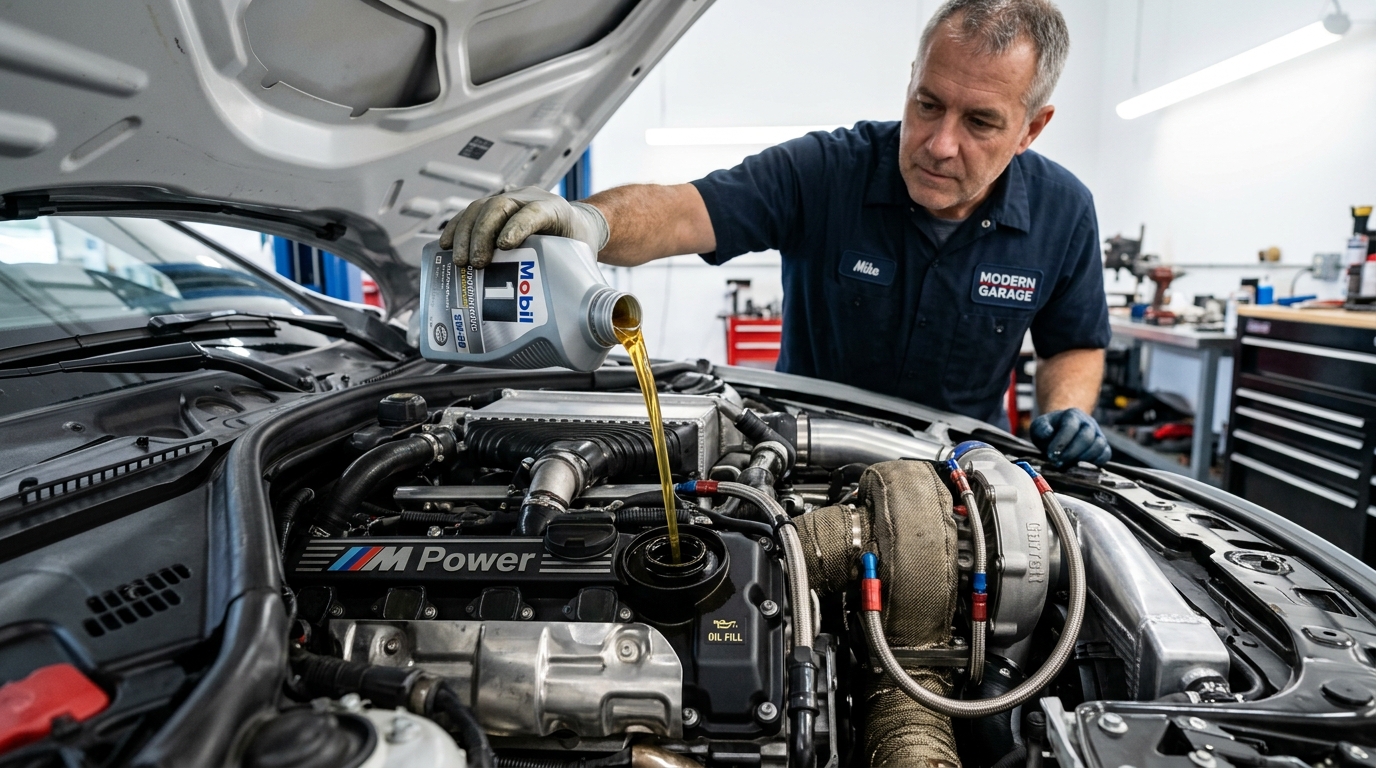
A retailer serving passenger-car owners may need dozens of fast-moving products in small retail packaging. A truck fleet may need only a few approved heavy-duty engine oils, but in drums, IBCs, or bulk quantities.
There is also an important distinction that wholesalers should understand:
Customer type does not determine the correct engine oil. The vehicle, engine, manufacturer specification, operating conditions, and application do.
A commercial fleet can contain passenger cars, vans, trucks, buses, and specialist equipment. Similarly, a retail customer may purchase oil intended for a heavy-duty application.
This guide explains how B2B lubricant distributors can build an engine-oil portfolio for retail, workshop, and fleet customers while minimizing unnecessary inventory and dead stock.
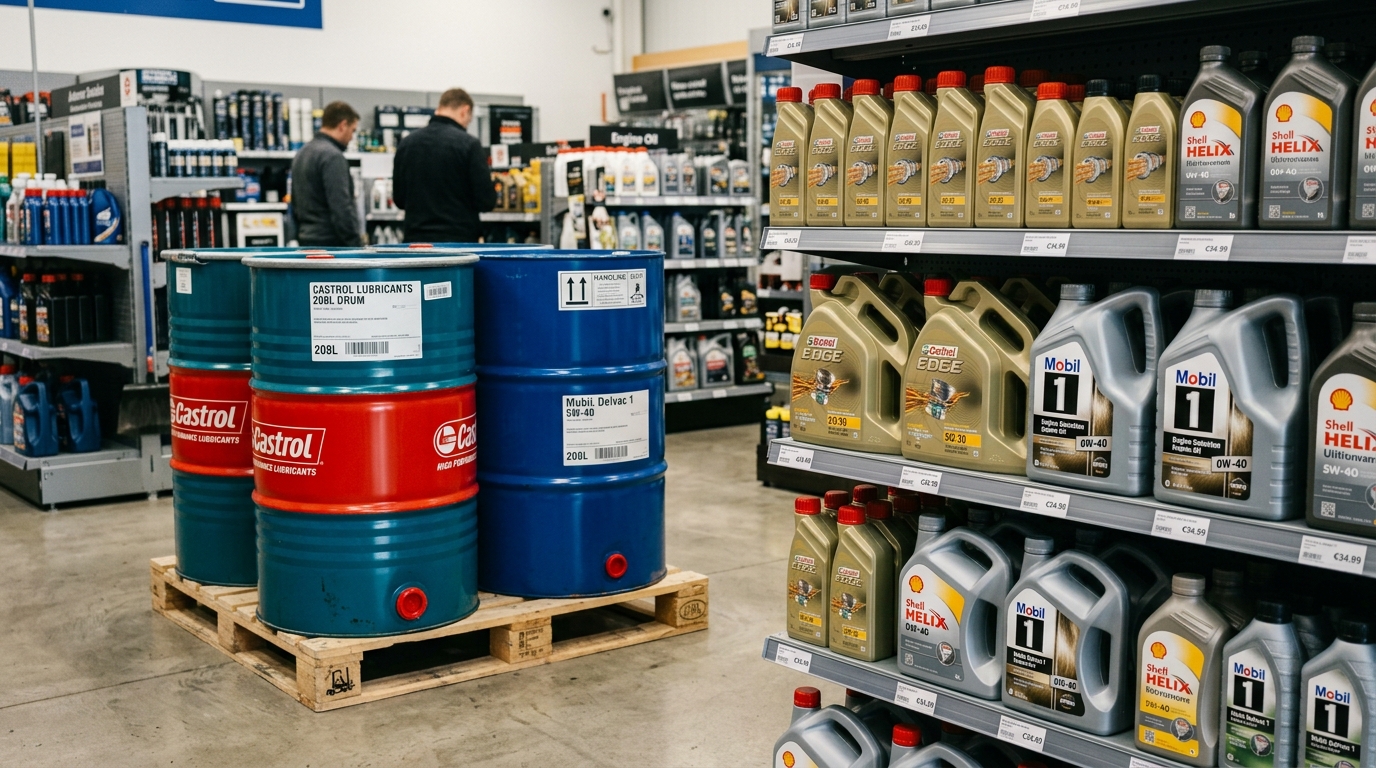
B2B Lubricant Portfolio Alignment: Comparing retail bottles (1L/5L) for passenger cars vs commercial drums (208L) for transport fleets.
Quick Answer: Retail vs. Fleet Engine Oil
Retail and fleet customers should not automatically receive different oil simply because one is a retail buyer and the other is a fleet buyer. Instead, wholesalers should segment their inventory according to:
Typical difference
Retail and workshop customers generally require a wider range of passenger-car and light-commercial products in smaller packaging. Fleet customers often purchase fewer products in larger quantities and place greater emphasis on availability, technical compliance, cost per kilometre, maintenance efficiency, and consistent supply. The best wholesale portfolio combines application-based product selection with customer-specific purchasing patterns.
Retail vs. Fleet: What Is Actually Different?
The difference is not simply the oil inside the bottle or drum. The major differences are usually the buying behavior, vehicle mix, packaging, order size, and commercial priorities:
| Factor | Retail / Workshop | Fleet |
|---|---|---|
| Typical customer | Retailer, workshop, DIY buyer | Logistics company, service fleet, contractor |
| Typical vehicles | Passenger cars, vans, light commercial vehicles | Cars, vans, trucks, buses, specialist vehicles |
| Order pattern | Smaller and more frequent | Larger and often recurring |
| Product range | Broad | More concentrated |
| Packaging | 1L, 4L/5L, 20L | 20L, drums, IBCs, bulk |
| Main buying factors | Price, brand, specification, availability | Specification, TCO, availability, reliability |
| Purchasing style | Transactional | Recurring/contractual |
| Key commercial metric | Margin per litre | Cost per km/hour and operational efficiency |
| Inventory risk | Too many slow-moving SKUs | Overstocking large-volume products |
This distinction matters because a wholesaler can lose money by applying the same stocking strategy to both channels.
Choose Engine Oil by Application, Not by Customer Type
This is the most important principle in the entire article. A fleet operator does not automatically need heavy-duty diesel oil. For example, a delivery company may operate small diesel vans, petrol company cars, hybrid vehicles, and heavy trucks. These vehicles can require completely different lubricants. Likewise, an independent workshop may service everything from a small city car to a commercial truck. Therefore, your product selection should begin with the application.
Passenger Cars
For passenger vehicles, wholesalers should consider SAE viscosity, API specification, ILSAC specification where applicable, ACEA category, OEM approvals, petrol or diesel application, DPF/GPF compatibility, hybrid requirements, and manufacturer-specific requirements.
Commonly encountered grades include 0W-16, 0W-20, 0W-30, 5W-30, 5W-40, and 10W-40. However, these are examples of commonly encountered grades—not universal recommendations. The correct viscosity and performance specification must always be determined from the vehicle manufacturer's requirements.
Understand the Passenger-Car Oil Portfolio
Modern passenger vehicles use a wide variety of engine-oil specifications. A wholesaler may encounter:
- 0W-16 and 0W-20: Used in modern engines specifying low-viscosity oils to support fuel-efficiency objectives.
- 5W-30: Widely encountered across many passenger-car applications, including European models, but required specifications and approvals vary by engine.
- 5W-40: Common in petrol and diesel engines, often relevant to older or performance-oriented engines.
- 10W-40: Still relevant to certain older passenger-car and light-commercial applications.
Don't stock viscosity grades in isolation. Stock the specifications customers actually need. A 5W-30 product with one set of approvals may not be interchangeable with another 5W-30 product.
Why OEM Approvals Matter in Retail Sales
Retail and workshop buyers often search for oils based on vehicle compatibility. Examples include specifications associated with Mercedes-Benz, Volkswagen Group, BMW, Ford, Renault, Volvo, Porsche, and General Motors. For an in-depth breakdown of global standards, view API vs ACEA: What's the Difference?.
Approval is not the same as a general claim
Wholesalers should distinguish between terms such as officially approved, meets the requirements of, recommended for, and suitable for. If a product is advertised with an official OEM approval, verify the manufacturer's documentation rather than relying solely on a supplier's marketing description. This is especially important when importing branded lubricants for resale.
Low-SAPS Oils and Modern Emissions Systems
Many modern passenger vehicles use emissions-control equipment such as Diesel Particulate Filters (DPF), Gasoline Particulate Filters (GPF), catalytic converters, and exhaust treatment systems. Certain engine oils are formulated with controlled levels of sulphated ash, phosphorus, and sulphur (Low-SAPS or Mid-SAPS). ACEA C-class categories are particularly relevant to passenger-car applications requiring emissions compatibility.
Fleet Customers Are Not One Category
The word fleet covers several different applications. A useful B2B segmentation is:
Light-duty fleets
Delivery vans, service vans, taxi fleets, company cars, rental vehicles, and small commercial vehicles.
Heavy-duty fleets
Long-haul trucks, distribution trucks, buses, construction vehicles, and heavy commercial vehicles.
Specialist fleets
Agricultural machinery, mining equipment, construction machinery, and municipal equipment.
Heavy-Duty Diesel Engine Oil
Heavy-duty diesel engines operate under demanding conditions, including high loads, long operating hours, high temperatures, frequent idling, long-distance operation, dusty environments, and towing heavy payloads. Common heavy-duty categories include API CK-4, API FA-4, ACEA E-categories, and manufacturer approvals. For a deeper dive into fleet demand calculations, read How to Choose Engine Oil for Commercial Fleets and How Much Engine Oil Does a Fleet Actually Need?.
CK-4 vs. FA-4
This distinction is particularly important. API CK-4 and API FA-4 are different performance categories. FA-4 is intended for certain newer heavy-duty diesel engines designed around lower-viscosity lubricants and fuel-efficiency objectives. It should not automatically be substituted for CK-4 simply because it is a newer category.
Don't Assume Fleet Oil Must Be 15W-40
15W-40 remains an important heavy-duty grade in many markets, but fleet engines can also use 10W-40, 5W-30, or 5W-40 depending on engine design, manufacturer requirements, climate, emissions technology, operating conditions, and drain strategy. A fleet portfolio should not be built around one viscosity alone.
Packaging Strategy: Retail vs. Fleet
Packaging is one of the clearest commercial differences between channels:
Retail and Workshop Packaging
Common formats include 1L bottles, 4L/5L bottles, and 20L containers. Smaller packaging is appropriate for retail sales, oil changes, top-ups, and workshop use. Retail labels play an important commercial role (brand, appearance, specification info, packaging quality, authenticity features).
Fleet Packaging
Fleet customers consume significantly larger quantities (20L containers, 60L drums, 200L/208L drums, 1,000L IBCs, or bulk delivery).
Why larger packaging can make sense
Larger formats reduce packaging cost per litre, handling frequency, container counts, storage footprint, and waste. However, larger containers require forklift access, drum handling, spill containment, and dispensing equipment. For container and drum packaging logistics, explore Bulk Engine Oil for Fleets: Drums vs IBC.
The Economics of Retail Engine Oil
Retail and workshop customers purchase smaller quantities but accept higher prices per litre. While gross margins per unit can be higher, wholesalers must factor in stock turnover, storage costs, SKU proliferation, working capital, and slow-moving stock risk.
The Economics of Fleet Engine Oil
Fleet buyers focus on total cost of ownership (TCO), cost per kilometre, technical approvals, delivery reliability, product consolidation, and drain interval compliance.
Cost per Kilometre Can Matter More Than Price per Litre
Consider two hypothetical products:
Product A
Price: €2.50/L
Consumption: 1L per 2,000 km
Oil cost: €0.00125/km
Product B
Price: €2.30/L
Consumption: 1L per 1,700 km
Oil cost: €0.00135/km
Product B has a lower purchase price but higher theoretical oil cost per kilometre. Fleet purchasing involves evaluating operating data within manufacturer recommended drain limits.
Oil Analysis and Fleet Maintenance
Larger fleets use used-oil analysis programs to test wear metals, contamination, viscosity changes, oxidation, fuel dilution, and coolant leaks. Providing technical support or oil-analysis services adds significant B2B value beyond price per litre.
How to Build a Retail Engine Oil Portfolio
Start with actual demand by analyzing historical sales, vehicle population, workshop requests, fast-moving viscosities, required OEM specs, brand demand, MOQs, lead times, margins, and turnover.
A practical retail portfolio might include
- Fast-moving passenger-car grades (0W-20, 5W-30, 5W-40)
- Key European OEM specifications (MB, VW, BMW, Ford)
- Popular Asian and American vehicle requirements
- Selected diesel and hybrid-compatible products
- 1L, 5L, and 20L packaging options
How to Build a Fleet Engine Oil Portfolio
Identify target fleet vehicle specs (manufacturer, engine model, fuel type, required oil spec, viscosity, annual km/hours, consumption, preferred packaging). Look for legitimate consolidation opportunities where 70–80% of a fleet can use one approved high-volume lubricant.
Don't Use a Fixed 60/40 Inventory Split
Fixed split rules (e.g. 60% retail / 40% fleet) are arbitrary. Allocate inventory based on actual customer contracts, local vehicle parc, lead times, MOQs, margins, turnover, and capital.
The objective
High stock turnover + adequate availability + healthy margin + controlled working capital.
Use ABC Analysis to Control Inventory
A Products
High-demand products with fast turnover. Require high stock availability, frequent replenishment, and close monitoring.
B Products
Moderate-demand products. Maintain reasonable stock levels without over-committing capital.
C Products
Slow-moving or specialized SKUs. Manage via lower stock levels, supplier ordering, or customer pre-orders.
Avoid Dead Stock
Prevent dead stock caused by stocking too many viscosities, redundant brands, niche OEM specs, excessive MOQs, or packaging mismatches. To protect margins, see How to Avoid Dead Stock When Buying Engine Oil Wholesale and Engine Oil FIFO: How to Manage Lubricant Inventory.
Retail vs. Fleet: What Should You Sell?
| Customer | Typical Application | Product Strategy | Packaging |
|---|---|---|---|
| Retail customer | Passenger car | Fast-moving PCMO grades and specifications | 1L–5L |
| Independent workshop | Mixed passenger vehicles | Broader range of OEM/specification-focused products | 5L–20L |
| Van fleet | Light commercial | Vehicle-specific fleet products | 20L/drums |
| Truck fleet | Heavy-duty | OEM/API/ACEA-compliant HDDO | Drums/IBC |
| Bus operator | Heavy-duty | Fleet-specific approved products | Drums/IBC |
| Construction company | Specialist equipment | Application-specific lubricants | Drums/IBC |
| Agricultural fleet | Tractors/equipment | Engine + transmission/hydraulic portfolio | Drums/IBC |
How Retail and Fleet Sales Differ
Retail and Workshop Customers
Emphasize product compatibility, OEM specifications, brand, availability, packaging, price, and technical info (“Which product can I safely use for this vehicle?”).
Fleet Customers
Emphasize product approvals, supply reliability, cost per kilometre, maintenance efficiency, delivery schedules, technical support, consolidation, and contract pricing (“Can you supply the correct approved oil consistently at a competitive total operating cost?”).
Build Customer-Specific Product Lists
Create targeted product catalogues:
For a passenger-car workshop
Show 0W-20, 5W-30, 5W-40, 10W-40, relevant OEM approvals, and 1L/5L/20L formats.
For a truck fleet
Show heavy-duty grades, API/ACEA specs, OEM approvals, drum/IBC formats, per-litre pricing, and delivery options.
How to Decide Whether to Stock or Source on Demand
Stock it when:
Predictable sales, frequent reorders, long supplier lead times, strong turnover, and stock-outs cost customers.
Source on demand when:
Irregular sales, highly specialized specs, manageable MOQs, acceptable lead times, and customer willingness to wait.
A Practical Inventory Decision Matrix
| Factor | Suggested Weight (%) |
|---|---|
| Historical sales | 30% |
| Customer demand | 20% |
| Existing contracts | 20% |
| Supplier lead time | 10% |
| MOQ | 10% |
| Gross margin | 10% |
What Wholesalers Should Ask Before Adding a New Oil
Evaluate Product suitability, Demand predictability, Commercial margins & MOQs, Packaging logistics, and Obsolescence risk before placing new orders.
The Best Portfolio Is Not the Largest Portfolio
Stock the products your customers actually need, then expand the portfolio based on proven demand.
A Simple Retail/Fleet Portfolio Strategy
Core Stock
Fast-moving products with predictable demand. Keep readily available.
Professional Stock
Products frequently required by workshops and commercial customers. Maintain moderate inventory.
Special-Order Products
Highly specialized specs or low-volume applications. Source against confirmed demand.
Final Checklist for B2B Engine Oil Stocking
Bottom-Line
Choosing engine oil for B2B customers is not simply a question of deciding between “retail oil” and “fleet oil.” The correct approach is to understand the application first and the customer segment second.
The goal is not to have the largest engine-oil catalogue. The goal is to have the right products available for the right customers at the right cost.
Frequently Asked Questions
Is fleet engine oil different from retail engine oil?
Not necessarily. The correct engine oil is determined by the vehicle, engine, manufacturer specification, operating conditions, and application. Fleet customers simply tend to purchase larger quantities and may have different commercial and logistical requirements.
What engine oils should a wholesaler stock for retail customers?
Start with the grades and specifications that are actually in demand in your target market. Common passenger-car grades can include 0W-20, 5W-30, 5W-40, and 10W-40, but the correct specification and OEM requirements are more important than viscosity alone.
What engine oil should I stock for truck fleets?
Stock products according to the engine manufacturers' requirements and the specifications of the vehicles your fleet customers operate. Depending on the application, this may include heavy-duty products meeting relevant API, ACEA, and OEM requirements.
Is 15W-40 suitable for every truck?
No. 15W-40 is widely used in many heavy-duty applications, but some engines require other viscosities such as 10W-40, 5W-30, or 5W-40. Always follow the engine manufacturer's specification.
Can I use API FA-4 instead of CK-4?
Not automatically. FA-4 and CK-4 are different API categories designed for different applications. FA-4 should only be used where the engine manufacturer permits or specifies it.
Should fleet buyers choose oil based on price per litre?
Price per litre is important, but fleet operators may also consider total cost of ownership, oil consumption, maintenance requirements, availability, downtime, and other operating factors.
What packaging is best for fleet customers?
It depends on consumption and facilities. Common options include 20L containers, drums, 1,000L IBCs, and bulk delivery. The appropriate choice depends on storage, handling equipment, consumption, and delivery frequency.
How can wholesalers avoid engine-oil dead stock?
Use sales history, customer demand, vehicle parc, MOQ, lead time, margins, and stock turnover to determine what to stock. Highly specialized or slow-moving products can often be sourced on demand rather than held in large quantities.
Should a lubricant wholesaler stock many brands?
Not necessarily. A focused portfolio with strong customer demand can be more profitable than a large catalogue containing many slow-moving products.
How should I divide inventory between retail and fleet products?
There is no universal percentage such as 60/40. Allocate inventory according to actual sales, customer contracts, local demand, supplier lead times, MOQ, margins, and working-capital availability.
Align Your Engine Oil Inventory with REIFTEIL
Building an engine oil portfolio requires balancing retail bottle variety with fleet drum economics. REIFTEIL provides full B2B lubricant export supply, OEM cross-referencing, and container logistics.