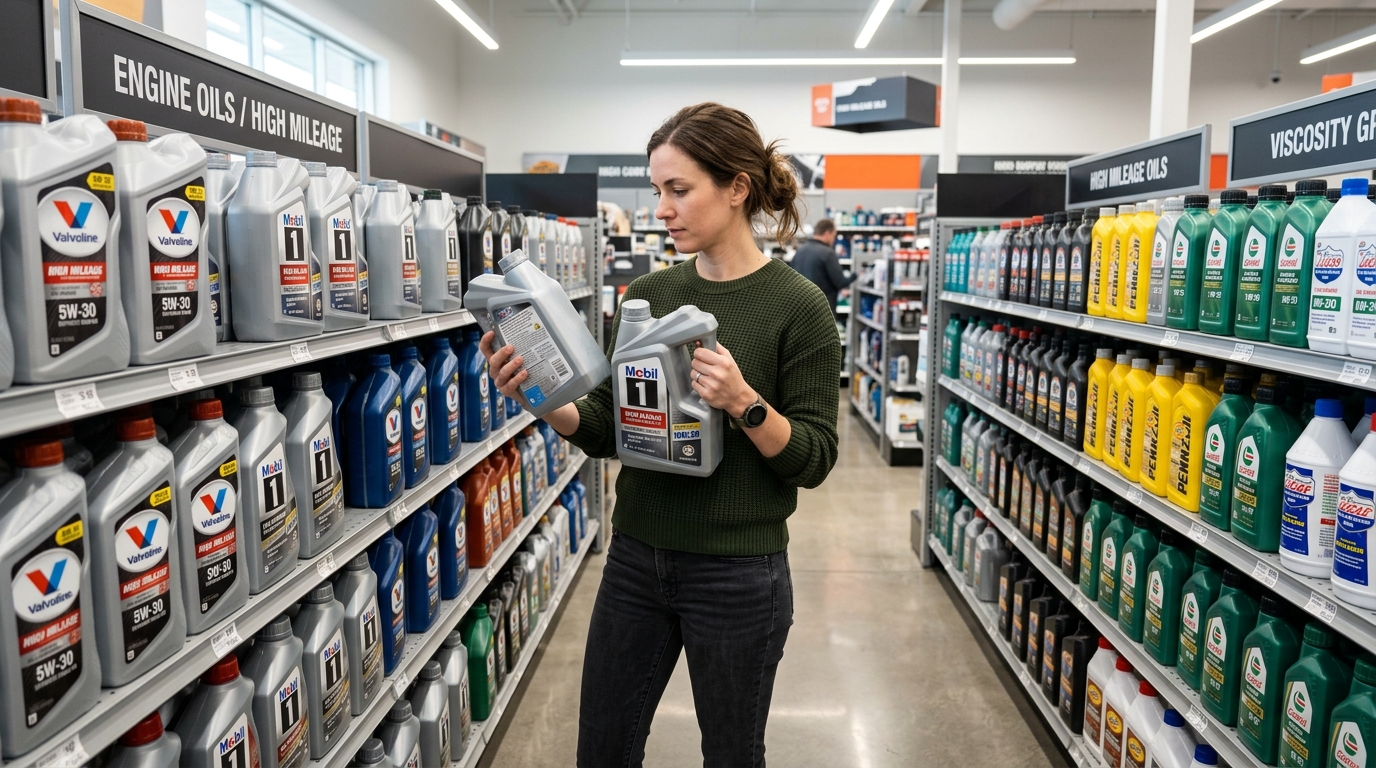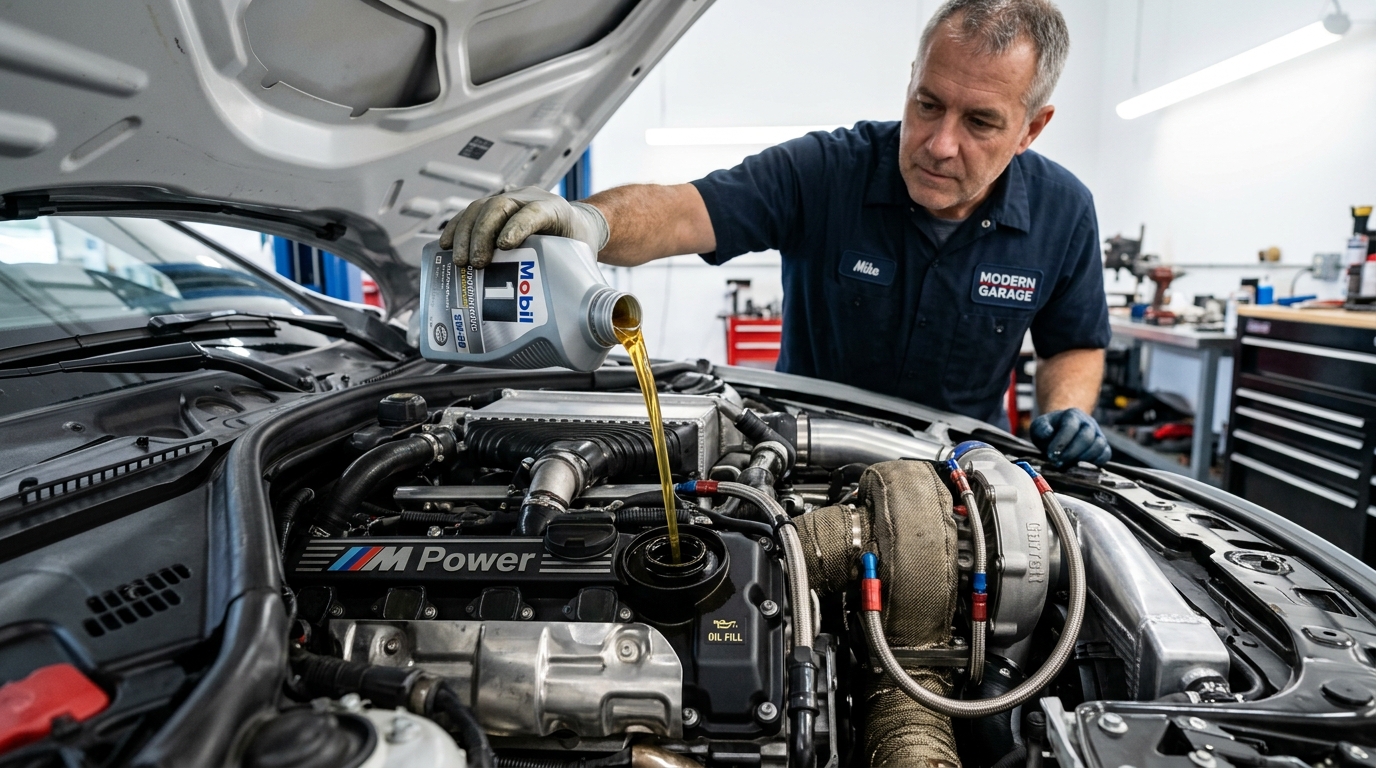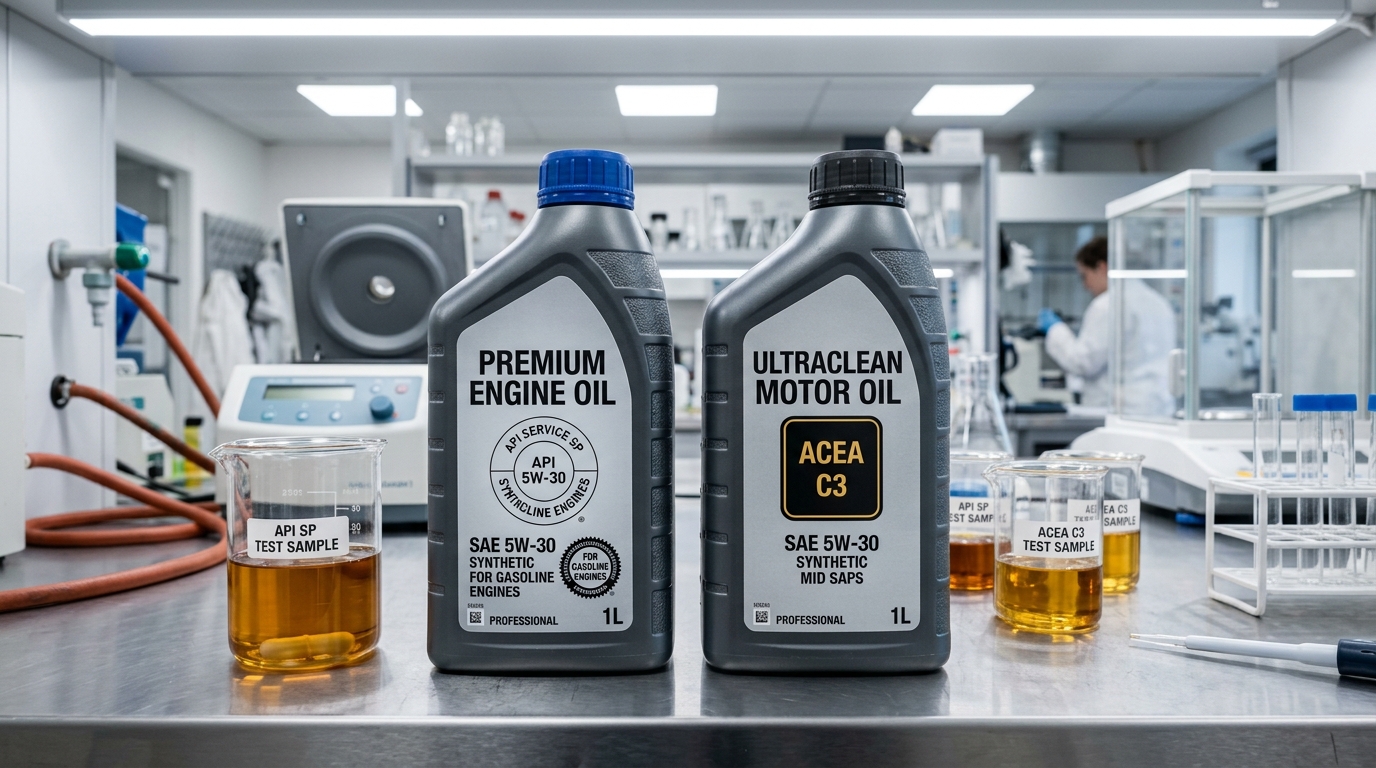
Procuring commercial engine oil on SAE viscosity grade alone (such as 5W-30 or 5W-40) is one of the costliest procurement mistakes in fleet operations and aftermarket distribution.
Viscosity indicates only fluid flow at defined test temperatures (-35°C to 100°C under SAE J300); it reveals nothing about shear stability under load, aftertreatment chemical compatibility, or piston deposit control. The actual service capability is governed by performance standards: primarily the American Petroleum Institute (API) and the European Automobile Manufacturers’ Association (ACEA).
Neither standard is universally superior. API categories (e.g., SP, CK-4, FA-4) originate from ASTM engine test matrices tailored to North American driving cycles, fuel standards, and engine architectures.
ACEA sequences (e.g., A3/B4, C2, C3, C5, E8, E11) address European powertrain design: high specific power output, sustained autobahn speeds, extended drain intervals (often 30,000 km or 24 months), and strict European Union emissions limits requiring strict control of Sulphated Ash, Phosphorus, and Sulfur (SAPS).
Direct Technical Comparison: API vs. ACEA
To establish baseline procurement requirements, distributors and fleet technical directors must evaluate oils across specific physical and chemical parameters:
| Parameter / Criterion | API (e.g., API SP / CK-4) | ACEA (e.g., ACEA C3 / E8) |
|---|---|---|
| Governing Body & Geographic Focus | American Petroleum Institute (North America, Asia, Global) | Association des Constructeurs Européens d'Automobiles (Europe, Global exports) |
| Primary Testing Framework | ASTM laboratory tests and engine dynamometer stands (Sequence IIIH, IVB, IX, X) | CEC (Coordinating European Council) test rigs + ASTM methods, EELQMS compliance |
| HTHS Viscosity Rigidity | Flexible; generally requires minimum 2.6 to 2.9 mPa·s for light passenger vehicle grades, ≥3.5 mPa·s for HDEO (CK-4) | Strictly categorized: ≥3.5 mPa·s (C3, C4, A3/B4) vs. 2.9–3.5 mPa·s (C2, A5/B5) vs. 2.6–2.9 mPa·s (C5, C6) |
| Exhaust Aftertreatment Protection (SAPS) | Chemical limits set via ILSAC GF-6 (P: 0.06–0.08%, S: 0.5% max) and CK-4 (Ash ≤1.0%) | Enforces defined Low-SAPS (C1/C4: Ash ≤0.5%) and Mid-SAPS (C2/C3/C5: Ash ≤0.8%) bands |
| Extended Drain Capabilities | Standard service profiles (typical 5,000–10,000 miles / 8,000–16,000 km) | Engineered for long-drain cycles (20,000–30,000+ km passenger car; up to 100,000+ km commercial heavy-duty) |
| Pre-ignition & Timing Chain Wear | Dedicated pass/fail engine dynamometer limits for LSPI (Seq IX) and Chain Wear (Seq X) | Introduced in ACEA 2021/2024 sequences (specifically C6 and A7/B7 categories) |
| Compliance Validation | Formal EOLCS registration & licensing system with API Donut mark on container | Self-certification under EELQMS Code of Practice; verified against formal OEM homologation |
Understanding the API Classification System
API specifications are split into two primary operational branches: the "S" (Service) series for spark-ignition (gasoline) engines and the "C" (Commercial) series for compression-ignition (heavy-duty diesel) powertrains.
API Passenger Car Categories (Current: SP, SN PLUS, SN)
API SP (introduced May 2020) is engineered to counter the failure modes of modern Gasoline Direct Injection (GDI) and turbocharged (TGDI) downsized engines. The critical performance gates in API SP include:
- Low-Speed Pre-Ignition (LSPI) Mitigation (ASTM D8291 / Sequence IX): Prevents catastrophic piston ring land breakage and cylinder liner destruction caused by uncontrolled super-knock at low engine RPM under high load.
- Timing Chain Elongation Protection (ASTM D8279 / Sequence X): Limits chain stretch to ≤0.085% over the 168-hour test cycle, maintaining valve timing integrity and preventing check-engine DTCs.
- High-Temperature Deposit Control (ASTM D7320 / Sequence IIIH): Prevents ring sticking and piston varnish formation under aggressive turbocharger back-heat soak.
API Heavy-Duty Commercial Diesel Categories (CK-4 vs. FA-4)
Fleet operators managing commercial transport must differentiate between split diesel categories:
- API CK-4: Backward-compatible with CJ-4, CI-4 PLUS, and CI-4. Formulated for heavy commercial vehicles equipped with Diesel Particulate Filters (DPFs), Selective Catalytic Reduction (SCR), and Diesel Oxidation Catalysts (DOC). Maintains a minimum High Temperature High Shear (HTHS) viscosity of 3.5 mPa·s. It delivers elevated oxidation control for engines operating at high coolant/oil temperatures.
- API FA-4: Specifically engineered for lower greenhouse gas (GHG) emission engines (model year 2017+). It features a reduced HTHS viscosity band (2.9 to 3.2 mPa·s) to cut hydrodynamic parasitic drag and improve fuel economy. Crucial Caveat: API FA-4 is not backward-compatible. Dispensing FA-4 into older commercial diesel engines requiring CK-4 or CI-4 causes boundary-lubrication breakdown, cam lobe scuffing, and premature bearing wear.
Understanding ACEA Sequences: Why European Engines Require Different Chemistries
The European market poses distinct operational challenges: higher average speeds, smaller displacement engines with higher power density, strict Euro 6/VI emissions legislation, and extended oil drain intervals. ACEA sequences are updated biennially or triennially (e.g., ACEA 2021, ACEA 2024 Heavy-Duty) and are segmented into three operational classes:
1. ACEA A/B Classes (High-SAPS Passenger Car)
Designed for older or high-output passenger cars without particulate traps (DPF or Gasoline Particulate Filter / GPF):
- ACEA A3/B4: High-performance baseline requiring HTHS ≥ 3.5 mPa·s and high Total Base Number (TBN ≥ 10.0 mg KOH/g). It contains higher levels of Zinc Dialkyldithiophosphate (ZDDP) and calcium detergent packages. It provides exceptional ring-wear and bore-polishing resistance but will rapidly poison catalytic converters and clog DPF/GPF monoliths if deployed in emissions-restricted vehicles.
- ACEA A5/B5: Lower viscosity, fuel-economy specification requiring HTHS between 2.9 and 3.5 mPa·s. It cannot be used in engines requiring HTHS ≥ 3.5 mPa·s.
- ACEA A7/B7: Added in the 2021 revision; builds upon A5/B5 by adding mandatory LSPI prevention, timing chain wear control, and turbocharger compressor deposit protection.
2. ACEA C Classes (Catalyst-Compatible Low- and Mid-SAPS)
Required for all Euro 4, 5, 6, and 7 passenger cars equipped with modern aftertreatment systems. Using the incorrect C-grade will either poison the emission catalysts or cause catastrophic oil film collapse:
| ACEA Grade | SAPS Level | Sulphated Ash (mass %) | Phosphorus Limits | HTHS Viscosity (mPa·s) | Typical OEM Applications |
|---|---|---|---|---|---|
| ACEA C2 | Mid-SAPS | ≤ 0.8% | 0.070 – 0.090% | ≥ 2.9 (Fuel Economy) | PSA B71 2290, Toyota, Fiat 9.55535-S1 |
| ACEA C3 | Mid-SAPS | ≤ 0.8% | 0.070 – 0.090% | ≥ 3.5 (High Shear Stress) | BMW LL-04, MB 229.51/229.52, VW 504.00/507.00 |
| ACEA C4 | Low-SAPS | ≤ 0.5% | ≤ 0.090% | ≥ 3.5 | Renault RN0720, Nissan DPF engines |
| ACEA C5 | Mid-SAPS | ≤ 0.8% | 0.060 – 0.090% | 2.6 to < 2.9 (Ultra-Low) | VW 508.00/509.00, Porsche C20, MB 229.71 |
| ACEA C6 | Mid-SAPS | ≤ 0.8% | 0.060 – 0.090% | 2.6 to < 2.9 + LSPI Test | Ford WSS-M2C952-A1, Modern TGDI Hybrids |
3. ACEA E Classes (Heavy-Duty Commercial Diesel)
For commercial truck fleets, ACEA 2022/2024 defines heavy commercial sequences:
- ACEA E4 / E7: High-SAPS legacy formulations for Euro I through Euro V heavy trucks without DPF. They provide massive TBN reserve (≥12.0 mg KOH/g for E4) for high-sulfur diesel fuel operational profiles common in non-EU export markets.
- ACEA E8: Replaces ACEA E6. Lower-SAPS formulation engineered for Euro VI heavy commercial engines with DPF/SCR, operating under severe long-drain intervals. Requires strict piston deposit control in OM471 and OM501LA engine tests.
- ACEA E11: Replaces ACEA E9. Mid-SAPS heavy-duty profile aligned closely with API CK-4, delivering oxidation and aeration control for standard long-haul service intervals.
The Technical Determinant: HTHS and SAPS Chemistry
Procurement teams frequently question why two oils of the same viscosity (e.g., 5W-30) carry drastically different price structures and applications. The technical differentiator lies in two chemical parameters:
High Temperature High Shear (HTHS) Viscosity (ASTM D4683)
Measured at 150°C and a shear rate of 106 s-1, HTHS simulates the physical hydrodynamic oil film thickness protecting the crankshaft journal bearings, connecting rod bearings, and the piston ring/cylinder wall interface under maximum thermal loading.
- High HTHS (≥ 3.5 mPa·s): Maximum hydrodynamic cushion. Essential for heavy German autobahn driving, heavy commercial haulage, and severe duty cycles. Found in ACEA A3/B4, C3, C4, E8, and API CK-4.
- Low HTHS (< 3.5 mPa·s; down to 2.6 mPa·s): Thinner operational oil film designed to minimize viscous drag and reduce CO2 emissions by 1.5% to 3.0%. Found in ACEA C2, C5, C6, and API FA-4.
Operational Warning: Using an ACEA C5 (HTHS 2.6 mPa·s) in an engine engineered for ACEA C3 (HTHS ≥ 3.5 mPa·s) will lead to accelerated bearing clearance erosion and catastrophic engine seizure under high load.
SAPS and Exhaust Aftertreatment Chemistry
SAPS consists of metallic detergent additives and anti-wear chemistries:
- Sulphated Ash: Non-combustible metallic residue from calcium/magnesium detergents. This ash cannot be burned off during active DPF regeneration cycles. High ash content permanently clogs the microscopic ceramic pore walls of the DPF, spiking exhaust backpressure, degrading fuel economy, and forcing premature filter replacement (€1,500–€4,500 replacement cost).
- Phosphorus and Sulfur: Derived from ZDDP anti-wear additives. Volatilized phosphorus vapor physically deposits onto the noble metal catalytic washcoats (platinum, palladium, rhodium) of Three-Way Catalysts and SCR systems, chemically deactivating (“poisoning”) them and causing emissions test failures.
B2B Procurement and Fleet Management: Cross-Referencing & Risk Control
Wholesale lubricant buyers, distributors, and fleet managers must establish a multi-tier verification process before issuing purchase orders or stocking bulk tanks (1,000L IBCs or 208L drums):
- Establish the Four-Layer Specification Hierarchy:
- Layer 1: SAE Viscosity (e.g., 5W-30) – Governs base pumpability.
- Layer 2: API Category (e.g., API SP or CK-4) – Establishes North American/Asian baseline and LSPI/chain wear protection.
- Layer 3: ACEA Sequence (e.g., ACEA C3 or E8) – Dictates HTHS structural threshold and SAPS aftertreatment boundaries.
- Layer 4: Formal OEM Approval (e.g., MB-Approval 229.52, VW 504.00/507.00, BMW Longlife-04, Porsche C30, Volvo VCC RBS0-2AE) – The non-negotiable manufacturer homologation.
- Verify "Approved" vs. "Meets Requirements": Lubricant Technical Data Sheets (TDS) use specific legal wording. "Approved under MB 229.52" indicates the blender paid for formal OEM testing and holds a valid manufacturer certificate. "Meets the requirements of MB 229.52" means the additive supplier tested a standard formulation, but the blender did not submit the finished oil for factory homologation. For fleets under factory warranty, unapproved oils can void warranty claims on powertrain components.
- Consolidate Fleet SKUs Without Compromising HTHS: For mixed commercial fleets (e.g., Mercedes-Benz Actros, MAN TGX, Scania, and light delivery vans), do not attempt single-oil consolidation using a generic 10W-40 or 15W-40. Standardize on high-performance dual-rated synthetic fluids (such as an ACEA E8/E11 + API CK-4 / MB 228.51 product) in bulk IBCs, maintaining dedicated drums of low-viscosity grades (0W-20 ACEA C5 / VW 508.00) for modern light commercial vehicles.
- Audit Batch Documentation: On international export orders (EX-1 customs declarations, BESC, or SONCAP documentation), demand a Certificate of Analysis (CoA) matching batch numbers on 208L drum seals or IBC delivery valves. The CoA must document kinetic viscosity at 100°C (ASTM D445), Cold Crank Simulator (CCS) viscosity, Noack volatility (ASTM D5800 ≤ 10-13%), and Total Base Number.