In this guide, we break down the SAE J300 viscosity standard, compare Kinematic Viscosity at 100°C, analyze HTHS (High-Temperature High-Shear) film strength, and outline OEM approval matching. Explore our wholesale engine oil range on the REIFTEIL Engine Oil & Lubricants Page and review base oil groups in Synthetic vs Semi-Synthetic vs Mineral Oil: What's the Difference?.
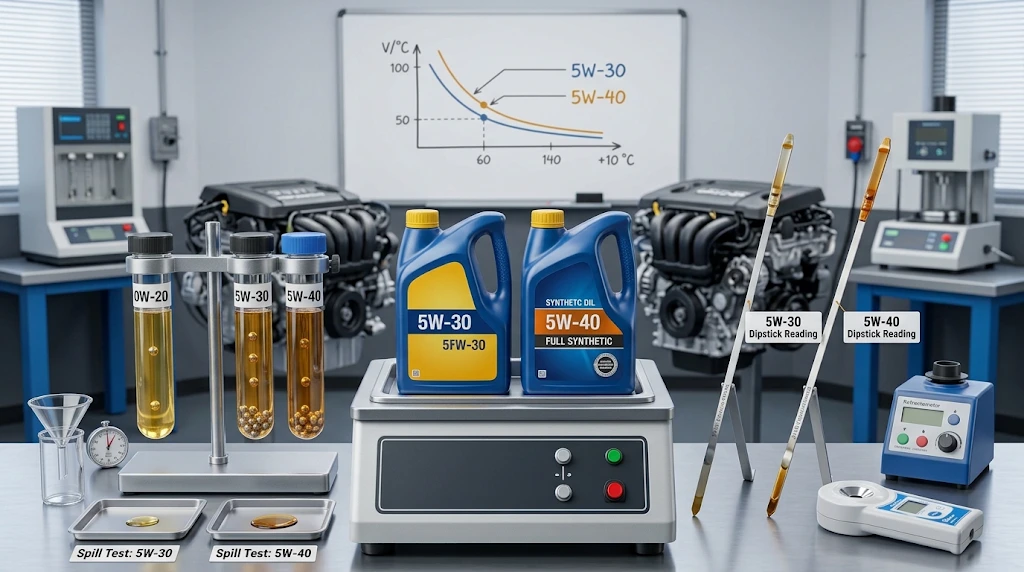
Viscosity Comparison: Analyzing high-temperature kinematic viscosity and film strength for 5W-30 vs 5W-40 synthetic engine oils.
1. SAE J300 Technical Viscosity Parameters
The Society of Automotive Engineers (SAE) J300 specification defines physical viscosity limits for engine lubricants:
| Viscosity Metric | ASTM Standard | SAE 5W-30 Spec | SAE 5W-40 Spec |
|---|---|---|---|
| Cold Cranking Simulator (CCS @ -30°C) | ASTM D5293 | ≤ 6,600 mPa·s | ≤ 6,600 mPa·s (Identical) |
| Kinematic Viscosity @ 100°C | ASTM D445 | 9.3 cSt – 12.5 cSt | 12.5 cSt – 16.3 cSt (+30% thicker) |
| HTHS Shear Viscosity @ 150°C | ASTM D4683 | 2.9 – 3.5 mPa·s | ≥ 3.5 mPa·s (Heavy Shear Protection) |
| Fuel Economy Impact | M111FE Test | +1.5% to +2.5% Fuel Savings | Standard Fuel Drag Baseline |
2. OEM Manufacturer Approval Mapping
Vehicle manufacturers specify exact viscosity grades based on engine design tolerance and emission equipment:
Typical 5W-30 OEM Approvals
- Volkswagen Group: VW 504.00 / 507.00 (LongLife III DPF)
- Mercedes-Benz: MB 229.51 / MB 229.52 (Low SAPS)
- BMW: BMW Longlife-04 / BMW LL-12 FE
- General Motors: dexos2 / dexos1 Gen 3
- Ford: WSS-M2C913-D / WSS-M2C946-B1
Typical 5W-40 OEM Approvals
- Mercedes-Benz: MB 229.5 (High SAPS Performance Gasoline)
- Porsche: Porsche A40 (High-Thermal Output)
- Volkswagen Group: VW 502.00 / 505.00 / 505.01
- Renault: RN0700 / RN0710
- Fiat / Chrysler: Fiat 9.55535-Z2 / MS-10725
3. Decision Matrix: When to Use 5W-30 vs 5W-40
Choose 5W-30 Engine Oil If:
- Your car manual explicitly lists 5W-30 as the primary factory fill grade.
- You prioritize maximum fuel efficiency and low hydrodynamic drag.
- You drive a modern Euro 6 diesel equipped with a Diesel Particulate Filter (DPF).
- You drive in cold or moderate ambient climate conditions below 35°C.
Choose 5W-40 Engine Oil If:
- You operate in hot summer ambient temperatures exceeding 35°C to 40°C.
- Your vehicle has over 120,000 km with minor bearing clearance wear or oil consumption.
- You engage in heavy-duty towing, mountain driving, or high-RPM track conditions.
- Your performance engine (Porsche, AMG, M-Performance) specifies high HTHS (≥3.5 mPa·s).
Source Wholesale 5W-30 & 5W-40 Synthetic Oils with REIFTEIL
Stock both fast-moving viscosity grades. Reifteil exports 5W-30 and 5W-40 synthetic motor oils with direct MB, VW, and BMW approvals in 1L/5L cases and 208L drums.