For commercial fleet operators, workshop chains, and regional lubricants distributors, base oil selection is not a marketing choice, it is a balance-sheet decision. Selecting between mineral, semi-synthetic, and fully synthetic formulations directly dictates maintenance downtime, filter consumption, diesel fuel burn, and aftertreatment longevity.
Summary
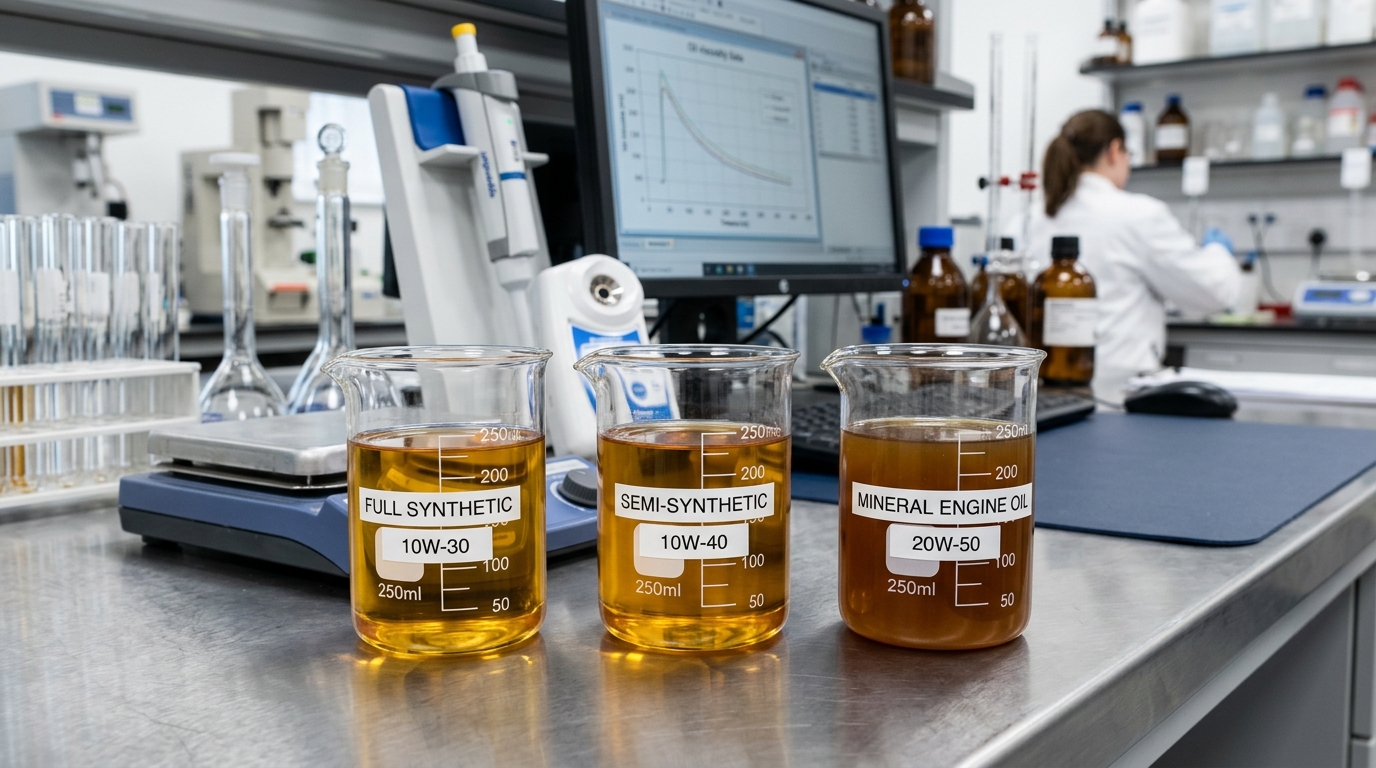
Group I and II mineral oils (15W-40, 20W-50) carry a 35–50% lower initial procurement price per drum, but require 5,000–10,000 km oil drain intervals (ODIs) and generate high Noack volatility burn-off.
Group III hydrocracked and Group IV Polyalphaolefin (PAO) synthetics extend heavy-duty drain intervals up to 40,000–100,000 km, deliver a documented 1.2–2.5% fuel economy benefit, and protect diesel particulate filters (DPFs) via low sulfated ash chemistry.
Across a 100,000 km operating cycle, synthetic lubrication yields lower total cost per kilometer (CPK) despite higher initial invoice costs.
Base Oil Chemistry: API Groups I Through V Defined
The American Petroleum Institute (API 1509) and ATIEL categorize base stocks into five distinct groups based on saturation levels, sulfur content, and Viscosity Index (VI). The formulation determines thermal degradation resistance, cold-cranking performance, and shear stability under hydrodynamic boundary conditions.
| API Group | Chemical Composition | Viscosity Index (VI) | Manufacturing Process | Commercial Classification |
|---|---|---|---|---|
| Group I | <90% Saturates, >0.03% Sulfur | 80–119 | Solvent extraction from crude vacuum residuum | Conventional Mineral |
| Group II | ≥90% Saturates, ≤0.03% Sulfur | 80–119 | Severe hydrotreating/catalytic dewaxing | Refined Mineral / Hydrotreated |
| Group III | ≥90% Saturates, ≤0.03% Sulfur | ≥120 | Severe hydrocracking and hydroisomerization | Synthetic Technology / HC-Synthese* |
| Group IV | 100% Polyalphaolefins (PAO) | ≥130–160 | Synthesized polymerization of 1-decene monomer | Full Synthetic (Vollsynthetisch) |
| Group V | Esters, PAGs, Alkylated Naphthalenes | 140–200+ | Chemical condensation of acids and alcohols | Synthetic Specialty / Performance Blends |
*Legal Note for German and EU Markets: Under German competition law (BGH ruling), Group III oils cannot be labeled "Vollsynthetisch" without qualifying language like "HC-Synthese" or "Synthetic Technology." Only Group IV (PAO) formulations can carry the unreserved "Vollsynthetisch" label. Importers and re-packagers must reflect this distinction on packaging to prevent regulatory recalls.
Technical Performance Matrix: Tribological Limitations
Performance disparities between lubricant types emerge under high thermal and mechanical stress. Modern downsized engines generate high High-Temperature High-Shear (HTHS) rates and elevated turbocharger bearing temperatures exceeding 250°C.
| Parameter | Mineral (Group I/II) | Semi-Synthetic (Blend) | Full Synthetic (Group III/IV) |
|---|---|---|---|
| Noack Volatility (ASTM D5800) | 14.0% – 20.0% | 11.0% – 13.5% | ≤ 6.0% – 9.0% |
| Pour Point (ASTM D97) | -20°C to -27°C | -30°C to -36°C | -45°C to -57°C |
| High-Temperature Sludge Resistance | Poor (coking >140°C) | Moderate (stable to 180°C) | Exceptional (stable >250°C) |
| Viscosity Index Stability | Requires high VII polymer load (shears rapidly) | Balanced polymer treat rates | High natural VI; low temporary/permanent shear loss |
| Emissions System Compatibility | High sulfated ash (≥1.3%), rapidly blocks DPF/GPF | Standard ash (0.9%–1.2%), variable compatibility | Dedicated Low/Mid-SAPS (≤0.8%), protects SCR & DPF |
High Noack volatility in mineral base oils increases oil evaporation through the crankcase ventilation (PCV) system. This increases top-up fluid demand and accelerates carbon fouling on turbocharger compressor wheels and intake valves in direct-injection engines.
TCO Comparison: Commercial Fleet Economics Over 100,000 km
Procuring low-cost mineral oil often increases total operating costs. Consider this representative operational model for a regional haulage tractor unit operating over 100,000 km per annum:
- Scenario A (Mineral 15W-40, API CI-4): Oil drain interval of 15,000 km. Requires 6.6 service events per year. Bulk oil price: €1.85/liter. Sump capacity: 35 liters. Filter cost: €22 per change. Workshop labor/downtime cost: €90 per service.
- Scenario B (Full Synthetic 5W-30 Low-SAPS, API CK-4 / ACEA E6/E8): Oil drain interval of 50,000 km. Requires 2 service events per year. Bulk oil price: €4.20/liter. Sump capacity: 35 liters. Extended-life filter cost: €38 per change. Workshop labor/downtime cost: €90 per service. Fuel consumption reduction: 1.5% on a baseline of 30 L/100 km at €1.40/L diesel.
| Operational Cost Element (per 100k km) | Mineral Lubricant (15W-40) | Full Synthetic Lubricant (5W-30) |
|---|---|---|
| Lube Volume Purchased | 231 Liters (€427.35) | 70 Liters (€294.00) |
| Filter Replacement Hardware | 6.6 Filters (€145.20) | 2 Filters (€76.00) |
| Workshop Labor & Vehicle Downtime | 6.6 Events (€594.00) | 2 Events (€180.00) |
| Fuel Expense (30,000L baseline @ €1.40/L) | €42,000.00 (Standard) | €41,370.00 (-1.5% fuel saving) |
| Total Lubrication & Fuel Associated TCO | €43,166.55 | €41,920.00 (€1,246.55 net savings/truck) |
Across a fleet of 40 heavy commercial trucks, deploying full synthetic lubricants yields €49,862 in annual direct operational savings, even after accounting for the higher purchase cost of synthetic oil.
Operational Application Boundaries
Lubricant choice is governed by engine engineering, emissions hardware, and regional duty cycles:
- When Mineral Oil is Mandated: Classical naturally aspirated stationary generators, agricultural machinery operating on high-sulfur diesel (>500 ppm), engine break-in cycles requiring deliberate mechanical seating of new piston rings against cylinder liners, and vintage commercial vehicles lacking modern Viton or PTFE elastomer seals.
- When Semi-Synthetic Represents the Commercial Sweet Spot: Light commercial vehicle fleets (LCVs) operating mixed regional duty cycles without extended drain intervals; secondary vehicle markets; and warm-climate transport operations where sub-zero pour-point capabilities are irrelevant.
- When Full Synthetic is Non-Negotiable: Any engine featuring Variable Valve Timing (VVT), Turbocharged Gasoline Direct Injection (TGDI), or Euro 5/6 and EPA 2010+ heavy-duty diesel engines with DPF, SCR, and DOC. Mineral oils produce sulfated ash that permanently blocks DPF channels and causes Low-Speed Pre-Ignition (LSPI) catastrophic piston failures in modern TGDI passenger cars.
Procurement Logistics: Packaging, Storage, and Import Parameters
Importers and workshop distributors must optimize packaging formats based on turnover and handling infrastructure:
| Packaging Format | Gross Weight / Unit | Container Loading Yield (20ft FCL) | Recommended Buyer Profile |
|---|---|---|---|
| 1,000L IBC Totes | ~960–980 kg | 18–20 Totes (18,000–20,000L) | Large fleet maintenance depots, industrial processing facilities |
| 208L Steel Drums | ~195–205 kg | 80 Drums / 4-drum pallets (16,640L) | Regional workshops, tyre-service centers with lube bays |
| 5L / 1L Retail Cartons | Varies by pack | ~14,000–16,000 Liters (palletized) | Automotive retail networks, spare parts distributors |
For cross-border export outside the European Union, lubricants must be cleared under customs tariff code HS 2710.19.81 (mineral based containing ≥70% petroleum oils) or HS 3403.19 (synthetic preparations containing <70% petroleum oil).
Ensure delivery includes full batch Certificates of Analysis (COA) specifying kinematic viscosity at 40°C and 100°C, Total Base Number (TBN), and cold cranking simulator (CCS) results.