For commercial fleet operators, automotive distributors, and industrial repair facilities, engine oil represents a substantial inventory investment. However, simply stacking drums in a corner of your warehouse is insufficient to safeguard product quality.
Improper storage subjects lubricants to moisture ingress, additive fallout, thermal degradation, airborne dust contamination, and environmental spill violations. Implementing a disciplined, professional warehouse storage protocol ensures that fluids deliver maximum protection when finally dispensed into engines.
This comprehensive guide details how to store engine oil properly in a warehouse, covering ambient temperature control, horizontal drum racking, moisture "breathing" mitigations, FIFO stock rotation, dedicated color-coded dispensing, and secondary spill containment bunding.
Quick Answer: Warehouse Engine Oil Storage Rules
Proper warehouse engine oil storage requires maintaining a climate-controlled temperature (5°C to 30°C), storing 208L drums horizontally with bungs at 3 and 9 o'clock, enforcing FIFO inventory rotation, and using 110% capacity spill containment bunding.
6 Core Storage Standards:
- Maintain ambient indoor temperatures between 5°C and 30°C
- Rack drums horizontally with bungs at 3 and 9 o'clock
- Install desiccant breathers on bulk oil tanks
- Enforce strict First-In, First-Out (FIFO) rotation
- Use dedicated color-coded pumps to avoid additive clashing
- Store containers on 110% capacity spill containment pallets
Review our dedicated guide on engine oil shelf life and storage for detailed additive stability timelines.
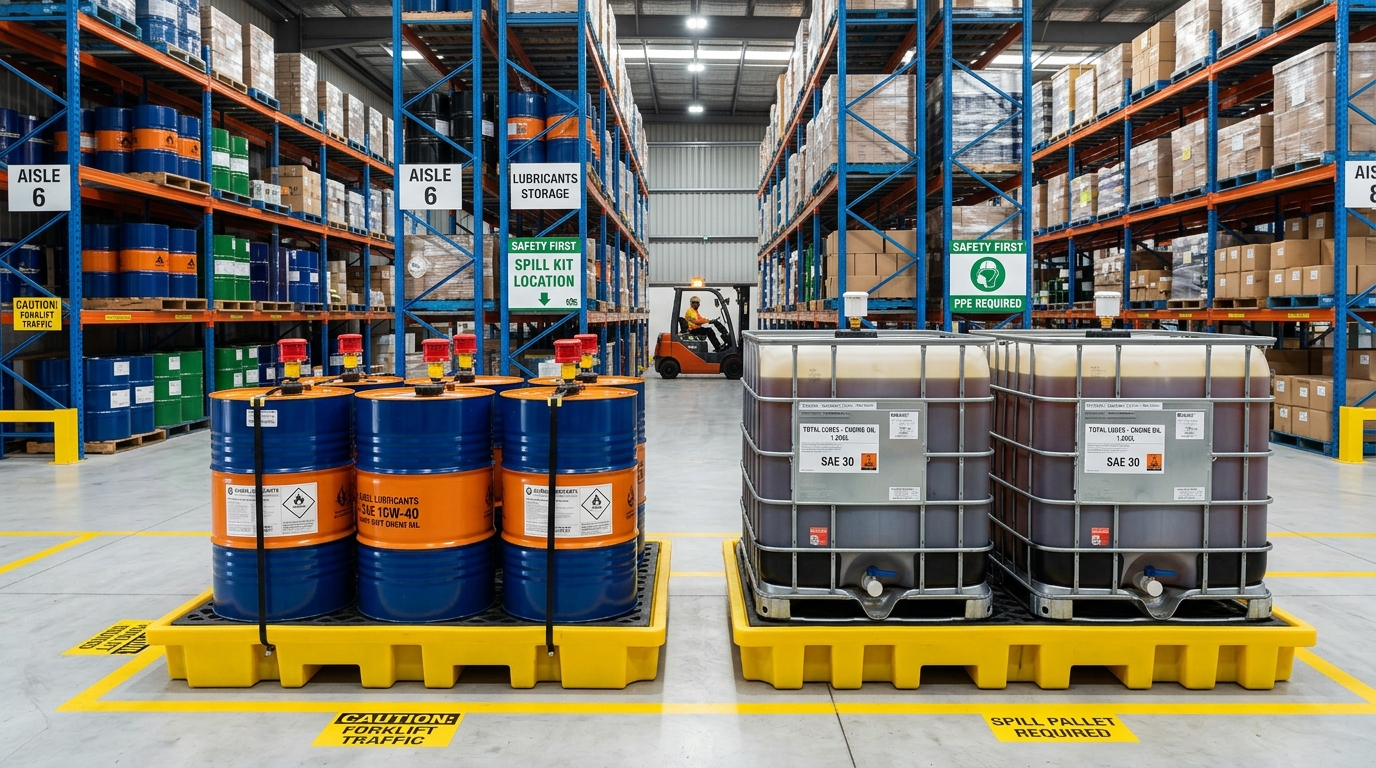
Table of Contents
1. Why Proper Oil Storage Matters
Modern engine oils are complex liquid formulations combining refined Group III or PAO base oils with balanced chemical additive packages (viscosity index improvers, dispersants, detergents, ZDDP anti-wear agents, and anti-foaming inhibitors).
When exposed to adverse storage conditions—such as extreme heat, freezing temperatures, or water contamination—additives can fall out of suspension or undergo chemical hydrolysis. Contaminated oil introduced into engines causes accelerated valvetrain wear, sludge accumulation, and filter plugging.
2. Temperature Control: 5°C to 30°C
Maintaining a stable ambient storage temperature is critical for lubricant stability:
The Freeze Danger (<0°C)
Freezing temperatures cause wax crystallization in mineral oils, turning fluid cloudy and thick. Cold, viscous oil restricts pumpability during initial dispensing.
The Heat Danger (>38°C)
Prolonged heat exposure accelerates oxidation, degrading base oils and depleting additive reserves prematurely.
3. Avoiding Moisture & "Drum Breathing"
A sealed steel drum is not completely immune to ambient air exchange due to the drum breathing effect.
As daytime temperatures rise, air inside the drum headspace expands and vents past bung seals. As temperatures cool at night, a partial vacuum forms, drawing humid ambient air back inside. If water has pooled on top of a vertical drum lid, moisture is sucked straight past the bungs into the oil, triggering additive hydrolysis and rust formation.
4. Drum Orientation: Horizontal Racking
How 208-liter steel drums are positioned in your warehouse directly impacts contamination prevention:
- Vertical Upright Storage (Discouraged): Water pools on top of flat drum lids, leading directly to moisture breathing ingress past bung threads.
- Horizontal Racking (Recommended): Resting drums horizontally on cradle racks prevents water pooling. Positioning bungs at the 3 o'clock and 9 o'clock positions keeps seals submerged in oil, ensuring an airtight seal.
5. First-In, First-Out (FIFO) Rotation
Engine oils have defined shelf lives. Full synthetic oils last up to 5 years stored indoors, while mineral oils have a 3-year optimal window.
Enforcing a strict First-In, First-Out (FIFO) inventory management system guarantees that older stock is deployed before newer deliveries arrive. Clearly mark receiving dates on all drums and IBC totes upon arrival.
6. Color-Coded Dispensing Safety
Fluid contamination frequently happens during internal workshop dispensing:
- Dedicated Pumps: Never share pumps or transfer containers between different oil grades (e.g. 5W-30 synthetic vs. 15W-40 heavy duty diesel). Mixing incompatible additive packages causes chemical clashing.
- Color-Coding: Label storage racks, transfer jugs, and metered dispensing nozzles with distinct color tags (e.g. Blue for 5W-30, Green for 0W-20, Red for 15W-40).
7. Spill Containment (Bunding Compliance)
Environmental authorities strictly enforce secondary spill containment (bunding) to prevent ground and water contamination.
Store all oil drums and 1,000L IBC totes on specialized spill containment pallets. Secondary bunding capacity must legally hold at least 110% of the volume of the largest single container or 25% of total stored fluid volume. Keep absorbent spill kits nearby at all times.
Frequently Asked Questions
What is the ideal ambient temperature range for warehouse engine oil storage?
Engine oil should ideally be stored in a dry environment maintained between 5°C and 30°C (40°F to 85°F) to prevent thermal degradation and additive separation.
Why should steel oil drums be stored horizontally with bungs at 3 and 9 o'clock?
Horizontal storage prevents moisture pooling on drum lids. Placing bungs at 3 and 9 o'clock keeps the seals submerged in oil, maintaining an airtight seal and preventing thermal breathing contamination.
How does temperature fluctuation cause water contamination inside sealed drums?
Daily heating causes air inside drum headspaces to expand and vent out. Nighttime cooling creates a vacuum, sucking humid ambient air (or standing lid water) back through the bungs.
What is the shelf life of synthetic vs. mineral engine oil in a warehouse?
When properly stored indoors, full synthetic oils have a shelf life of up to 5 years, whereas conventional mineral oils have an optimal shelf life of 3 years.
What secondary spill containment (bunding) capacity is legally required for warehouse oil storage?
Environmental regulations typically require secondary spill containment pallets (bunds) capable of holding 110% of the volume of the largest single container or 25% of total stored volume.
Final Takeaway
Proper warehouse lubricant storage protects product chemical integrity and facility safety.
Enforcing climate control (5°C–30°C), horizontal drum racking at 3 and 9 o'clock, FIFO stock rotation, and 110% bunding spill pallets ensures your inventory performs flawlessly when dispensed into client engines.
Sourcing Bulk Engine Oil for Warehouse Distribution?
REIFTEIL supplies European motor oils in heavy-duty 208L steel drums and 1,000L IBC totes with durable packaging designed for long-term warehouse stability.
REIFTEIL Bulk Packaging Advantages: