For passenger cars, vans, trucks, and commercial vehicles, the safest way to select an air filter is to start with the vehicle or OEM part number and then verify the filter's dimensions, construction, application, and performance specifications.
This guide explains how to choose the correct engine air filter for your vehicle and what to consider when comparing paper, synthetic, and other filter constructions.
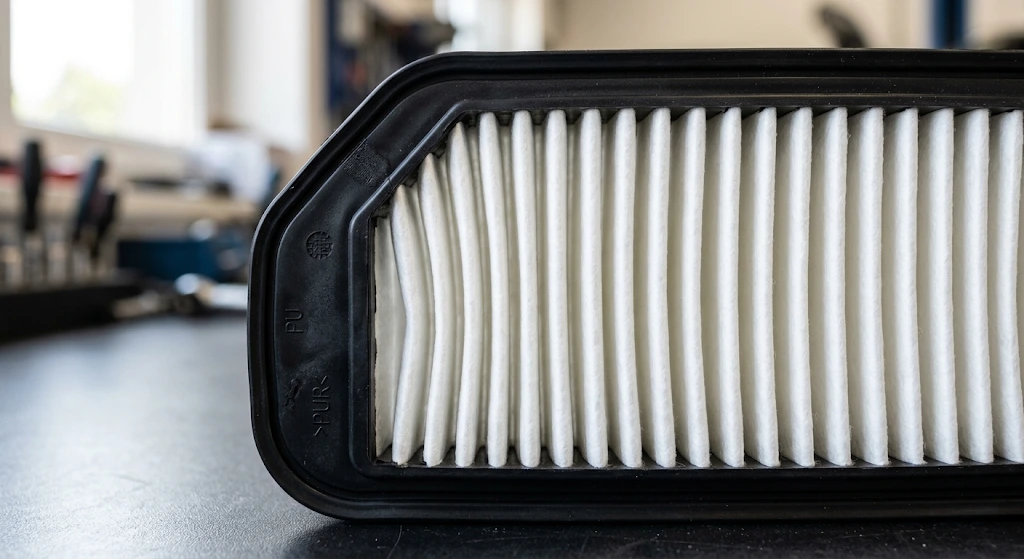
Air Filter Construction: Pleated synthetic media matrix bound by a flexible polyurethane perimeter seal.
Why the Correct Engine Air Filter Matters
An engine needs a large volume of clean air for combustion. At the same time, the intake system must prevent dust, dirt, sand, and other airborne contaminants from reaching sensitive engine components.
A properly selected air filter helps:
- Protect cylinders, piston rings, and other engine components from abrasive contaminants
- Maintain the required airflow to the engine
- Protect sensitive intake components and air-flow sensors
- Support consistent engine performance
- Maintain the manufacturer's intended filtration system
- Reduce the risk of premature filter restriction
- Provide reliable filtration throughout the recommended service interval
An air filter should therefore be evaluated as part of the complete intake system—not simply as a disposable piece of filter material.
How to Choose the Correct Engine Air Filter
The following process can help you identify the correct filter before purchasing.
1. Identify the Exact Vehicle and Engine
Start with the vehicle application. At minimum, verify:
This is important because the same vehicle model can use different air filters depending on its engine, production year, or drivetrain configuration. For example, two versions of the same vehicle may have different airbox dimensions and therefore require completely different filters.
When purchasing for a fleet, application data becomes even more important because a single vehicle model may contain several engine variants.
2. Find the OEM or Aftermarket Part Number
The OEM part number is usually one of the most reliable starting points when selecting an air filter. You can find the original number through:
- The vehicle manufacturer's parts documentation
- The existing filter physically removed from the airbox
- A reputable parts catalogue (e.g. MANN-FILTER, TecDoc)
- A dealer, workshop, or professional aftermarket supplier
After identifying the OEM number, you can compare it against reputable aftermarket cross-reference catalogues. Professional filter catalogues connect aftermarket numbers with vehicle applications, exact dimensions, and original-equipment numbers. Learn more about cataloging in our guide on How to Cross-Reference Auto Parts Before Ordering.
3. Check the Filter Dimensions
Part numbers should be checked against physical specifications whenever possible. Important dimensions include:
A filter may appear visually similar to another filter but still be unsuitable because it is slightly different in size or sealing configuration (e.g., 374 × 213 × 68 mm vs 374 × 213 × 58 mm).
4. Check the Shape and Airbox Design
Engine air filters are available in many shapes including rectangular panel, cylindrical, conical, oval, and custom-molded designs. The shape matters because the filter must sit correctly inside the airbox. Always inspect:
- Overall shape & filter orientation
- Sealing frame & perimeter gaskets
- Locating tabs & locking clips
- Airflow openings & internal supports
5. Pay Attention to the Filter Seal
The sealing surface is one of the most important—and most overlooked—parts of an engine air filter. The filter media may have excellent filtration characteristics, but those characteristics become irrelevant if air can travel around the filter.
A correctly fitted filter should create a reliable seal against the airbox or filter housing. Inspect rubber or polyurethane (PU) sealing surfaces, gasket elasticity, frame rigidity, and deformation under housing clamp pressure.
6. Choose the Appropriate Filter Media
Different engine air filters use different media constructions:
Cellulose or Paper Filter Media
Pleated cellulose-based media remains widely used in conventional automotive air filters. Advantages include proven filtration technology, cost-effective production, broad vehicle application coverage, and an optimal balance between filtration and airflow for normal road use.
Synthetic Filter Media
Synthetic media can be engineered with different fibre structures and densities to achieve high dust-holding capability, consistent media construction, and low airflow resistance under heavy dust loads.
Cotton Gauze and Performance Filters
Some performance-oriented air filters use oiled cotton gauze. These prioritize maximum airflow and may be washable. However, for a standard road vehicle, the priority is: Correct application + effective filtration + reliable sealing + appropriate airflow rather than maximum airflow alone.
Airflow vs Filtration: Which Is More Important?
One of the most common misconceptions about air filters is that the filter allowing the most air into the engine must be the best. That is not necessarily true. An engine air filter must balance:
Increasing airflow without maintaining effective contaminant capture compromises engine protection. Likewise, a filter with very high filtration performance but excessive restriction will starve an engine of air.
What Is Air Filter Restriction?
Air-filter restriction refers to the resistance created as air passes through the filtration system. As a filter accumulates dust during operation, restriction generally increases. Excessive restriction reduces the air volume available to the engine and can negatively affect performance.
What Is ISO 5011?
ISO 5011 is an international test standard for evaluating the performance of inlet air-cleaning equipment used with internal-combustion engines and compressors. The standard provides test procedures and conditions that allow air cleaners to be compared under controlled laboratory conditions.
Key characteristics evaluated under ISO 5011 include:
- Airflow restriction or differential pressure ($\Delta P$)
- Dust collection efficiency (%)
- Total dust capacity (grams)
- Oil carry-over for applicable oil-bath air cleaners
The current ISO 5011 edition is ISO 5011:2025.
Why ISO 5011 Matters
If you are comparing air filters from different manufacturers, standardized testing makes performance data meaningful. However, be careful with unverified claims such as "99% efficient" without knowing the test dust type, airflow CFM, or test procedure. Always request full test documentation for B2B procurement.
Consider Where the Vehicle Operates
Normal Road Use
OE-equivalent replacement filters provide an optimal balance of airflow, filtration, competitive cost, and service life on paved roads.
Dusty & Off-Road
Construction, mining, and agricultural vehicles require high dust-holding capacity synthetic media to prevent rapid filter clogging.
Commercial Fleets
Fleets prioritize dust capacity, batch consistency, total operating cost, and extended service intervals to minimize vehicle downtime.
Air Filters and MAF Sensors
Many modern engines use a Mass Air Flow (MAF) sensor to measure incoming intake air volume. The intake system needs to maintain clean, laminar airflow around the sensor wire. Using filters with poor perimeter seals or over-oiled cotton media can contaminate the MAF sensor wire, leading to lean fuel codes and hesitation.
How to Choose an Air Filter for a Fleet
For fleet operators, filter selection should be standardized wherever practical by creating a master application list:
| Information | Example Entry |
|---|---|
| Vehicle | Volkswagen Transporter |
| Model Generation | T6 |
| Engine | 2.0 TDI |
| Engine Code | CXHA / CXFA |
| OEM Filter Number | 7E0 129 620 |
| Aftermarket Cross-Ref | MANN C 35 154 |
| Filter Dimensions | 344 x 135 x 78 mm |
| Operating Environment | Mixed Urban & Regional Fleet |
Common Mistakes When Choosing an Air Filter
A single model can use multiple engine and airbox variants. Always verify engine code and OEM part number.
Low unit price can lead to poor sealing, pleat collapse, and accelerated engine wear.
Over-sized filters won't fit or seal properly in the airbox housing.
Filters with matching dimensions may have different frame rigidities or sealing lip depths.
High airflow without adequate dust efficiency causes abrasive engine wear.
A distorted perimeter gasket lets unfiltered dust bypass the filter media completely.
Efficiency percentages mean little without knowing ISO 5011 test conditions and dust types.
Always validate sample applications before committing to large volume wholesale orders.
How to Choose Air Filters for Wholesale Purchasing
When sourcing engine air filters for resale or fleet distribution, evaluate suppliers on application coverage, OEM cross-reference accuracy, ISO test documentation, manufacturing consistency, GTIN/barcode packaging, MOQ, and export shipping lead times.
Sample Verification Checklist Before Large Orders
- 1. Verify OEM & cross-reference part numbers
- 2. Check vehicle application coverage
- 3. Measure physical dimensions precisely
- 4. Inspect frame & sealing perimeter
- 5. Inspect pleat count & alignment
- 6. Test fitment inside OEM airbox
- 7. Request ISO 5011 test reports
- 8. Audit box labeling & GTIN barcodes
Air Filter Buying Checklist
Frequently Asked Questions
How do I know which air filter fits my car?
The safest method is to identify the exact vehicle and engine and then match the OEM or verified aftermarket part number. Confirming the dimensions and sealing configuration provides an additional check.
Can I choose an air filter based only on its dimensions?
No. Dimensions are useful for verification, but they should not be the primary selection method. Two filters with similar dimensions can have different applications or sealing arrangements.
Is a synthetic air filter better than a paper filter?
Not necessarily. Synthetic and paper filters can both be engineered for effective engine protection. The important factors are the complete filter's filtration performance, airflow restriction, dust capacity, construction, and suitability for the application.
Does a high-flow air filter improve engine performance?
Not automatically. An engine's intake system is designed around specific airflow requirements. A high-flow filter may reduce restriction in some applications, but it must still provide appropriate contaminant protection.
What does ISO 5011 measure?
ISO 5011 provides standardized procedures for testing air-cleaner performance, including airflow restriction, dust-collection efficiency, and dust capacity.
Should I buy an OEM or aftermarket air filter?
A reputable aftermarket filter can be a suitable replacement when it is correctly matched to the vehicle and meets the required performance and quality specifications. The important consideration is verified application compatibility rather than the label alone.
How often should an engine air filter be replaced?
Replacement intervals vary according to the vehicle manufacturer's maintenance schedule and operating conditions. Vehicles operating in dusty environments may require more frequent inspection or replacement.
What is the most important thing when buying air filters wholesale?
Application accuracy should come first. Before focusing on price, verify the part numbers, vehicle applications, dimensions, sealing configuration, product quality, documentation, MOQ, and supplier reliability.
Source Verified Engine Air Filters with REIFTEIL
Choosing the correct engine air filter requires matching vehicle, engine, application, construction, and operating environment. If you are sourcing engine air filters for wholesale distribution, fleet maintenance, or export, REIFTEIL can help with spare-parts sourcing, cross-referencing, and bulk supply.