However, navigating the global wholesale tire supply chain requires understanding distributor tiers, legal trade documentation (EORI, VAT, resale certificates), freight thresholds (LTL vs. FCL container cubing), commercial credit arrangements, and stringent quality control protocols. Without a structured procurement plan, dealers risk purchasing slow-moving inventory—learn how to avoid dead stock in the tire business to keep cash flow liquid.
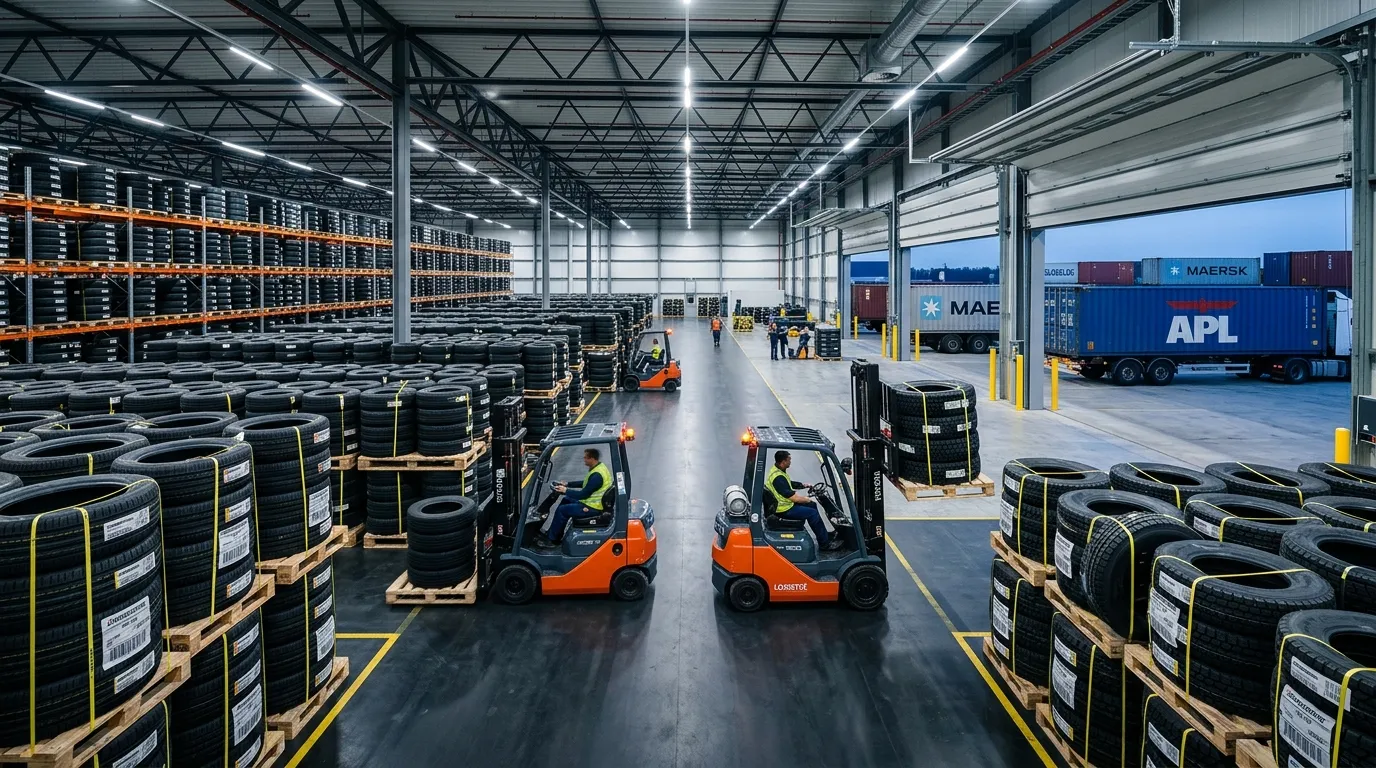
B2B Wholesale Tire Procurement: Multi-brand container logistics, palletized passenger car radials, and global commercial fleet supply.
The 4 Fundamentals of Wholesale Tire Buying
Source from Master Importers for full containers or Regional Distributors for mixed pallet lots.
FCL 40ft containers drop shipping overhead to €1.80–€3.20/tire compared to €8.00–€14.00 for LTL.
Strictly contract for DOT date freshness under 24 months to maintain customer safety and resale value.
Leverage 2/10 Net 30 terms or establish trade credit to fund inventory through customer receivables.
1. The 3-Tier Brand Hierarchy: Margin vs. Velocity
A successful wholesale inventory portfolio balances consumer brand awareness with gross margin contribution across three distinct manufacturer tiers:
Michelin, Continental, Bridgestone, Goodyear, Pirelli
- OE Approvals: Factory-fitted on Mercedes, BMW, Audi, Porsche.
- Gross Margin: 12% to 18% (high turnover, price-transparent).
- Best For: Dealerships, premium retail garages, luxury fleets.
Hankook, Kumho, Nexen, Falken, Yokohama
- Value Proposition: 90% of Tier-1 performance at 65% of the price.
- Gross Margin: 22% to 32% (optimal dealership profit engine).
- Best For: General motorists, commercial fleets, municipal contracts.
Sailun, Linglong, Triangle, Giti, Westlake
- Cost Structure: Lowest capital acquisition cost; rapid inventory turns.
- Gross Margin: 35% to 45%+ (high-volume price shoppers).
- Best For: Budget commuters, rideshare operators, wholesale redistribution.
2. Order Sizing & Minimum Order Quantities (MOQ)
Wholesale tire distributors price orders in tiers based on volume thresholds. Understanding what is MOQ in wholesale tire buying ensures you never overpay per unit or tie up excess working capital:
| Wholesale Sourcing Tier | Minimum Order Size | Unit Price Impact | Freight Delivery Mode |
|---|---|---|---|
| Mixed Pallet Lot | 40–80 Tires (1–2 Pallets) | Standard Wholesale | LTL Curbside Tailgate Delivery |
| 20ft Ocean / Road Container | 450–500 PCR / 120 TBR | 5%–8% Volume Discount | FCL Dedicated Container |
| 40ft High Cube Container | 1,000–1,200 PCR / 260 TBR | 12%–18% Master Tier | FCL Laced Floor Loading |
3. Incoterms 2020: FOB vs. CIF vs. DDP
When contracting international wholesale tire shipments, your selected Incoterm dictates who pays freight, who bears marine transit risk, and who handles customs clearance. Always model your total landed investment—refer to our guide on how to calculate landed cost for imported tires:
FOB (Free On Board)
Seller delivers tires loaded on board the vessel at the export port (e.g. Hamburg or Rotterdam). You control ocean freight rates, vessel routing, and destination customs clearance.
CIF (Cost, Insurance & Freight)
Seller pays ocean freight and marine insurance to your named destination port. You handle port terminal handling charges (THC), import duties, and inland trucking.
DDP (Delivered Duty Paid)
Seller assumes 100% responsibility, delivering tires directly to your warehouse door with all import tariffs and duties pre-paid. Highest convenience, zero customs risk.
4. Payment Mechanisms: Protecting Capital & Building Credit
International wholesale tire transactions utilize specific payment instruments to balance supplier security with buyer protection:
30% advance deposit upon order confirmation to commence production/picking; remaining 70% balance paid against scanned copy of Original Bill of Lading (OBL).
Bank-guaranteed payment released only when the seller presents compliant shipping documents (inspection certs, EUR.1, packing list). Standard for high-value multi-container deals.
Extended to established buyers with verified credit history (Euler Hermes / Atradius underwriting), allowing dealerships to sell inventory before paying the invoice.
Deduct 2% from the total invoice if paid within 10 days, effectively earning an annualized risk-free return of over 36% on working capital.
5. The 5-Point Warehouse Receiving Protocol
Protect your business from receiving non-conforming or aged inventory by executing this 5-point audit before signing the driver's delivery receipt:
-
1
Container Seal Verification: Verify container bolt seal serial numbers match the Bill of Lading (BOL) prior to cutting.
-
2
DOT Manufacture Date Sampling: Randomly sample DOT 4-digit date stamps across top, middle, and bottom tiers to ensure freshness (<24 months).
-
3
Bead Compression & Lacing Audit: Audit bottom floor tiers for pinched bead bundles or heavy compression distortion caused by overtight lacing.
-
4
ECE E-Mark & 3PMSF Compliance: Confirm sidewall markings contain valid E-Mark approval codes and official 3PMSF alpine symbols where required.
-
5
Damage Exception Notation: Document any discrepancy or physical damage directly on the carrier delivery receipt before signing.
Frequently Asked Questions (FAQ)
What credentials are required to buy tires directly from a wholesale distributor?
Legitimate wholesale distributors require a registered business entity (LLC, GmbH, Ltd), a valid Tax ID / VAT Number, an Economic Operators Registration and Identification (EORI) number for cross-border European imports, and a state/national resale certificate to exempt trade purchases from consumer sales tax.
What is the difference between Tier 1, Tier 2, and Tier 3 wholesale tire brands?
Tier 1 brands (Michelin, Continental, Bridgestone, Goodyear, Pirelli) offer premium OE approval, highest customer pull demand, but tighter margins (12%–18%). Tier 2 brands (Hankook, Kumho, Nexen, Falken) provide the optimal balance of OE quality and higher dealer profit margins (22%–32%). Tier 3 budget brands (Sailun, Linglong, Triangle) offer the lowest initial purchase price and fastest cash turnaround with margins up to 35%–45%.
What freight method offers the lowest landed cost per tire in wholesale procurement?
Full Container Load (FCL) shipping (40ft High Cube container holding ~1,000–1,200 passenger car tires or ~260 truck radial tires) provides the lowest freight cost per unit, dropping unit shipping overhead down to €1.80–€3.50 per tire compared to €8.00–€14.00 for Less-Than-Truckload (LTL) pallet shipments.
How should tire buyers verify the age and freshness of wholesale shipments?
Inspect the 4-digit Department of Transportation (DOT) date code molded onto the outer sidewall (e.g. '1826' indicates production during the 18th week of 2026). In B2B supply contracts, stipulate that all delivered new stock must have a DOT manufacture date of less than 24 months.
What payment terms are standard in international wholesale tire transactions?
First-time international buyers typically transact via Advance Telegraphic Transfer (30% deposit, 70% against Bill of Lading copy) or an Irrevocable Letter of Credit (L/C at sight). Once a positive 6-month transaction track record is established, suppliers extend Net 30, Net 60, or early-settlement cash discounts (e.g., 2/10 Net 30).
What certifications must tires carry for legal sale in Europe and the UK?
Tires sold in the EU and UK must carry the ECE 'E-Mark' approval code on the sidewall (Regulation ECE R30 for PCR, R54 for commercial TBR), 3PMSF (Three-Peak Mountain Snowflake) certification for winter/all-season legality, and an official EU Tyre Label indicating wet grip, rolling resistance, and exterior pass-by noise decibel ratings.
Which Incoterm is best for international wholesale tire buyers?
cif-vs-ddp-vs-exw-when-buying-engine-oil.html" class="text-amber-600 hover:text-amber-700 underline font-medium">FOB (Free On Board) is preferred by experienced importers with their own freight forwarding agreements. CIF (Cost, Insurance & Freight) is ideal for buyers wanting the seller to handle ocean logistics to the destination port, while DDP (Delivered Duty Paid) provides a fully hands-off experience with customs and tariffs pre-paid.
How does REIFTEIL assist independent tire dealers and fleet buyers?
REIFTEIL operates master distribution hubs in Germany and the UK, supplying certified Tier-1, Tier-2, and commercial TBR tires in flexible mixed-pallet and full container loads with factory-fresh DOT dates and complete EUR.1 export documentation.
Final Verdict: Precision Sourcing Unlocks Maximum Margins
Succeeding in wholesale tire buying requires treating freight efficiency, supplier verification, and DOT quality with equal rigor:
The Golden Summary:
- Consolidate Shipping: Aim for container or multi-pallet loads to minimize freight overhead.
- Balance Your Tier Mix: Combine fast-turning Tier-1 brands with high-margin Tier-2/3 stock.
- Source Factory-Direct with REIFTEIL: Access verified European warehouse inventories.
Source Factory-Direct Wholesale Tires with REIFTEIL
Eliminate middlemen markups. Access wholesale PCR, TBR, and specialty tire inventories direct from European manufacturer hubs with flexible container consolidation and rapid shipping.