The right stock keeps customers supplied, increases sales, and reduces lead times. The wrong stock sits in the warehouse, occupies valuable space, ties up working capital, and eventually has to be discounted or liquidated.
This is the challenge of dead stock.
The goal isn't to keep your warehouse empty. It's to keep the right tires, in the right quantities, at the right time.
A practical tire inventory-management strategy combines sales data, stock rotation, demand forecasting, purchasing discipline, and early action on slow-moving products. Here's how to build one.

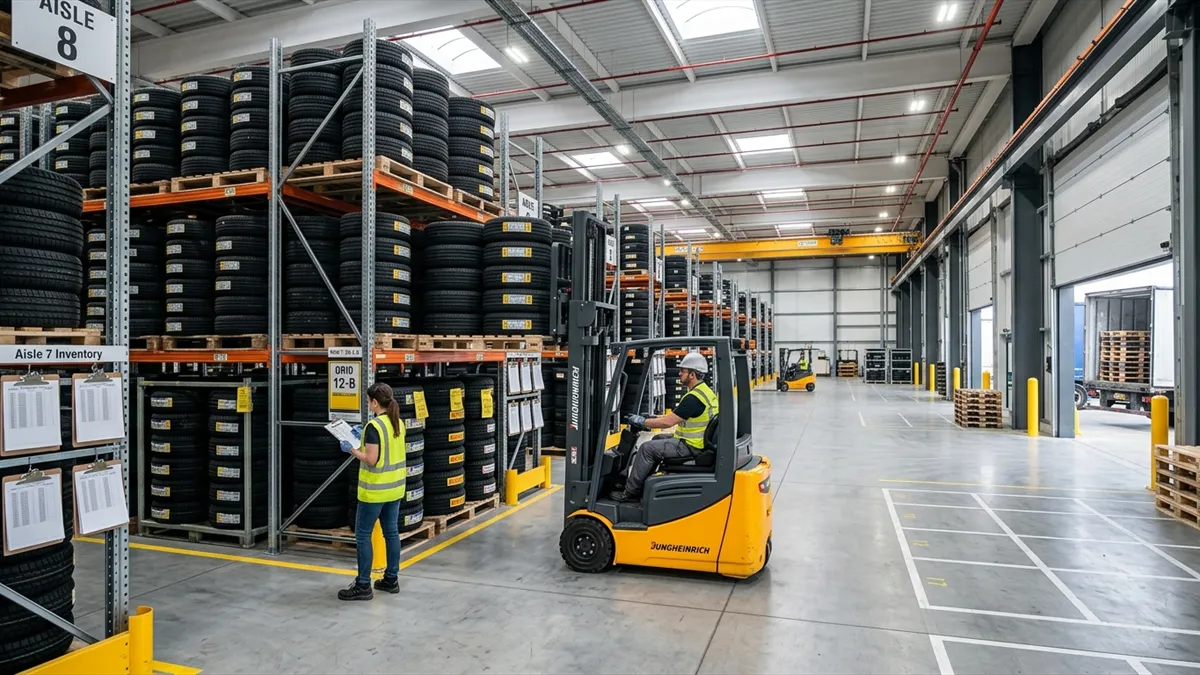
Digital Inventory Auditing: Scanning tire rack barcodes to track sales velocity, enforce FIFO rotation, and prevent dead stock.
The 4 Pillars of Dead Stock Prevention
Focus working capital heavily on high-velocity core sizes (A-stock) while keeping niche SKUs lean.
Never buy extra slow-moving units just to unlock a small wholesale volume discount.
Always position older stock in the picking spot so older inventory moves before newer deliveries.
Use 60-, 90-, and 120-day thresholds to promote, bundle, or transfer stock before steep clearance losses.
What Is Dead Stock in the Tire Business?
Dead stock is inventory that remains unsold for an extended period and no longer generates a reasonable return on the capital invested in it.
There is no universal number of days that automatically makes a tire "dead stock." Each business should define its own threshold based on sales velocity, product category, seasonality, margins, and customer demand.
A common 205/55 R16 tire is expected to sell quickly and turn over within weeks.
A low-profile 20-inch performance fitment naturally takes longer to sell due to lower vehicle population.
A dedicated winter tire may remain inactive for several months before peak seasonal demand returns.
A specialized TBR regional drive or steer tire has a completely different sales cycle and volume profile from passenger tires.
For internal inventory control, a 90-, 120-, or 180-day aging threshold can be useful for identifying products that need attention.
Why Does Tire Dead Stock Happen?
Dead stock rarely appears overnight. It usually starts with a purchasing decision that looked reasonable at the time.
Common causes include:
The Unit-Price Trap: €70 vs €75
One of the most common mistakes is focusing entirely on the unit price. A tire that costs €70 instead of €75 may look like the better purchase.
The Reality: If the €70 tire sits in your warehouse for a year while the €75 tire sells within weeks, the cheaper purchase may actually be the far more expensive business decision once storage, capital cost, and depreciation are factored in.
The Real Cost of Dead Stock
Dead stock costs more than the original purchase price.
Suppose a tire dealer purchases:
If those tires sell quickly, the capital is converted back into cash and profit. But if they remain in inventory for months, that €8,000 is frozen.
That capital could otherwise have been used for:
There is also the cost of warehouse space, handling, financing, discounts, and eventual liquidation.
This is why inventory turnover matters just as much as purchase price.
1. Stock Your Fast-Moving Tire Sizes First
Not every SKU deserves the same level of inventory investment. Start by identifying the tire sizes and products that consistently generate sales.
These are your A-stock items.
For example, a tire dealer might discover that a relatively small group of common passenger-car sizes generates a large percentage of monthly tire sales. Those products deserve:
Meanwhile, slow-moving specialty sizes should generally be purchased more cautiously.
2. Use ABC Inventory Analysis
A simple ABC classification can help determine how aggressively you should stock different tire SKUs.
| Category | Typical Characteristics | Inventory Strategy |
|---|---|---|
| A | High-volume, fast-moving | Keep reliable stock |
| B | Moderate demand | Maintain calculated quantities |
| C | Slow-moving or niche | Keep limited stock or special-order |
A-stock
These are the products customers regularly ask for. Stockouts can mean lost sales, so maintaining availability is important.
B-stock
These products sell consistently but at a lower rate. Use sales history to determine appropriate reorder quantities.
C-stock
These products may have occasional demand but can tie up significant capital if overstocked. For C-stock, consider:
This approach prevents slow-moving inventory from consuming the cash needed for your best-selling products.
3. Don't Buy Slow-Moving Tires Just to Hit an MOQ
Minimum order quantities can create a dangerous temptation. A supplier offers a better unit price if you increase an order from 50 tires to 100. The discount looks attractive.
But if the additional 50 tires are unlikely to sell quickly, the saving may disappear through carrying costs, storage, markdowns, and lost working capital.
A better approach is to build the order around your fast-moving products first, then evaluate whether additional quantities make commercial sense.
Before increasing an order to reach a better price, ask:
The cheapest tire is not always the cheapest inventory decision.
4. Track Inventory Age
Every tire warehouse should have an inventory-aging system. At minimum, track:
Then divide inventory into age categories:
| Inventory Age | Recommended Action |
|---|---|
| 0–60 days | Normal sales activity |
| 61–90 days | Monitor movement |
| 91–120 days | Increase promotion |
| 121–180 days | Consider discounting or targeted B2B sales |
| 180+ days | Review for liquidation, transfer or special promotion |
These are management thresholds, not universal tire-expiration rules. The correct thresholds depend on your product mix and market.
5. Use FIFO to Prevent Inventory Aging
FIFO means First In, First Out. The principle is simple: sell older stock before newer stock whenever the product specifications and customer requirements allow it.
The Hidden Warehouse Problem:
Without proper stock rotation, new tires arrive and are placed in front of older inventory. The newest stock gets picked first, while older tires remain at the back of the warehouse. Months later, the dealer discovers that the tires at the back have become significantly older than the rest of the inventory.
A Practical FIFO System:
Record the receiving date and relevant production information (DOT week/year).
Make older stock easy for warehouse and workshop staff to identify instantly.
Don't bury older pallets behind newer deliveries. Arrange racks so older units are pulled first.
Flag products approaching your internal aging thresholds (60, 90, 120 days).
Discount, bundle, transfer, or liquidate slow-moving inventory before it becomes a major problem.
6. Don't Ignore Seasonal Demand
Tire demand is not constant throughout the year. Seasonal patterns can dramatically change what customers want.
Winter tire demand may increase before colder weather. Summer tire demand may increase as temperatures rise and drivers switch seasonal sets.
If your business operates in a market with seasonal tire requirements, purchasing too early or too late can create problems. Use your previous sales data to identify:
Then use that information to plan your next order. Historical sales data is usually more valuable than guesswork.
7. Manage Odd Quantities Carefully
A stranded single tire can be difficult to sell. However, the solution is not necessarily to avoid every odd quantity. Instead, understand how your customers buy:
Your stock strategy should reflect your actual customer behavior. For example, if your sales data shows that a particular size is normally sold in pairs, purchasing in quantities that naturally support pair sales may reduce stranded inventory.
For specialty sizes, keeping only one or two units may make more sense than purchasing a large batch. The key is to match purchasing quantities to real demand.
8. Monitor Slow-Moving Tires Before They Become Dead Stock
Don't wait until a product has completely stopped selling. Create an early-warning system. A simple monthly report can identify:
Fast-moving
High HealthHigh sales velocity and healthy margins.
Slow-moving
Attention NeededSales are below expectations.
Aging
WarningInventory has remained in stock beyond your target period.
Dead stock
CriticalNo meaningful sales for an extended period.
The earlier you identify the problem, the more options you have.
9. Use Discounts Before You Need a Clearance Sale
One of the worst inventory strategies is waiting until a tire becomes extremely difficult to sell before reducing the price. A controlled markdown strategy can protect more of your original investment.
| Inventory Age | Possible Action |
|---|---|
| 90 days | Increase visibility & front-line counter promotion |
| 120 days | Promotional pricing or bundled service (fitting/balancing) |
| 150–180 days | Target commercial/B2B fleet buyers at cost |
| 180+ days | Consider liquidation or stock transfer |
The exact discount should depend on:
The goal isn't to discount everything. It's to intervene early when the sales data tells you a product isn't moving as expected.
10. Consider Stock Transfers Instead of Deep Discounts
A tire that isn't selling in one market may be exactly what another dealer needs. For example, you may have several units of a niche tire size sitting in your warehouse while another workshop nearby has a customer waiting for that exact specification.
Instead of heavily discounting the tires to the end consumer, consider:
This can recover more value than allowing the stock to continue aging on your warehouse racks.
11. Don't Overcomplicate Your Brand Portfolio
Carrying too many brands and tread patterns can create another form of dead stock. Imagine selling the same popular tire size across:
Your total inventory requirement can become much larger than if you focused on a smaller number of proven products. This doesn't mean you should sell only one brand. Instead, determine which combinations of:
actually generate sales, then reduce unnecessary duplication. A smaller, better-performing assortment can often produce better inventory turnover than a huge catalog sitting on shelves.
12. Calculate Reorder Points Using Real Sales Data
Reordering should not simply happen because a shelf looks empty. A basic reorder calculation can use:
Worked Example:
If you sell an average of 2 tires per day, your supplier takes 10 days to deliver, and you want 10 tires as safety stock:
Your reorder point would therefore be approximately 30 tires. When stock reaches 30, place the next order.
This is only a simplified example. Actual calculations should account for seasonality, demand variability, supplier reliability, and the way tires are sold in pairs or sets. But even a simple formula is better than guessing.
13. Measure Inventory Turnover
Inventory turnover tells you how efficiently your stock is being converted into sales.
Higher turnover: Generally means your inventory is moving faster and capital is healthy.
Lower turnover: Can indicate that too much capital is tied up in slow-moving stock.
Don't compare turnover blindly across different tire categories, however. A fast-moving passenger-car tire and a specialized truck tire can naturally have very different sales cycles.
Use turnover to compare similar products and categories within your own business.
14. Work With a Wholesale Supplier That Supports Flexible Purchasing
Your supplier can have a major impact on your inventory risk. A good wholesale relationship should help you avoid buying more stock than your customers actually need.
Look for suppliers that can provide:
R The REIFTEIL Supply Advantage
REIFTEIL supplies wholesale PCR and TBR tires alongside other automotive products and supports international logistics for wholesale buyers.
For dealers, the goal should be to keep deep inventory where demand is predictable while using the supplier network to source slower-moving sizes when required. That reduces the amount of capital sitting idle in your warehouse.
A Simple Tire Inventory Management System
You don't need an expensive inventory platform to start improving stock control. Begin with a spreadsheet or inventory-management system containing:
| Field | Example Entry | Operational Purpose |
|---|---|---|
| SKU | BR-1956515 | Unique catalog code |
| Size | 195/65 R15 | Dimension specification |
| Brand | Brand name | Manufacturer identity |
| Model | Model name | Tread pattern designation |
| Quantity | 48 units | Current warehouse on-hand |
| Purchase Date | 18/08/2026 | Receiving timeline |
| Production Date | DOT week/year | Physical age compliance |
| Units Sold / Month | 18 units | Sales velocity benchmark |
| Inventory Value | €3,840 | Tied-up working capital |
| Last Sale | 12/08/2026 | Recency tracking |
| Stock Class | A | ABC classification |
| Inventory Age | 32 days | Days on rack |
| Action | Reorder | Next operational step |
Review this data every single month. The objective is to answer five simple questions:
Tire Inventory Management Checklist
Before placing your next wholesale order, audit your inventory with these 11 strategic questions:
The Goal Isn't Maximum Inventory. It's Maximum Inventory Efficiency.
A well-stocked tire business isn't necessarily the business with the most tires in its warehouse. It's the business that can consistently provide the products customers want without tying up excessive capital in products that don't move.
And most importantly: don't allow a temporary wholesale discount to convince you to buy inventory your customers are unlikely to purchase. The cheapest purchase price means very little if the tires remain unsold.
Frequently Asked Questions (FAQ)
What is dead stock in the tire business?
Dead stock is inventory that remains unsold for an extended period and no longer generates a reasonable return on the capital invested in it. Businesses typically define aging thresholds such as 90, 120, or 180 days based on sales velocity, product category, and seasonality.
Why does dead stock happen in tire dealerships and workshops?
Common causes include over-ordering slow-moving sizes, buying extra stock merely to hit wholesale MOQs, carrying too many overlapping brands or tread patterns, failing to rotate older stock using FIFO, poor demand forecasting, and buying based on low unit price rather than sales velocity.
What is the real cost of dead stock beyond the purchase price?
Dead stock ties up critical working capital that could otherwise fund fast-moving sizes, payroll, marketing, or seasonal stock. It also incurs storage and handling costs, financing expenses, risk of aging obsolescence, and forced deep markdown losses.
How does ABC inventory analysis apply to tires?
A-stock covers high-volume, fast-moving core sizes that require reliable availability. B-stock represents moderate-demand sizes maintained in calculated quantities. C-stock consists of slow-moving or niche sizes managed via smaller quantities, special orders, or just-in-time replenishment.
Why is buying slow-moving tires to meet a wholesale MOQ dangerous?
A minor unit price discount is quickly erased if extra tires sit in the warehouse for months. Holding costs, tied-up working capital, and eventual markdowns easily exceed any initial bulk-purchase saving.
What inventory aging thresholds should tire businesses use?
A practical aging framework is: 0–60 days (normal sales activity), 61–90 days (monitor movement), 91–120 days (increase promotion/bundling), 121–180 days (target commercial B2B buyers or discount), and 180+ days (review for liquidation or stock transfer).
How does FIFO rotation prevent tire inventory aging?
FIFO (First In, First Out) ensures older stock is placed in the picking position so it sells before newer deliveries. Without FIFO, newly delivered pallets placed in front bury older tires, allowing them to age unnoticed in the back of the warehouse.
How do you calculate reorder points and inventory turnover for tires?
Reorder Point = (Average Daily Sales × Supplier Lead Time) + Safety Stock. Inventory Turnover = Cost of Goods Sold ÷ Average Inventory. These formulas help maintain optimal stock levels without over-committing capital.
How can working with a flexible wholesale supplier like REIFTEIL reduce dead stock risk?
A reliable wholesale partner provides mixed-size orders, flexible minimums, consistent lead times, and broad PCR and TBR availability, allowing dealers to stock fast-movers deeply while sourcing niche products on demand.
Final Thoughts: Protect Your Working Capital
Dead stock is not simply a warehouse problem. It's a cash-flow problem. Every slow-moving tire represents money that could otherwise be working somewhere else in your business.
The solution is not to eliminate inventory. Tire dealers need stock to serve customers quickly. The solution is to build an inventory system based on sales velocity, demand forecasting, stock aging, product classification, and disciplined purchasing.
And when you need products that don't make sense to hold in large quantities, a responsive wholesale supply partner can help you source them without forcing you to turn your warehouse into long-term storage.
The Golden Rule
Buy what moves. Monitor what doesn't. Act before slow stock becomes dead stock.
Optimize Your Inventory with REIFTEIL
Access competitive wholesale PCR and TBR tires with flexible order sizes, mixed-pallet ordering, and reliable international logistics. Keep your fast-movers in stock while minimizing cash-flow risk.