At first glance, 195/65 R15 and 205/55 R16 look very different. One uses a 15-inch wheel and the other uses a 16-inch wheel. One is 195 mm wide and the other is 205 mm wide.
But there is a surprising and important engineering detail: their overall tyre rolling diameters are almost identical.
That means these two sizes can frequently be used as factory-approved alternatives on the same vehicle model, depending on the exact trim level, wheel configuration, and manufacturer specifications. So what's really different? The answer comes down to tyre width, sidewall height, wheel size, comfort, handling, and the overall driving experience.
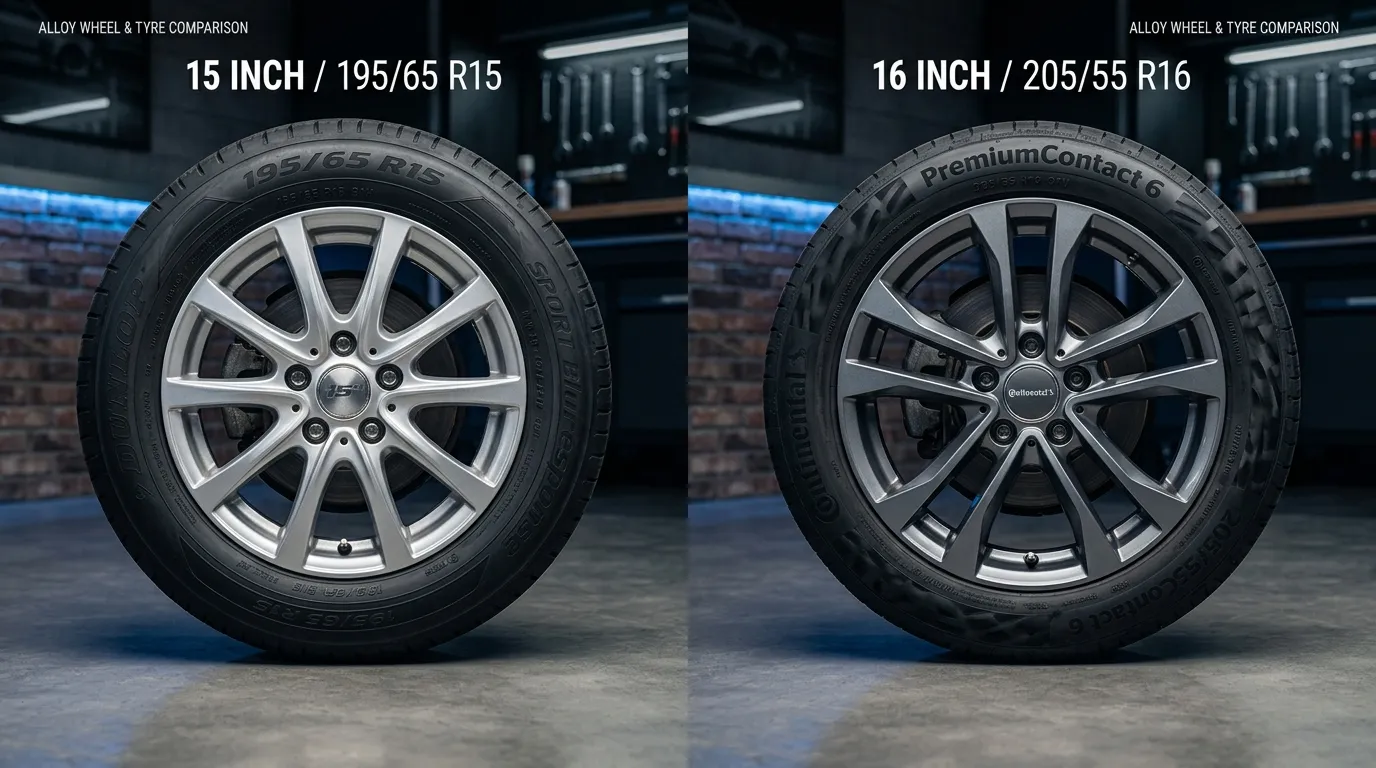
Visual Comparison: 15-Inch wheel with tall 65-profile sidewall (left) vs 16-Inch wheel with low 55-profile sidewall (right).
Quick Comparison: Specs at a Glance
| Specification | 195/65 R15 | 205/55 R16 | Difference |
|---|---|---|---|
| Tyre Width | 195 mm | 205 mm | +10 mm (+5.1%) |
| Aspect Ratio (Profile) | 65% | 55% | -10% lower profile |
| Wheel Rim Diameter | 15 Inches (381 mm) | 16 Inches (406.4 mm) | +1 Inch (+25.4 mm) |
| Sidewall Height | 126.75 mm | 112.75 mm | -14.00 mm (-11.0%) |
| Approx. Overall Diameter | 634.5 mm | 631.9 mm | -2.6 mm (-0.41%) |
| Approx. Rolling Circumference | 1,993 mm | 1,985 mm | -8 mm (-0.40%) |
| Revolutions Per Kilometre | ~502 revs/km | ~504 revs/km | +2 revs/km |
| Construction | Radial (R) | Radial (R) | Identical |
Breaking Down 195/65 R15
- 195 — Width: The nominal width is approximately 195 mm.
-
65 — Profile: The sidewall height is 65% of width:
195 mm × 0.65 = 126.75 mm (≈ 127 mm)
- R — Construction: Standard radial plies.
- 15 — Wheel Diameter: Engineered for a 15-inch wheel rim.
Breaking Down 205/55 R16
- 205 — Width: Approximately 205 mm wide (+10 mm wider).
-
55 — Profile: The sidewall height is 55% of width:
205 mm × 0.55 = 112.75 mm (≈ 113 mm)
- R — Construction: Standard radial plies.
- 16 — Wheel Diameter: Engineered for a 16-inch wheel rim.
The Surprising Part: Why Their Overall Diameter Is Almost Identical
This is the part that often surprises car owners. Although the wheels have different rim diameters (15" vs 16"), the complete tyre-and-wheel assemblies stand virtually neck-and-neck in total height:
195/65 R15 Total Diameter:
205/55 R16 Total Diameter:
The Exact Difference: Only 2.6 mm (0.4%)
634.5 mm − 631.9 mm = 2.6 mm. Because standard automotive engineering allows a ±1.5% to ±2.5% tolerance in rolling circumference, this difference is practically negligible for speedometer calibration and ABS/ESP operation.
Why Are These Two Sizes Engineered So Closely?
The larger 16-inch wheel (+25.4 mm) perfectly compensates for the shorter sidewalls (-28 mm total across top and bottom). This allows car manufacturers to offer entry-level trim packages on 15-inch steel or alloy wheels and higher-spec trim packages on 16-inch alloys without having to redesign gear ratios, suspension geometry, or speedometer calibrations.
195/65 R15 vs 205/55 R16: The 7 Main Differences
Tyre Width (195 mm vs 205 mm)
The 205/55 R16 is approximately 10 mm wider. A wider tread pattern puts a broader contact patch onto the tarmac, which can alter steering feel, turn-in resistance, and lateral stability during spirited cornering.
Sidewall Height (126.75 mm vs 112.75 mm)
This is one of the most substantial real-world differences. The 195/65 R15 offers 14 mm more sidewall rubber.
- 195/65 R15: Taller sidewall flexes more easily to absorb road irregularities, cracks, and bumps.
- 205/55 R16: Shorter sidewall has higher torsional stiffness, reducing lateral deflection for a tighter steering feel.
Wheel Rim Fitment (15" vs 16")
You cannot mount a 205/55 R16 tyre on a 15-inch rim, nor can you mount a 195/65 R15 on a 16-inch rim. Switching sizes requires purchasing a complete matching set of wheels.
Ride Comfort & Road Shock Absorption
If everyday driving comfort is your top priority, the 195/65 R15 holds a noticeable advantage. The extra 14 mm of flexible air chamber acts as an extra secondary spring, cushioning your suspension from speed humps, cobblestones, and broken city tarmac.
Steering Response & Cornering Precision
The 205/55 R16 provides sharper turn-in and reduced tyre roll during quick direction changes. This is why carmakers specify 16-inch wheels on sportier trims (e.g., GT, Sport, or R-Line models).
Fuel Consumption & Rolling Resistance
The 195/65 R15 is narrower, which can offer lower aerodynamic drag and marginally lower rolling resistance. However, a fuel-efficient Class A-rated 205/55 R16 will consistently beat an older Class C-rated 195/65 R15. Always compare the EU Tyre Label rating rather than relying on tyre size alone.
Road Noise Levels
Neither size is inherently quieter. Cabin noise is governed by the specific tread pattern, pitch sequencing, rubber compound, and your car's sound deadening. Check the measured dB level on the tyre's EU label.
Which Is Better for Potholes & Rough Roads?
195/65 R15 is significantly better. The taller 126.75 mm sidewall provides a larger buffer zone protecting your expensive alloy wheel rims from pinch flats, rim bending, or cracking when hitting unexpected potholes at speed.
If you regularly commute on poorly maintained urban streets, country lanes, or unpaved tracks, the 15-inch setup offers superior mechanical protection.
Which Looks Better?
205/55 R16 generally wins on aesthetics. The larger 16-inch alloy wheel combined with a thinner 55-profile tyre creates a modern, purposeful stance that fills the vehicle's wheel arches more aggressively.
The 195/65 R15 has a more traditional, utilitarian look with a prominent rubber profile.
Best for Everyday Commuting:
195/65 R15
Ideal for family transport, city runabouts, rideshare drivers, and daily commuters who value smooth comfort, cheaper replacement costs, and robust durability over high-speed cornering stiffness.
Best for a Sportier Feel:
205/55 R16
Ideal for enthusiastic drivers seeking crisp steering response, minimal body lean in tight bends, and a refined European alloy wheel aesthetic.
Common Misconceptions: Grip & Top Speed
Myth 1: 205 mm automatically has more grip than 195 mm. Real-world stopping distance is dictated by tyre compound, temperature, and tread pattern. A premium Michelin or Continental in 195/65 R15 will easily stop shorter than a budget tyre in 205/55 R16.
Myth 2: 205/55 R16 is faster. Tyre size does not determine maximum speed; the speed rating letter does (e.g. 91H for 210 km/h vs 91V for 240 km/h).
Can You Swap Between 195/65 R15 and 205/55 R16?
Strict Vehicle Approval Required
Even though their outer diameters differ by just 2.6 mm, you can only switch sizes if both dimensions are officially approved by your vehicle manufacturer.
Before changing your wheel and tyre setup, verify these technical checkpoints:
Wheel Rim Diameter
You must change wheels (15" vs 16")
Brake Caliper Clearance
Check that 15" wheels clear front brake calipers
Load Index & Speed Rating
Ensure replacement meets or exceeds OEM rating
Wheel Offset (ET) & Width
Verify rim width (e.g. 6J vs 6.5J) and bolt pattern
Which Size Should You Choose?
Choose 195/65 R15 if you prioritize:
- Maximum ride comfort and bump cushioning
- Daily commuting and urban stop-start driving
- Frequent travel on rough roads and potholes
- Lower purchase price for replacement tyres
- Practicality and lower running expenses
Choose 205/55 R16 if you prioritize:
- Modern, sporty aesthetic with larger alloy wheels
- Direct steering response and sharper turn-in
- Lower-profile sidewall with reduced flex
- Wider tyre footprint on smooth tarmac
- High-speed motorway lane change stability
Before You Change Tyre Sizes: 8-Point Checklist
1. Vehicle Approval
Is the alternative size listed in your handbook or door sticker?
2. Load Index
Does the new tyre meet or exceed the minimum load rating?
3. Speed Rating
Does the speed rating (H, V, W) satisfy legal and OEM specs?
4. Wheel Rim Match
Do you have the corresponding 15" or 16" wheel rims?
5. Wheel Rim Width
Is the rim width (e.g. 6.0J vs 6.5J) compatible with tyre width?
6. Brake & Suspension Clearance
Is there adequate clearance at full suspension travel and steering lock?
7. Tyre Pressures
Have you noted the correct inflation pressure for the new size?
8. Legal & Insurance Compliance
Does the modification comply with national roadworthiness standards?
Frequently Asked Questions
Is 195/65 R15 the same size as 205/55 R16?
No. They are different tyre sizes requiring different wheel diameters (15-inch vs 16-inch). However, their overall outer rolling diameters are almost identical (634.5 mm vs 631.9 mm, a difference of just 2.6 mm or 0.4%).
Which is wider, 195/65 R15 or 205/55 R16?
The 205/55 R16 is wider by approximately 10 mm (205 mm nominal width compared to 195 mm).
Which has the taller sidewall?
The 195/65 R15 has a taller sidewall: approximately 126.75 mm, compared with approximately 112.75 mm for the 205/55 R16 (a 14 mm difference).
Which tyre is more comfortable?
The 195/65 R15 can provide a more comfortable ride because of its taller sidewall, particularly on rough roads. However, the actual tyre model and vehicle setup also have a significant influence.
Which tyre looks sportier?
The 205/55 R16 generally gives a sportier appearance because of its larger wheel and lower-profile sidewall.
Is 205/55 R16 better than 195/65 R15?
Not universally. The 205/55 R16 can offer a more direct driving feel, while the 195/65 R15 can offer greater comfort and practicality. The best choice depends on your vehicle and priorities.
Can I put 205/55 R16 tyres on my 15-inch wheels?
No. A 205/55 R16 tyre requires a 16-inch wheel.
Can I use 195/65 R15 instead of 205/55 R16?
Only if 195/65 R15 is an approved tyre size for your specific vehicle and you have the correct 15-inch wheels.
Will changing from 15-inch to 16-inch wheels affect comfort?
It can. Moving to a larger wheel generally means using a lower-profile tyre, which can result in a firmer ride and less sidewall cushioning.
Does 205/55 R16 use more fuel?
Not necessarily. Fuel consumption depends on the tyre model, rolling resistance, vehicle, pressure, driving style and many other factors. Compare the actual tyre's EU label rather than relying on size alone.
Final Verdict
195/65 R15 and 205/55 R16 are surprisingly close in overall diameter (only 2.6 mm difference), but they deliver a noticeably different wheel-and-tyre combination on the road.
The 195/65 R15 uses a narrower tyre, smaller wheel, and taller sidewall, making it an attractive option for comfort, practicality, rough-road resilience, and everyday commuting. The 205/55 R16 combines a wider tread with a larger alloy wheel and lower profile, making it appealing to drivers who prefer a sportier appearance and sharper steering response.
The Simple Rule of Thumb:
- • 195/65 R15: Comfort, pothole protection, and practicality
- • 205/55 R16: Modern style, larger alloys, and sharper handling feel
And whichever size you choose, the quality and model of the tyre matter just as much as the physical dimensions.
Order 15" and 16" Tyres at Wholesale Pricing
Explore REIFTEIL's extensive wholesale catalogue of premium and budget PCR tyres in 195/65 R15, 205/55 R16, and all popular passenger-car sizes.