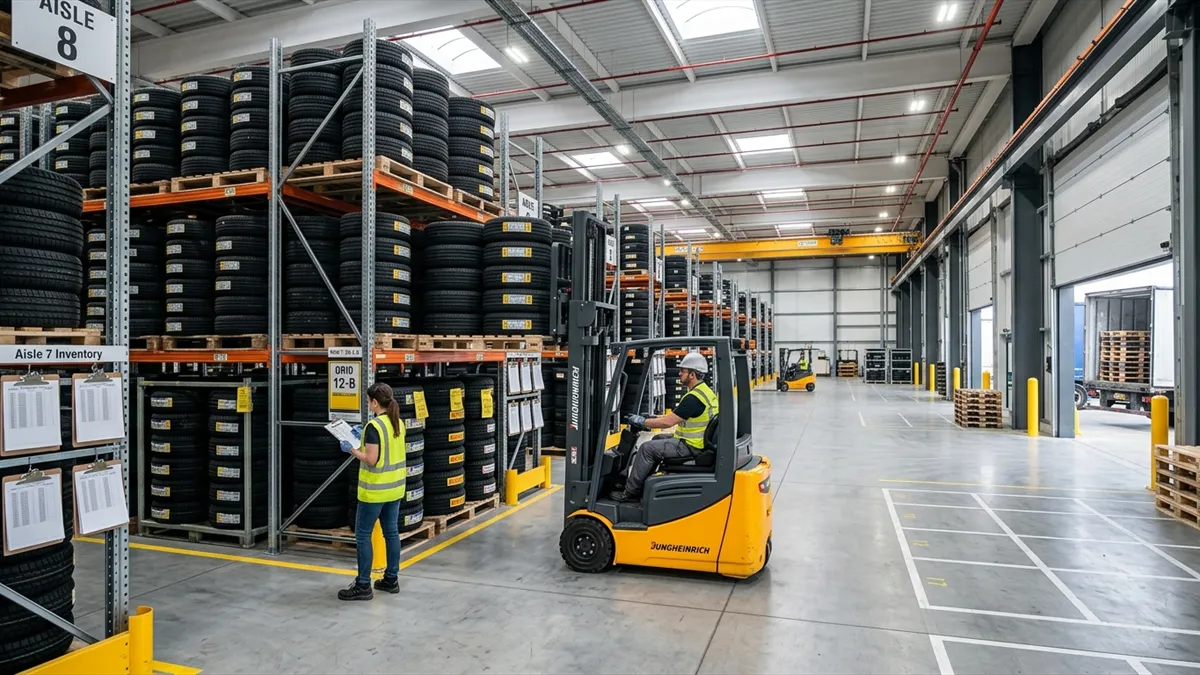
To maximize bay throughput while keeping holding costs lean, successful tire dealers calculate their optimal inventory levels using service bay throughput ratios and Days of Inventory Outstanding (DIO) benchmarks.
Inventory Optimization: Matching workshop bay throughput with high-density vertical tire storage.
The 4 Inventory Sizing Rules
A 2-bay shop needs 150–250 tires; a 4-bay shop needs 400–600 tires of core fast-movers.
Maintain a 30 to 45-day turnover cycle to protect cash flow and eliminate aged DOT stock.
Dedicate 75% of racks to the Top 10 European sizes (205/55R16, 195/65R15, 225/45R17).
Ramp up winter stock 3 weeks before the first autumn freeze to capture 3x fitting volume.
1. Recommended Stock Levels by Workshop Bay Capacity
Standard stock sizing models for independent European auto repair shops:
| Workshop Bay Size | Daily Fitting Volume | Recommended Stock (Tires) | Capital Committed | Replenishment Model |
|---|---|---|---|---|
| Small (1–2 Bays) | 8 – 16 tires / day | 150 – 250 units | €6,000 – €11,000 | Weekly mixed pallets (40 units) |
| Medium (3–4 Bays) | 24 – 40 tires / day | 400 – 650 units | €18,000 – €30,000 | Twice-weekly pallet replenishment |
| Large (5–6 Bays) | 48 – 70 tires / day | 750 – 1,200 units | €35,000 – €55,000 | Full container / truckload drops |
| Tire Center (7+ Bays) | 80 – 150+ tires / day | 1,500 – 3,000 units | €70,000 – €140,000 | Direct container deliveries (FCL) |
2. The Reorder Point & Safety Stock Formula
Avoid guesswork when replenishing fast-moving inventory:
The Reorder Point (ROP) Equation:
Where Safety Stock = (Max Daily Demand × Max Lead Time) − (Avg Daily Demand × Avg Lead Time). When your on-hand stock for a size reaches the ROP, trigger a wholesale pallet order immediately.
Frequently Asked Questions (FAQ)
How many tires should an independent 2-bay repair shop keep in stock?
A 2-bay shop fitting 12–20 tires daily should maintain an on-hand inventory of 150 to 250 tires. This covers 10–14 days of demand for the Top 10 fast-moving sizes (e.g. 205/55R16, 195/65R15) without tying up excessive working capital.
What is the optimal Days of Inventory Outstanding (DIO) for a tire shop?
The industry benchmark for high-performing tire dealers is 30 to 45 Days of Inventory Outstanding (DIO). Maintaining a DIO above 60 days signals overstocking and aging DOT liability, while under 20 days leads to frequent service bay stockouts.
What is the mathematical formula for tire safety stock?
Safety Stock = (Maximum Daily Demand × Maximum Supplier Lead Time) − (Average Daily Demand × Average Lead Time). For example, if max daily sales of 205/55R16 is 8 tires with a 2-day lead time, and average sales is 4 tires with 1-day lead time: Safety Stock = (8 × 2) − (4 × 1) = 12 tires.
How does delivery frequency from suppliers impact shop inventory requirements?
With twice-daily delivery from a distributor like REIFTEIL, a shop only needs to stock high-velocity Class-A tires on racks, relying on just-in-time afternoon deliveries for slow-moving 19-inch+ or specialty fitments.
How much should a dealer increase stock during seasonal winter/summer tire changeover peaks?
During peak seasonal changeover windows (October–November for winter, March–April for summer), fitting volume triples. Dealers should expand on-hand inventory by 50% to 100% 3 weeks prior to the seasonal rush.
What is the financial holding cost of keeping excess tire stock?
Tire inventory carrying costs range between 20% and 25% of stock value annually. A €50,000 idle tire inventory incurs €10,000–€12,500 per year in warehouse rent, insurance, interest on capital, and DOT depreciation.
What percentage of shop inventory should be allocated to fast movers vs slow movers?
Following the 80/20 inventory rule, 75% to 80% of your physical tire racks should be dedicated to the Top 15 best-selling European tire sizes. The remaining 20% should cover niche or popular SUV fitments.
How does REIFTEIL help tire dealers optimize their stock levels?
REIFTEIL offers flexible mixed-pallet drops (40–60 tires) and rapid fulfillment across UK and European distribution hubs, allowing dealers to maintain lean inventory while securing container-tier volume pricing.
Final Verdict: Maintain Velocity, Not Excess Weight
Proper stock sizing creates predictable cash flow and rapid fitting turnaround:
The Golden Summary:
- Keep 75–125 Tires per Bay: Size your stock to maintain a 30–45 day DIO cycle.
- Focus on Top Fast-Movers: Dedicate 80% of floor space to high-turnover European sizes.
- Leverage REIFTEIL Pallet Drops: Replenish with mixed pallets without trapping excessive working capital.
Keep Lean Inventory with REIFTEIL Pallet Drops
Eliminate overstocking and cash flow bottlenecks. Order flexible 40-unit mixed pallets of top European tire sizes delivered directly from REIFTEIL's UK and European distribution hubs.