Buying engine oil in bulk for export is not simply a matter of finding the lowest price per litre. A profitable export purchase has to balance product specifications, supplier reliability, order quantity, packaging, freight, documentation, import requirements and total landed cost.
A supplier offering the lowest factory price may not be the cheapest option once transport, export charges and destination costs are included. Likewise, a large MOQ can look attractive on a price-per-litre basis while tying up working capital in inventory that takes months to sell. The objective is to buy the right product, from the right supplier, in the right quantity, using the right logistics model.
Quick answer: Before buying engine oil in bulk for export, define your destination market, identify the required specifications, determine a realistic order quantity, verify the supplier and product documentation, choose the appropriate packaging, calculate the complete landed cost, agree on the right Incoterm, and confirm destination-country requirements before placing the order.
Quick Checklist for Bulk Engine Oil Export
Verify these 16 essential milestones before confirming any international bulk lubricant purchase order:
Table of Contents
- 1 Define Market & Technical RFQ Specifications
- 2 Branded, Private-Label & Bulk Oil
- 3 Supplier Vetting & Product Verification
- 4 Order Sizing, MOQ & Volume Pricing Risks
- 5 Calculate Total Landed Cost (EXW vs FOB)
- 6 Packaging Options & Flexitank Feasibility
- 7 Documentation, Import Rules & Inspection
- 8 10 Common Bulk Export Mistakes to Avoid
- 9 Supplier Comparison Purchasing Model
- FAQ Frequently Asked Questions
Define Market & Technical RFQ Specifications
The first question shouldn't be "Which engine oil is cheapest?", but "Which engine oil can I actually sell in my destination market?". Avoid sending suppliers a vague RFQ asking for "5W-30 engine oil". Specify:
| Specification Parameter | Professional RFQ Example | Commercial Importance |
|---|---|---|
| SAE Viscosity | 5W-30 | Defines flow grade & temperature window |
| Performance Standard | API SP / ACEA C3-16 | Defines additive chemistry & emissions safety |
| OEM Requirement | MB-Approval 229.51 / VW 504.00/507.00 | Required for vehicle warranty compliance |
| Application & Fuel | Passenger Car Light-Duty Diesel & Petrol | Prevents misapplication across vehicle types |
| Packaging Format | 208L Steel Drums / 1,000L IBC Totes | Matches destination handling equipment |
| Destination & Quantity | 16,640 Litres (1 x 20ft FCL) to Port of Hamburg | Enables exact freight & customs calculation |
Never confuse viscosity with performance specification. Learn more in our guide to API vs ACEA engine-oil specifications.
Choose Between Branded, Private-Label and Bulk Oil
Export buyers generally have three broad purchasing models:
Finished Branded Engine Oil
Existing brand recognition & ready packaging. Higher unit cost, potential territory restrictions & brand authorizations needed.
Private-Label Engine Oil
Manufacturer produces under your brand name. Control over positioning & higher margin, but higher MOQs & artwork setup.
Bulk Engine Oil
Purchased in Drums (208L), IBCs (1,000L), or Flexitanks (24,000L). Best for commercial distributors & blenders.
Read how packaging choices affect costs in bulk engine oil for fleets: drums vs IBC totes.
Supplier Vetting & Product Verification
A low-priced supplier providing inconsistent quality or unreliable documentation will become much more expensive than a reliable supplier. Evaluate candidates across four core areas:
| Audit Category | Key Verification Criteria | Required Documentation |
|---|---|---|
| Company Audit | Legal registration, ISO 9001 blending plant, production capacity, export track record | Business License & ISO Certs |
| Product Quality | Viscosity parameters, flash point, TBN, wear metals, API/ACEA compliance | TDS, SDS, COA, OEM Approvals |
| Commercial Terms | MOQ thresholds, unit pricing tiers, payment terms, lead times, packaging formats | Proforma Invoice / Sales Agreement |
| Logistics & Port | Factory loading location, preferred port, export customs clearance capability | Bill of Lading, Certificate of Origin |
See our detailed quality inspection guide: how to check engine oil before buying in bulk.
Order Sizing, MOQ & Volume Pricing Risks
Don't let a supplier's MOQ or volume discounts determine your order size. Calculate demand first:
Net Purchasing Requirement Worked Example
Expected Demand = 5,000 L/month | Target Inventory = 3 Months (15,000 L)
Stock on Hand = 2,000 L | Confirmed Incoming Transit = 3,000 L
15,000 − 2,000 − 3,000 = 10,000 Litres Order
Requirement
| Volume Tier | Unit Price / Litre | Months of Stock (at 5,000L/mo sales) | Working Capital Risk |
|---|---|---|---|
| 5,000 Litres | €2.70 / L | 1.0 Month | Low Capital Exposure / Fast Turnover |
| 10,000 Litres | €2.60 / L | 2.0 Months | Optimal Commercial Balance |
| 25,000 Litres | €2.45 / L | 5.0 Months | High Inventory Exposure & Tied Cash |
Calculate Total Landed Cost (EXW vs FOB)
Never compare engine-oil suppliers using headline product price alone. Model full landed costs:
Landed Cost Formula
| Cost Element | Supplier A (EXW €2.40/L) | Supplier B (FOB €2.55/L) |
|---|---|---|
| Base Factory Quote | €2.40 / L | €2.55 / L |
| Inland Factory Transport | + €0.12 / L (Buyer pays) | Included in FOB |
| Export Customs & Terminal Handling | + €0.08 / L (Buyer pays) | Included in FOB |
| Effective Subtotal to Vessel | €2.60 / L | €2.55 / L |
| Commercial Result | EXW Quote is €0.05/L More Expensive Overall | FOB Quote is Cheaper & Simpler |
Understand trade rules in FOB vs CIF vs DDP vs EXW when buying engine oil.
Packaging Options & Flexitank Feasibility
Match your packaging format with customer receiving equipment:
Steel Drums (208L)
80 drums per 20ft container (16,640L). Ideal for workshops and distributors without bulk pumps.
IBC Totes (1,000L)
18–20 IBCs per 20ft container (18,000–20,000L). Faster handling than drums for medium commercial buyers.
Flexitanks (24,000L)
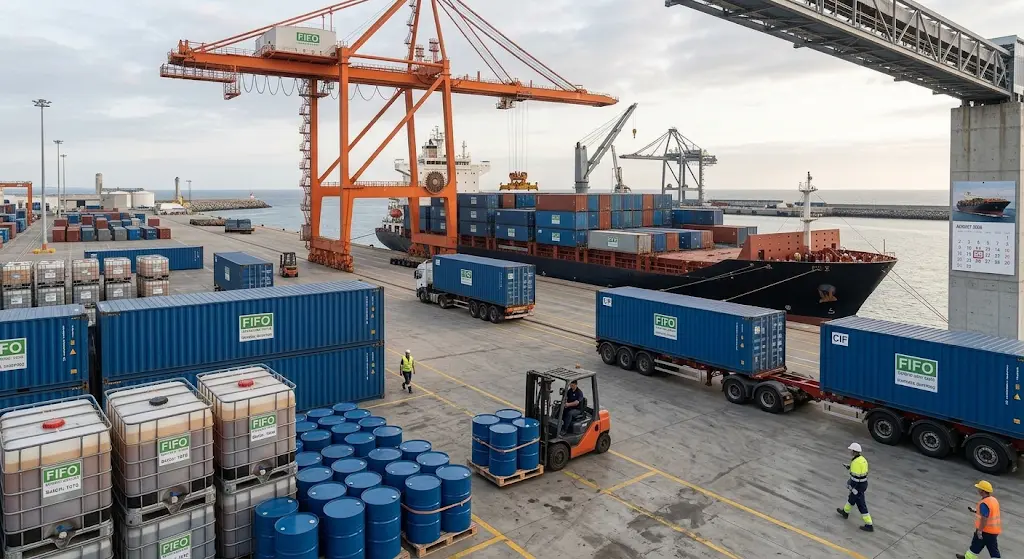
Single-use liquid bladder in 20ft container. Maximizes payload (+40% vs drums) where destination discharge pumps exist.
Documentation, Import Rules & Pre-Shipment Inspection
Establish documentation, labeling compliance, and risk protections before issuing payment:
Export Compliance & Risk Protection Steps
Read our full import documentation guide: what documents are needed to import engine oil.
10 Common Bulk Export Mistakes to Avoid
Avoid these 10 common pitfalls during bulk export procurement:
Supplier Comparison Purchasing Model
Use this multi-supplier evaluation template when reviewing export quotations:
| Evaluation Factor | Supplier A | Supplier B | Supplier C |
|---|---|---|---|
| Product Price / Litre | €2.40 / L (EXW) | €2.55 / L (FOB) | €2.80 / L (CIF) |
| Minimum Order Quantity | 25,000 L | 10,000 L | 5,000 L |
| Packaging Format | 208L Drums | 1,000L IBC Totes | Flexitank (24,000L) |
| Inland & Export Charges | + €0.20 / L | Included | Included |
| Ocean Freight & Insurance | + €0.25 / L | + €0.25 / L | Included |
| Destination Duties & Taxes | + €0.30 / L | + €0.30 / L | + €0.30 / L |
| Estimated Total Landed Cost | €3.15 / L | €3.10 / L | €3.10 / L |
| Documentation Provided | TDS, SDS | TDS, SDS, COA, OEM Certs | TDS, SDS, COA |
| Commercial Decision | Reject (High MOQ & Landed Cost) | Recommended Winner | Secondary Option |
Calculate total import expenses using our guide to how to calculate the landed cost of wholesale engine oil.
Exporting Engine Oil in Bulk?
REIFTEIL supplies premium European engine oils in drums, IBC totes, and flexitanks with complete TDS, SDS, COA, and export documentation.
REIFTEIL Bulk Export Capabilities:
Explore our complete B2B guide to buying engine oil wholesale.
Frequently Asked Questions
How do I buy engine oil in bulk for export?
Define the destination market and required specifications first. Then identify and vet suppliers, determine the appropriate quantity, compare MOQ and landed cost, select packaging and shipping arrangements, confirm documentation and import requirements, and only then finalize the purchase.
How much engine oil should I buy for export?
Base the quantity on realistic demand, current inventory, customer commitments, supplier lead time and safety stock. Don't increase the order simply because a supplier offers a lower price at a higher volume.
What is the best packaging for exporting engine oil?
There is no universal best option. Drums and IBCs can be practical for distributors and commercial customers, while flexitanks may be suitable for larger bulk shipments when the product and destination infrastructure support them.
Is bulk engine oil cheaper than packaged oil?
It can be at sufficiently large volumes, but the complete economics depend on packaging, freight, handling, storage and receiving infrastructure. Always compare total landed cost.
What documents should I request from an engine-oil supplier?
Depending on the transaction, request the Technical Data Sheet, Safety Data Sheet, Certificate of Analysis and documentation supporting relevant specifications or approvals. Export and import documents depend on the origin and destination.
Should I buy branded or private-label engine oil?
Branded products can provide immediate market recognition, while private label provides greater control over branding and positioning. The right choice depends on your market, expected volume, customer base and long-term strategy.
Is a flexitank suitable for engine oil?
It can be suitable for certain high-volume shipments, but compatibility and logistics must be confirmed with the supplier, flexitank provider, carrier and receiving facility.
How do I compare EXW and FOB engine-oil prices?
Don't compare the headline prices directly. Calculate the additional costs associated with each option and compare the resulting landed cost.
How do I verify an engine-oil supplier?
Review the company's business information, manufacturing capabilities, export experience, product documentation, commercial terms and references. For larger purchases, consider a trial order and independent product testing.
Should I place a large order with a new supplier?
Not necessarily. A smaller initial order can help you evaluate product quality, documentation, logistics and supplier reliability before committing to larger volumes.