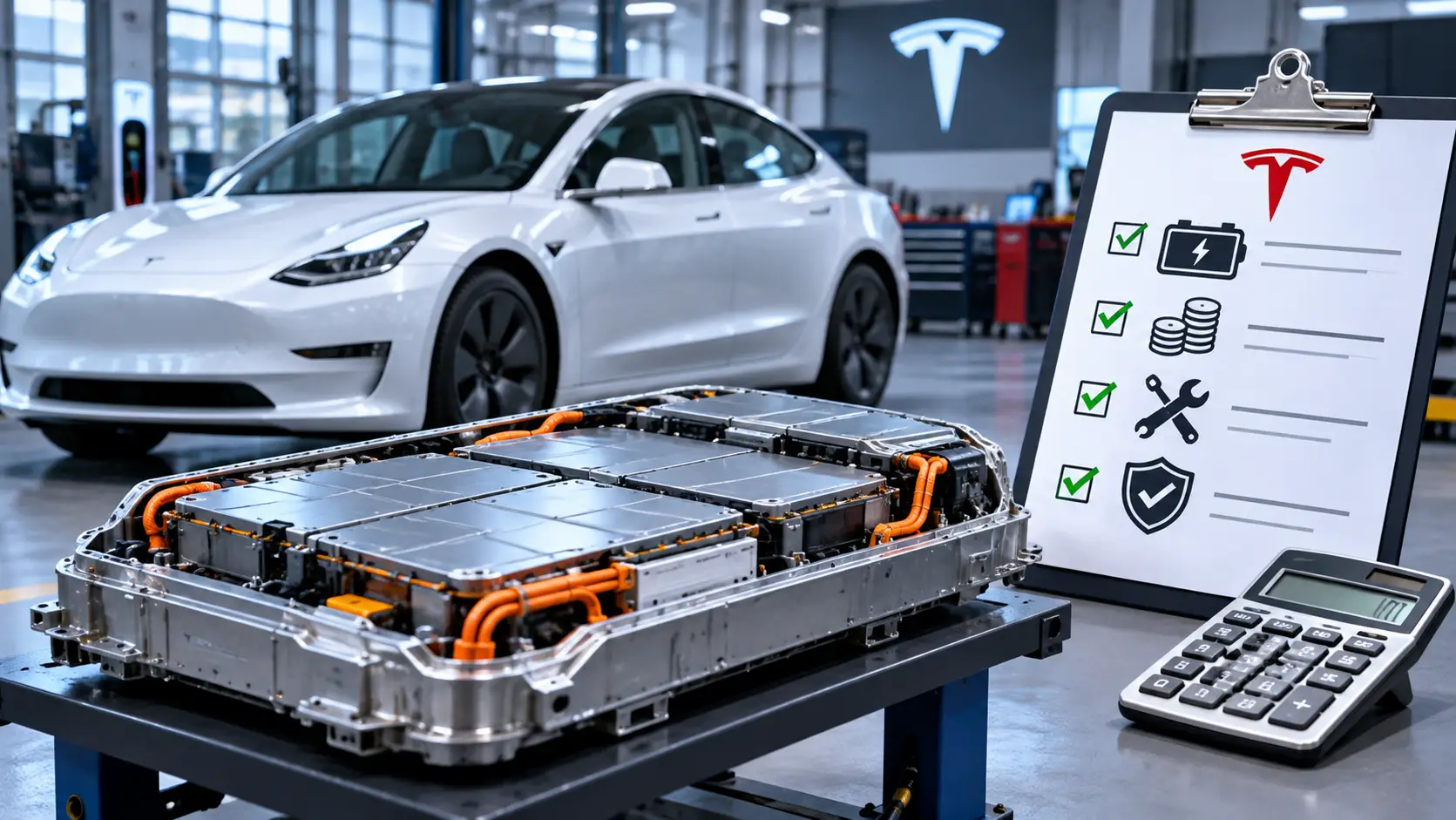
Replacing a Tesla battery can be one of the most expensive repairs an electric vehicle owner may face. However, the actual cost depends on the vehicle model, battery configuration, model year, warranty coverage and whether the repair requires a complete battery pack replacement.
For owners researching Tesla battery replacement costs in the United States, estimates commonly discussed in the automotive repair market range from approximately $10,000 to over $20,000 for a complete out-of-warranty replacement. These are broad budgeting estimates, not fixed prices published by Tesla. A specific repair quote may be considerably different.
It is also important to understand that reduced driving range does not automatically mean a battery needs replacing. Lithium-ion batteries gradually lose capacity with age and use, and many vehicles remain perfectly usable despite some degradation.
This guide explains what influences Tesla battery replacement costs, how warranty coverage works, when battery repairs may be possible and what owners should consider before paying for a replacement.
What Determines Tesla Battery Replacement Costs?
A Tesla's high-voltage battery pack is a complex assembly containing thousands of individual battery cells, electrical connections, cooling components, sensors and battery management systems. The cost of replacing it depends on more than the price of the cells themselves.
Several factors influence the final repair bill.
Vehicle Model and Battery Configuration
Tesla has used different battery designs and configurations across its vehicle range. Battery capacity, chemistry, pack construction and component availability vary according to model, production year and trim.
For example, a Model 3 Standard Range may use a different battery configuration from a Model 3 Long Range. Model S and Model X vehicles have also undergone several battery and drivetrain revisions since their introduction.
Larger or more complex battery packs can cost more to replace, although capacity alone does not determine the final price.
Before requesting a quotation, owners should establish:
-
The exact vehicle model and production year.
-
The battery configuration and capacity.
-
Whether the vehicle uses an LFP or nickel-based battery chemistry.
-
The part number and compatibility of the replacement pack.
-
Whether a new, remanufactured or refurbished battery is being offered.
New, Remanufactured and Refurbished Battery Packs
The type of replacement battery can significantly influence the cost.
New battery pack: A new pack may be the most expensive option. It provides a replacement assembly manufactured to the relevant specification, subject to the supplier's warranty and terms.
Remanufactured battery pack: A remanufactured pack has been restored using inspected and serviceable components. It may offer a lower-cost alternative to a new assembly, depending on availability and the work performed.
Refurbished or used battery pack: Some independent specialists offer previously used packs or components recovered from other vehicles. These options can reduce the initial purchase price, but their remaining capacity, condition and history need careful evaluation.
The cheapest option is not necessarily the best value. Buyers should check the battery's documented condition, compatibility, installation requirements and warranty before agreeing to a repair.
Labour and Installation Costs
Replacing a high-voltage battery is a specialist repair. The vehicle must be properly isolated, the battery disconnected and the replacement assembly installed and tested using suitable equipment.
Labour costs depend on the workshop, vehicle configuration, diagnostic requirements and complexity of the work.
A quotation should clarify whether it includes:
-
Initial diagnostic work.
-
Battery pack removal and installation.
-
Replacement seals, fasteners and related components.
-
Software configuration or commissioning where required.
-
Cooling-system checks.
-
Disposal or handling of the old battery.
-
Taxes and any additional workshop charges.
A parts-only price should not be confused with the total installed replacement cost.
How Much Does Tesla Battery Replacement Cost?
There is no single replacement price that applies to every Tesla. Tesla does not publish a universal retail price list for complete replacement battery packs across all models.
Third-party estimates provide a useful starting point, but they should be treated as indicative figures rather than confirmed service-centre quotations.
For preliminary budgeting in the United States, owners may encounter estimates in the following broad ranges:
| Repair or replacement option | Indicative cost |
|---|---|
| Complete battery pack replacement | Approximately $10,000–$22,000+ |
| Remanufactured or refurbished pack | Varies considerably by model and supplier |
| Module-level repair | Depends on the fault and pack design |
| Warranty-covered battery repair | Potentially $0 to the owner |
These figures are broad market estimates, not guaranteed prices or official Tesla quotations. The lower end may not be available for every model, and a specialist repair may not be technically suitable for every battery fault.
For context, Recurrent's published research has discussed out-of-warranty Tesla replacement costs of approximately $15,000–$22,000, with different cost components depending on the vehicle. A documented historical Model 3 replacement invoice also illustrates why it is important to distinguish the battery part price from labour and the total installed cost.
Why Model-Specific Quotes Matter
A Model 3 and a Model S should not automatically be assigned the same replacement budget. Their battery assemblies, production generations and repair requirements can differ.
The same applies to the Model Y and Model X.
Rather than relying on a single online estimate, owners should request a quotation using their vehicle identification number (VIN). This helps the service provider identify the correct battery configuration and compatible replacement components.
A useful quotation should state whether the price covers a complete new pack, a remanufactured assembly or a different repair solution.
Does a Tesla Battery Always Need Complete Replacement?
No. A fault involving the high-voltage battery system does not necessarily mean the entire battery pack must be replaced.
The battery management system monitors several operating parameters, including cell voltages, temperatures and other electrical conditions. Diagnostic testing can help identify whether a problem is caused by an individual component, a group of cells or a more extensive pack failure.
Depending on the battery design and the nature of the fault, a specialist may be able to repair or replace individual components rather than installing a complete assembly.
Module-Level Battery Repairs
Some battery packs contain modules that can be inspected and serviced separately. If a fault is isolated to a repairable section, a qualified specialist may be able to replace or repair the affected component.
However, this approach is not suitable for every Tesla battery.
The design of the pack, the extent of damage, cell compatibility and the condition of the remaining components all influence whether module-level repair is practical.
When Complete Replacement May Be Necessary
A complete battery pack replacement may be required when:
-
The battery has extensive internal damage.
-
Multiple modules or components have failed.
-
The pack has suffered serious physical damage.
-
Water intrusion has compromised critical components.
-
The battery cannot be safely or economically repaired.
-
The manufacturer or specialist determines that replacement is the appropriate solution.
A proper diagnosis should come before any decision to purchase a replacement pack.
Tesla Battery Warranty: What Is Covered?
Warranty coverage is one of the first things owners should investigate before paying for a battery repair.
Tesla provides a separate Battery and Drive Unit Limited Warranty. In the United States, coverage periods and mileage limits vary according to the vehicle model and configuration.
The following are examples of the published coverage terms for common vehicle configurations:
| Tesla model or configuration | Battery and drive unit warranty |
|---|---|
| Model 3 Standard Range / Standard Range Plus | 8 years or 100,000 miles |
| Model 3 Long Range / Performance | 8 years or 120,000 miles |
| Model Y Standard Range configurations | 8 years or 100,000 miles |
| Model Y Long Range / Performance | 8 years or 120,000 miles |
| Model S and Model X | Generally 8 years or 150,000 miles |
The applicable warranty document for the vehicle's model year, configuration and warranty region should always be checked. These figures should not be assumed to cover every historical or current vehicle configuration.
The 70% Battery Capacity Retention Guarantee
For the configurations covered by the relevant US warranty terms, Tesla provides a minimum battery capacity retention guarantee of 70% over the specified warranty period.
This means that if the battery's measured capacity falls below the applicable threshold during the warranty period, the owner may qualify for a warranty remedy, subject to the warranty conditions.
However, the vehicle's displayed range is not a direct measurement of battery capacity. Range estimates are influenced by factors such as temperature, driving conditions, speed and energy consumption.
Tesla determines battery capacity using its own assessment methods.
What Is Not Necessarily Covered?
Normal battery degradation is expected with lithium-ion technology. Gradual loss of capacity over time and use is not automatically treated as a warranty defect.
Coverage may also be affected by exclusions and conditions in the warranty documentation, including certain types of physical damage, improper use or unauthorised modifications.
Owners should review the warranty terms rather than assume that every battery-related warning qualifies for a free replacement.
If a battery problem occurs while the vehicle is still within its warranty period, contact Tesla before authorising an independent repair.
How Long Do Tesla Batteries Last?
Battery lifespan is one of the most important considerations for people buying or operating an electric vehicle.
Tesla batteries are designed for long-term use, but their capacity gradually declines as the vehicle accumulates mileage and ages.
The rate of degradation varies according to battery chemistry, charging habits, operating temperatures, usage patterns and other conditions.
Tesla's 2022 Impact Report stated that its Model S and Model X batteries had lost approximately 12% of their original capacity on average after 200,000 miles. This was manufacturer-reported data, not a guarantee for every vehicle.
Separate data published by Tesla for Model 3 and Model Y Long Range vehicles also showed an average capacity loss of approximately 15% after 200,000 miles.
These figures illustrate why battery replacement should not be assumed to be a routine maintenance requirement at a particular mileage.
Factors That Influence Battery Degradation
Several operating conditions can affect battery ageing.
Charging habits: Different battery chemistries have different charging recommendations. Owners should follow the charging guidance provided for their particular vehicle rather than applying one rule to every Tesla.
Temperature: High temperatures can accelerate certain battery ageing processes. Very cold conditions can temporarily reduce available range and charging performance without necessarily indicating permanent battery damage.
Driving and usage patterns: Frequent high-power charging, repeated high-load operation and intensive vehicle use can influence battery ageing, although their effects depend on the battery design and operating conditions.
Battery chemistry: LFP and nickel-based battery packs have different characteristics and charging recommendations. Their degradation behaviour should not be treated as identical.
Battery Degradation Is Not the Same as Battery Failure
A Tesla that no longer achieves its original driving range does not necessarily need a new battery.
For example, a vehicle that originally delivered 300 miles of usable range may deliver less after several years of use. This reduction can be part of normal battery ageing.
A genuine battery fault is a different issue. It may involve abnormal cell behaviour, electrical problems, isolation faults or other conditions that require professional diagnosis.
Understanding this distinction can prevent owners from spending thousands of dollars on an unnecessary replacement.
Tesla Battery Replacement: Official Service Centre vs Independent Specialist
Owners generally have two broad routes when a battery repair is required: using Tesla's authorised service network or approaching an independent electric vehicle battery specialist.
Each option has advantages and considerations.
Tesla Authorised Service Centres
Tesla service centres can assess the vehicle using manufacturer service procedures and determine the appropriate repair route.
Potential advantages include:
-
Access to Tesla-specific diagnostic procedures.
-
Access to compatible replacement components.
-
Manufacturer repair processes.
-
Support with software-related service requirements.
-
Clearer handling of repairs covered by the vehicle warranty.
The actual repair method and replacement component depend on Tesla's assessment and the applicable service arrangements.
Independent EV Battery Specialists
Independent workshops may offer battery diagnostics, component-level repairs, remanufactured packs or other alternatives.
Potential advantages include:
-
Additional repair options.
-
Possible savings on certain out-of-warranty repairs.
-
Specialist experience with battery pack refurbishment.
-
Alternatives where a complete replacement is not necessary.
However, not every independent workshop has the equipment, qualifications or experience required to work safely on every Tesla battery configuration.
Before selecting a provider, ask about its high-voltage qualifications, repair experience, battery sourcing, warranty terms and testing procedures.
Do not choose a workshop solely because it offers the lowest price.
Is Replacing a Tesla Battery Worth the Cost?
Whether battery replacement makes financial sense depends on the condition and value of the vehicle.
A replacement pack may extend the useful life of a Tesla considerably, but the repair cost should be compared with the vehicle's market value and the price of alternative transport.
Consider the following factors before making a decision.
Compare the Repair Cost with Vehicle Value
Start by determining the current market value of the Tesla in its existing condition.
Then compare that figure with the cost of the proposed battery repair.
If the replacement cost represents a large proportion of the vehicle's value, selling the car or considering another vehicle may be financially more sensible.
However, a replacement can still be worthwhile when the vehicle is otherwise in good condition and the owner intends to keep it for several more years.
Consider the Battery's Remaining Condition
If a replacement is being proposed, ask whether the current battery has been tested and whether the fault can be repaired.
A detailed diagnostic report is more useful than relying on a dashboard warning or a general statement that the battery is failing.
Evaluate the Replacement Battery Warranty
The warranty offered with a replacement battery is an important part of its overall value.
Check:
-
Warranty duration.
-
Mileage limitations.
-
Minimum capacity or performance commitments.
-
Whether labour is included.
-
Whether the warranty transfers to a subsequent owner.
-
Conditions that could invalidate coverage.
A lower-priced battery with limited warranty protection may create additional financial risk.
Calculate the Total Cost of Ownership
Battery replacement should be evaluated alongside the vehicle's other operating costs.
These may include tyres, suspension components, brakes, insurance, charging expenses, routine servicing and depreciation.
For commercial fleet operators, the calculation should also account for vehicle downtime and the cost of maintaining replacement transport.
How to Reduce the Risk of Expensive Battery Repairs
Although battery ageing cannot be eliminated, sensible operating practices can help owners manage battery condition.
-
Follow Tesla's charging recommendations. Charging limits should reflect the battery chemistry and the vehicle's intended use.
-
Avoid unnecessary exposure to extreme heat. Where practical, use suitable parking and charging conditions.
-
Monitor unusual battery warnings. Have persistent warnings or unexpected performance changes investigated.
-
Keep vehicle software updated. Software updates may include improvements to battery management and vehicle operation.
-
Check warranty coverage before repairs. An eligible warranty claim could prevent a substantial out-of-pocket expense.
-
Use qualified service providers. High-voltage battery work requires appropriate training, equipment and procedures.
-
Keep service records. Documented diagnostics and repair history can help when selling the vehicle or assessing future repair requirements.
These practices do not guarantee that a battery will never fail, but they can help owners make better-informed maintenance decisions.
Frequently Asked Questions
How much does it cost to replace a Tesla battery?
A complete out-of-warranty replacement can cost approximately $10,000 to over $20,000 in the US market, depending on the vehicle and replacement battery. These are broad third-party budgeting estimates, not official Tesla prices. Obtain a vehicle-specific quotation before making financial decisions.
How long does a Tesla battery last?
Tesla batteries are designed for long-term use, and manufacturer-reported data shows that some vehicle batteries retain a substantial proportion of their original capacity after 200,000 miles. Actual lifespan depends on the vehicle, battery chemistry, age and operating conditions.
Does Tesla replace batteries for free?
A battery repair or replacement may be covered if the vehicle meets the applicable Battery and Drive Unit Limited Warranty conditions. Coverage depends on the vehicle configuration, age, mileage, nature of the fault and warranty exclusions.
Can a Tesla battery be repaired instead of replaced?
In some cases, yes. Depending on the battery design and the fault, a qualified specialist may be able to repair individual components or replace affected modules. Extensive damage or certain pack failures may require complete replacement.
Does battery degradation mean a Tesla needs a new battery?
No. Gradual capacity loss is a normal characteristic of lithium-ion batteries. A reduction in driving range does not automatically indicate battery failure. A proper diagnostic assessment is necessary to determine whether a repair is needed.
Is an independent Tesla battery repair cheaper?
An independent specialist may offer a less expensive repair or remanufactured battery option. However, prices and repair capabilities vary. Owners should compare the complete installed cost, warranty protection and quality of the replacement components.
Does Tesla's battery warranty transfer to a new owner?
Battery and drive unit warranty coverage generally follows the vehicle, subject to Tesla's applicable warranty terms and conditions. Buyers of used Teslas should verify the remaining coverage using the vehicle's details.
Conclusion: Understand the Repair Before Replacing the Battery
Tesla battery replacement can be expensive, but the highest quoted price is not necessarily the repair a vehicle needs.
Battery configuration, vehicle age, warranty coverage and the nature of the fault all influence the final cost. In some cases, a complete battery pack replacement is necessary. In others, a specialist repair may provide a more economical solution.
Owners should begin with a proper diagnosis, check the remaining warranty and compare quotations from qualified service providers before committing to a replacement.
For anyone considering a used Tesla, understanding battery condition and warranty coverage is just as important as checking mileage and general vehicle condition. A well-maintained electric vehicle may retain useful battery capacity for many years without requiring a complete replacement.