A supplier may offer the same lubricant under EXW, FOB, CIF or DDP, but the amount you ultimately pay—and who is responsible for transport, customs, insurance and risk—can be very different. These shipping terms are part of the Incoterms® 2020 rules published by the International Chamber of Commerce (ICC).
For engine-oil wholesalers and importers, understanding these terms is especially important because lubricant shipments can involve pallets, drums, IBCs, containers or other bulk transport arrangements. This guide explains the differences between EXW, FOB, CIF and DDP, what each means for an engine-oil buyer, and how to compare supplier quotations properly.
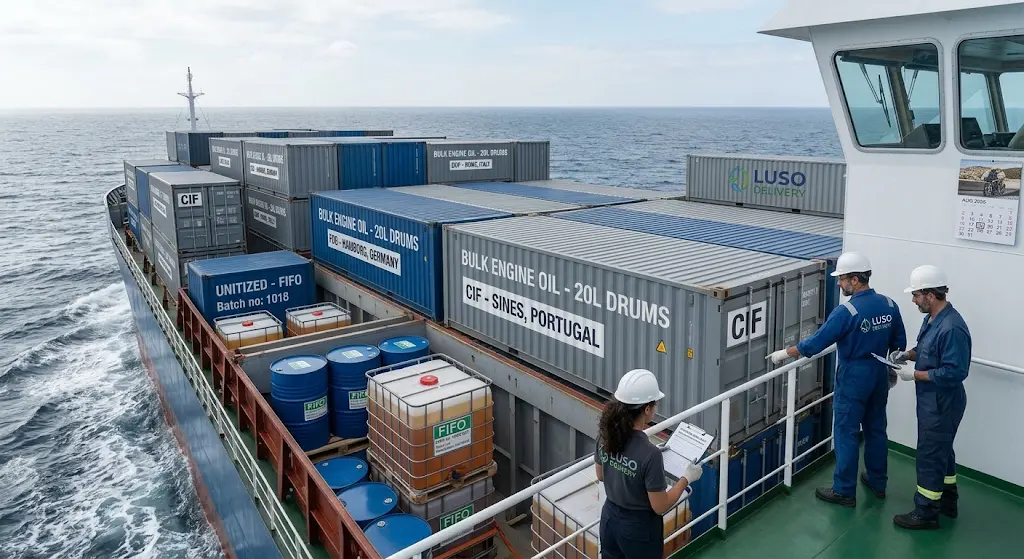
Quick answer: EXW places the greatest transport and customs responsibility on the buyer. FOB transfers risk when the goods are loaded on board the vessel at the named port of shipment. CIF requires the seller to arrange and pay for ocean freight and insurance to the named destination port, while risk still transfers at the origin when the goods are loaded on board. DDP places the greatest responsibility on the seller, including import clearance and duties, with delivery and risk transfer at the named destination.
Quick Summary: Key Incoterms Breakdown
Incoterms dictate delivery points, risk transfer, ocean freight responsibility, export/import clearance, and insurance obligations. Never compare unit prices without factoring in the full landed cost.
EXW
Buyer Max Risk
FOB
Standard Sea
CIF
Seller Freight
DDP
Door Delivery
Container
Consider FCA
Comparison
Landed Cost
Selecting the appropriate Incoterm requires balancing freight rates, logistics capabilities, risk tolerance, and international customs expertise.
Table of Contents
- 1 What Are Incoterms?
- 2 EXW vs FOB vs CIF vs DDP at a Glance
- 3 EXW: Ex Works
- 4 FOB: Free On Board
- 5 CIF: Cost, Insurance and Freight
- 6 DDP: Delivered Duty Paid
- 7 FOB vs CIF: What's the Difference?
- 8 EXW vs FOB: What's the Difference?
- 9 CIF vs DDP: What's the Difference?
- 10 Which Incoterm Is Best for Engine Oil?
- 11 Don't Compare Prices Without Incoterms
- 12 How to Calculate Your Landed Cost
- 13 Example: Comparing Four Engine Oil Quotes
- 14 Engine Oil Shipping Documents to Confirm
- 15 Don't Forget Product Compliance
- 16 Common Mistakes When Choosing Incoterms
- 17 A Practical Decision Guide
- 18 What's the Landed Cost? Essential Questions
- 19 Final Pre-Order Checklist
- 20 Final Executive Summary
- FAQ Frequently Asked Questions
What Are Incoterms?
Incoterms® are standardized international trade rules published by the International Chamber of Commerce (ICC) that help buyers and sellers define their precise responsibilities in a sales contract.
What Incoterms Cover
- Where physical delivery takes place
- When risk transfers from seller to buyer
- Who arranges international transport
- Who handles export clearance formalities
- Who handles import clearance formalities
- Which party pays specific transport & port costs
- Whether seller has cargo insurance obligations
What Incoterms Do NOT Cover
Incoterms do not by themselves determine every part of a commercial transaction. Separate contractual terms must specify:
- Base unit price per litre
- Commercial payment terms (e.g. LC, TT)
- Product technical specifications & OEM approvals
- Ownership & title transfer timing
- Warranty terms & dispute remedies
EXW vs FOB vs CIF vs DDP at a Glance
Compare the four primary shipping terms used in international lubricant trading:
| Incoterm | Main Transport | Export Clearance | Import Clearance | Seller Responsibility | Risk Transfer Point |
|---|---|---|---|---|---|
| EXW | Buyer Arranges | Buyer | Buyer | Lowest | At named place when goods made available |
| FOB | Buyer Arranges Sea Freight | Seller | Buyer | Medium | When goods are loaded on board vessel |
| CIF | Seller Arranges Sea Freight | Seller | Buyer | Higher | When goods are loaded on board vessel |
| DDP | Seller Arranges | Seller | Seller | Highest | At named destination ready for unloading |
Note: The exact contractual obligations always depend on the specific Incoterm selected and the named place or port specified in the purchase agreement.
EXW: Ex Works
EXW means Ex Works. Under EXW, the seller makes the goods available at their named place, such as a factory or warehouse. The seller's responsibility is relatively limited; the buyer takes full responsibility for arranging movement from that point onward.
How EXW Works for Engine Oil
Suppose a lubricant supplier offers €1.20/L EXW. The oil is available at the supplier's warehouse. You must arrange and pay for:
Under Incoterms® 2020, EXW delivery occurs when the seller places the goods at the buyer's disposal at the named place; the seller does not have to load the goods onto the collecting vehicle or clear them for export.
ICC Recommendation on EXW
The ICC notes that EXW is primarily suited to domestic trade. Export transactions can create major practical difficulties because foreign buyers often struggle to complete export formalities in the seller's country. For international engine-oil purchases, consider discussing FCA (Free Carrier) with your supplier instead.
FOB: Free On Board
FOB means Free On Board. It is specifically a sea and inland-waterway Incoterm. Under FOB, the seller delivers the goods on board the vessel nominated by the buyer at the named port of shipment. Risk transfers when the goods are on board the vessel.
How FOB Works for Engine Oil
Suppose your supplier quotes €1.35/L FOB Shanghai.
Inland transport, export customs clearance, and physical loading onto the vessel.
Ocean freight, cargo insurance, import clearance, duties/taxes, destination port charges, and inland delivery.
Important Container Limitation for FOB
FOB is intended for sea or inland-waterway transport where delivery occurs directly on board the vessel. ICC specifically notes that FOB is not appropriate where goods are handed to a carrier at a container terminal before being loaded onto the ship. In containerized engine-oil shipments, FCA (Free Carrier) is often more appropriate.
CIF: Cost, Insurance and Freight
Under CIF, the seller arranges and pays for carriage to the named destination port and provides the insurance required under the CIF rule. However, risk does not remain with the seller until the shipment reaches the destination port.
Critical CIF Misunderstanding: Risk Transfer
A supplier might quote €1.48/L CIF Hamburg. Under CIF, risk transfers when the goods are loaded on board the vessel at the origin port—exactly as with FOB.
Export clearance, origin carriage, loading on board, ocean freight, and basic required insurance.
Import clearance, import duties/taxes, un-included destination port charges, and final inland transport.
CIF Insurance: Don't Assume Comprehensive Coverage
Under Incoterms® 2020, the seller's insurance obligation under CIF is limited to the required minimum level of cover (Clause C) unless agreed otherwise. For high-value engine-oil shipments, examine insurance coverage, insured values, exclusions, deductibles, and claims procedures before assuming your cargo is fully protected.
DDP: Delivered Duty Paid
DDP places the maximum level of responsibility on the seller. The seller is responsible for bringing the goods to the agreed destination, including handling export and import formalities and paying applicable import duties and taxes. Delivery occurs when goods are placed at the buyer's disposal on the arriving vehicle, cleared for import and ready for unloading.
How DDP Works for Engine Oil
Suppose a supplier quotes €1.75/L DDP Munich Warehouse. The supplier arranges origin transport, export clearance, ocean freight, import clearance, import duties/taxes, and inland delivery.
Buyer Responsibility Note: Under Incoterms® 2020, the buyer remains responsible for taking delivery, and unloading from the arriving vehicle can remain the buyer's responsibility depending on the transport contract.
The Biggest Problem With DDP
DDP can be complicated for foreign sellers because they must handle import formalities, customs registrations, importer-of-record status, VAT, and local chemical/environmental compliance in the buyer's country. If local import compliance is impractical for the seller, consider DAP (Delivered at Place) instead.
FOB vs CIF: What's the Difference?
The primary difference between FOB and CIF lies in who arranges and pays for the main carriage and insurance:
FOB
Buyer arranges main ocean freight. Risk transfers when goods are loaded on board at origin port.
CIF
Seller arranges & pays main ocean freight and required insurance. Risk still transfers at origin when goods are loaded on board.
Simple Comparison Example: If Supplier A offers €1.30/L FOB and Supplier B offers €1.48/L CIF, do not automatically conclude Supplier A is cheaper. Calculate FOB price + freight + insurance + destination costs before comparing with the CIF quote. Learn how in our guide on how to calculate the landed cost of wholesale engine oil.
EXW vs FOB: What's the Difference?
The main difference between EXW and FOB is where the seller's responsibility ends:
EXW Responsibility Point
Seller makes goods available at their factory/warehouse floor. Buyer handles everything from collection onward.
FOB Responsibility Point
Seller handles inland transport, export customs, and loading on board the vessel. Buyer takes over main carriage.
For an inexperienced international buyer, EXW involves substantially more operational work and risk in a foreign jurisdiction.
CIF vs DDP: What's the Difference?
CIF and DDP represent drastically different allocation of responsibilities and risks:
CIF Overview
- Seller: Ocean freight & required insurance to destination port.
- Buyer: Import clearance, duties/taxes & final delivery.
- Risk Transfer: At origin when loaded on board vessel.
DDP Overview
- Seller: Transport, export clearance, import clearance, duties/taxes & door delivery.
- Buyer: Taking delivery & unloading.
- Risk Transfer: At named destination upon delivery.
Which Incoterm Is Best for Buying Engine Oil?
There is no single "best" Incoterm for every buyer. Your choice should depend on import experience, shipment size, destination country, freight rates, customs capabilities, supplier capabilities, cash flow, risk tolerance, and existing logistics partners.
Max Buyer Responsibility
Best suited for buyers with strong local forwarders in origin country.
Buyer Controls Freight
Ideal for experienced sea-freight importers with negotiated rates.
Seller Controls Freight
Useful when buyers want suppliers to manage ocean shipping.
Door-to-Door Service
Best when sellers can efficiently handle destination customs & duties.
Don't Compare Engine-Oil Prices Without Comparing Incoterms
Comparing quoted per-litre prices without accounting for Incoterms is one of the most expensive mistakes wholesale buyers make.
| Supplier | Quoted Price / Litre | Incoterm | Apparent Rank | Actual Landed Cost Impact |
|---|---|---|---|---|
| Supplier A | €1.20 / L | EXW | Rank 1 (Looks Cheapest) | High extra costs: collection, export, freight, insurance, duties. |
| Supplier B | €1.32 / L | FOB | Rank 2 | Medium extra costs: main freight, insurance, import clearance, duties. |
| Supplier C | €1.45 / L | CIF | Rank 3 | Lower extra costs: import clearance, duties, destination inland transport. |
| Supplier D | €1.68 / L | DDP | Rank 4 (Looks Most Expensive) | Zero extra transport/duty costs (all-inclusive door delivery). |
At first glance, Supplier A looks cheapest. However, these prices are not directly comparable until you calculate estimated landed costs.
How to Calculate Your Landed Cost
Use this simplified formula to calculate true landed cost:
Landed Cost Baseline Formula
For detailed instructions, read our full guide on how to calculate the landed cost of wholesale engine oil.
Example: Comparing Four Engine Oil Quotes
Suppose you are importing 10,000 litres of engine oil and receive four supplier quotes:
€12,000 Total
€13,000 Total
€14,200 Total
€16,800 Total
You cannot choose Supplier A simply because €12,000 is the lowest initial number. The correct comparison evaluates: Total Landed Cost + Operational Complexity + Risk—not simply quoted price per litre.
Engine Oil Shipping Documents to Confirm
Before an international lubricant shipment leaves the supplier, verify that all mandatory documentation is prepared:
For complete documentation checklists, read our guide on what documents are needed to import engine oil.
Don't Forget Product Compliance
Incoterms determine commercial responsibilities between buyer and seller—they do not make a non-compliant product compliant. Before importing engine oil, verify:
Read our specialized B2B guide on how to import engine oil from Europe.
Common Mistakes When Choosing Incoterms
Avoid these seven common pitfalls when selecting shipping terms:
Choosing Lowest Quoted Price
The lowest EXW price can produce a higher landed cost than CIF or DDP quotes.
Assuming CIF Risk Extends to Arrival
Under CIF, risk transfers when goods are loaded on board at origin port.
Assuming DDP Means Zero Responsibilities
The buyer still must take delivery and potentially handle unloading from vehicle.
Using FOB for Containerized Cargo
FOB applies when loaded on board vessel. For container terminal handover, use FCA.
Assuming EXW Is Always Cheapest
Fewer seller costs in quote mean massive buyer logistics responsibility and potential fees.
Assuming CIF Insurance Is Comprehensive
CIF requires only minimum required insurance cover unless agreed otherwise.
Choosing DDP Without Checking Seller Import Capability
The seller must be legally and practically able to handle destination import formalities. Otherwise, consider DAP.
A Practical Decision Guide
Use this framework as a decision matrix for your lubricant orders:
Choose EXW When:
- You have strong local origin logistics capabilities.
- You can arrange factory collection efficiently.
- You thoroughly understand export procedures.
- You have a reliable forwarder in the origin country.
Consider FOB When:
- You regularly import via ocean freight.
- You have negotiated competitive freight rates.
- You want complete control over main carriage.
- You are comfortable managing destination logistics.
Consider CIF When:
- You want supplier to arrange main ocean freight.
- You prefer a simpler origin-to-port arrangement.
- You don't want to negotiate main ocean shipping.
- You accept that import clearance remains your duty.
Consider DDP When:
- Seller can legally handle destination import steps.
- You want a fully managed door delivery arrangement.
- Seller provides a highly competitive landed price.
- Product regulations permit seller to fulfill DDP.
The Most Important Question: What's the Landed Cost?
When comparing engine-oil suppliers, don't ask only "What's your price per litre?" Ask: "What's your price per litre under which Incoterm, and what costs remain for the buyer?"
Ten Essential Points to Request from Supplier
Final Checklist Before Ordering Engine Oil
Review this 18-point checklist before accepting an international lubricant quotation:
Final Answer: FOB vs CIF vs DDP vs EXW
The right Incoterm depends on how much of the logistics process you want to manage yourself:
EXW gives the seller the least responsibility and puts most logistics obligations on the buyer. FOB allows the seller to handle the origin-side shipment through loading on board, while the buyer arranges main carriage. CIF allows the seller to arrange ocean freight and required insurance to the destination port, but risk transfers at origin when loaded on board. DDP places the greatest responsibility on the seller, including import clearance and duties, with delivery at the named destination.
The cheapest quotation isn't necessarily the cheapest shipment. For wholesale engine oil, always compare total landed cost, risk, logistics responsibility, and customs requirements before deciding which offer provides the best value.
Need Wholesale Engine Oil?
REIFTEIL supplies engine oils and lubricants under flexible Incoterms for wholesalers, distributors, workshops and commercial buyers.
When requesting an international quotation, provide:
Explore our complete B2B guide to buying engine oil wholesale.
Frequently Asked Questions
Is FOB cheaper than CIF?
Not necessarily. FOB and CIF allocate freight responsibilities differently. The correct comparison is the total landed cost after adding the buyer's remaining transport, insurance, customs and destination expenses.
What is the difference between FOB and CIF?
Under FOB, the buyer arranges the main carriage. Under CIF, the seller arranges and pays for the main carriage and required insurance to the named destination port. Risk transfers at the origin when the goods are loaded on board under both terms.
Is DDP better than CIF for buying engine oil?
Not automatically. DDP can simplify the buyer's logistics responsibilities, but it requires the seller to handle import formalities and applicable duties/taxes. Whether it is better depends on the destination, seller's capabilities and total price.
Is EXW good for international engine-oil purchases?
It can be, but it puts substantial logistics responsibility on the buyer. ICC notes that EXW is primarily suited to domestic trade and can create practical difficulties in export transactions.
Does CIF include insurance?
Yes. CIF requires the seller to arrange insurance meeting the Incoterms® 2020 requirement, but the required cover is limited unless the parties agree otherwise.
When does risk transfer under CIF?
Risk transfers when the goods are delivered on board the vessel at the port of shipment, not when the goods arrive at the destination port.
When does risk transfer under FOB?
Risk transfers when the goods are delivered on board the vessel at the named port of shipment.
Who pays import duties under DDP?
The seller is responsible for import clearance and applicable import duties/taxes under DDP.
Is FOB suitable for container shipments?
FOB is intended for sea or inland-waterway delivery where the goods are delivered on board the vessel. If goods are handed to a carrier at a container terminal before being loaded onto the vessel, ICC indicates that FCA may be more appropriate.
What should I ask an engine-oil supplier before accepting a quotation?
Ask for the product specification, quantity, packaging, Incoterm, named place, freight responsibility, insurance, customs responsibilities, taxes/duties, documentation and estimated total landed cost.