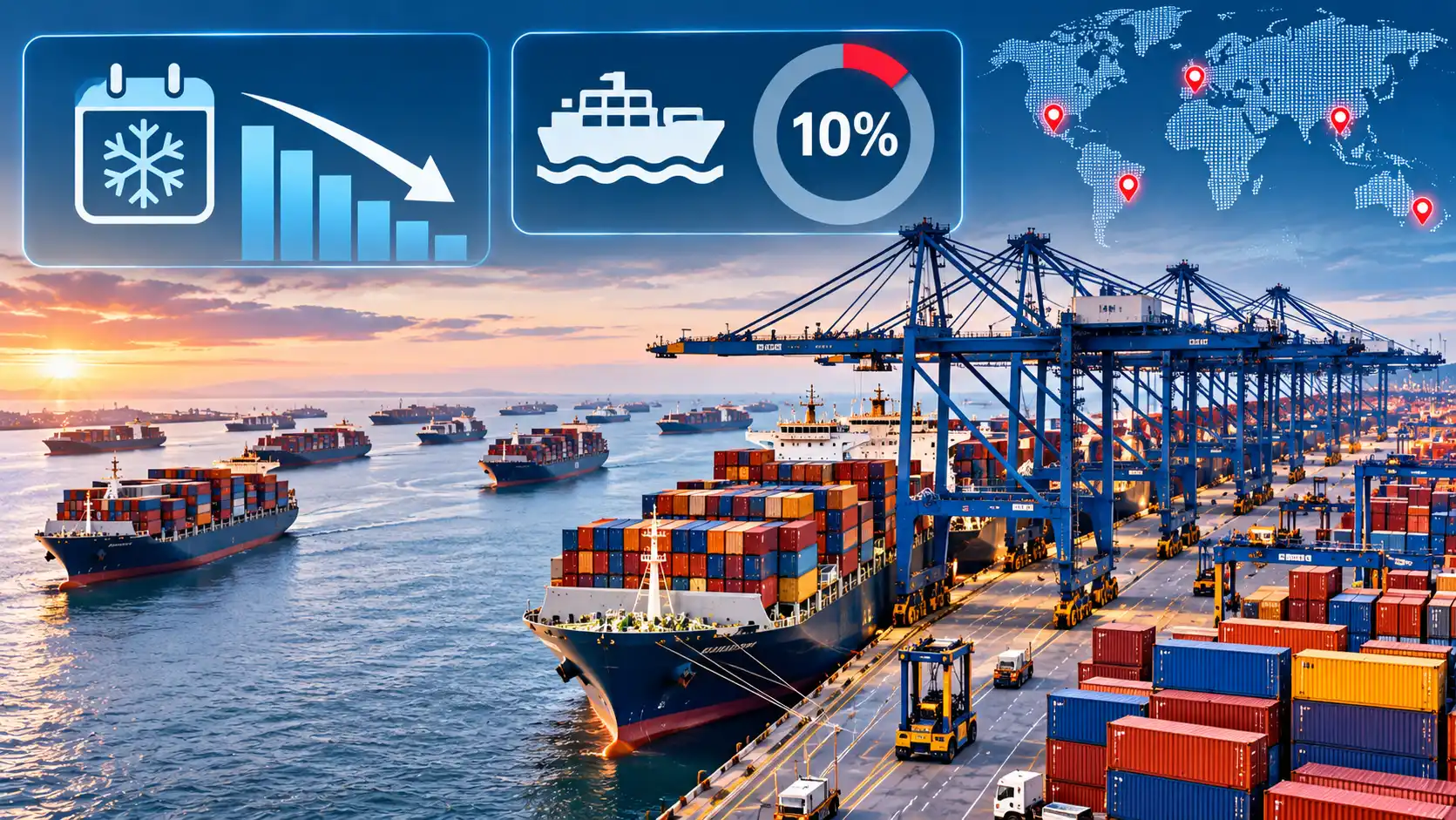
Global ocean freight networks are experiencing an easing of traditional peak-season container volumes, yet persistent terminal bottlenecks and vessel queuing continue to immobilise approximately 10% of the active global container ship fleet, according to maritime intelligence reported on 16 November by Seatrade Maritime News.
While the deceleration in cargo demand typically signals falling freight rates, the scale of trapped vessel capacity is maintaining an artificial floor under ocean transit costs and disrupting vessel turnaround schedules across major east-west and north-south trade corridors.
Reported Bottlenecks and Vessel Absorption Metrics
Data monitored across global shipping hubs indicates that while cargo booking momentum has plateaued following the late-summer and early-autumn volume surges, carrier efficiency remains compromised. The immobilisation of nearly one-tenth of total operational TEU capacity stems from a compounding set of network disruptions:
- Hub Congestion: Critical transshipment hubs in Southeast Asia, the Mediterranean, and Northern Europe continue to report vessel waiting times ranging from three to seven days, preventing scheduled vessel rotations from resetting.
- Extended Rotations via the Cape of Good Hope: Continued re-routing away from the Red Sea corridor absorbs vessel capacity over longer transit distances, leaving regional feeder feeder services and terminal berths out of sync with deep-sea arrival windows.
- Empty Container Imbalances: Delays in offloading and returning empty 40-foot High Cube (40ft HC) boxes to primary manufacturing origins continue to limit equipment availability at key departure points.
What sources confirm is that overall shipping demand has softened relative to Q3 peaks, moderating carrier rate hikes. What remains uncertain is how quickly terminal dwell times can normalise if winter weather disruptions in the Northern Hemisphere coincide with pre-Lunar New Year manufacturing cycles.
REIFTEIL Trade Analysis: Practical Implications for Automotive & Tyre Importers
For procurement directors, logistics operators, and commercial tyre distributors, a market where demand softens but 10% of vessel capacity remains trapped presents specific operational friction points. The standard assumption that post-peak shipping guarantees rapid port turnaround or plummeting freight rates does not hold under these structural conditions.
Impact on Tyre Freight and 40ft High Cube Utilisation
Tyres—particularly high-volume Passenger Car Radials (PCR) and commercial Truck and Bus Radials (TBR, such as 315/80R22.5 and 385/65R22.5)—rely heavily on 40ft High Cube equipment to achieve viable payload economics.
A commercial TBR tyre importer stuffing between 240 and 270 units per container faces severe margin compression when demurrage and detention (D&D) charges accumulate due to port gate congestion.
With 10% of container ship capacity trapped, carriers are aggressively managing port rotations by skipping congested terminal calls or executing blank sailings. This increases transit variance for containerised tyre imports by 10 to 18 days, requiring distributors to increase safety stock allocations rather than relying on just-in-time replenishment.
Lubricants, Base Oils, and Flexitank Operations
Shipments of finished OEM lubricants (such as heavy-duty 15W-40 CK-4 fleet engine oils and synthetic 5W-30 passenger vehicle formulations) moving via 20ft containerised flexitanks or ISO tanks face extended terminal dwell times. Flexitanks subjected to protracted vessel holding periods or yard stacking run elevated risks of heating-cycle degradation and valve stress. Logistics teams must verify port free-time terms to avoid punitive daily demurrage penalties at destination ports in West Africa, the Middle East, and Latin America.
Customs Clearance and Documentation Sequencing (EX-1, ABD, SONCAP)
Vessel schedule slippage complicates export and import customs clearance. In European trade hubs, export accompanying documents (Ausfuhrbegleitdokument / ABD, EX-1) risk timing out or requiring manual customs re-submissions if the container misses its booked vessel loading window due to terminal intake cuts. For African export corridors requiring pre-shipment verification (such as Nigeria's SONCAP regime), mismatched bill of lading (BL) dates caused by delayed carrier departures can trigger mandatory destination inspection fees and regulatory holds.
Commercial Procurement Actions
| Logistics Factor | Observed Condition | Recommended Procurement / Operational Action |
|---|---|---|
| Spot Ocean Freight | Peak easing, but 10% capacity trapped | Avoid long-term fixed rate lock-ins at peak levels; negotiate 30-day index-linked or short-term carrier contracts. |
| Container Free Time | Port yard congestion and gate delays | Require a minimum of 14 to 21 combined Demurrage & Detention free days at discharge destinations. |
| TBR / PCR Inventory Buffer | Unpredictable sailing rotations and blankings | Increase working inventory on fast-moving fleet dimensions (e.g., 315/80R22.5, 295/80R22.5) by two weeks. |
| Export Documentation | Terminal gate-in cuts and vessel omissions | Hold issuance of final ABD/EX-1 departure confirmations until physical gate-in and loading confirmation are secured. |
Until container terminal productivity improves and idle fleet percentages drop below historical baselines (typically 4–5%), automotive aftermarket importers and tyre fleets must prioritize schedule reliability and free-time agreements over marginal spot-freight discounts.