A market analysis released on November 11 by research firm IndexBox confirms that global demand for automotive brake boosters and master cylinders is undergoing a structural realignment through 2035.
The transition is driven by two converging regulatory and technical factors: the expansion of electric vehicle (EV) architectures that lack internal combustion manifold vacuum, and statutory mandates for Autonomous Emergency Braking (AEB) requiring faster hydraulic pressure build rates than mechanical vacuum boosters can deliver.
The Transition from Vacuum Diaphragms to Mechatronic Units
Conventional hydraulic braking systems rely on engine-derived manifold depression or auxiliary mechanical vacuum pumps to operate pneumatic brake boosters (servo units). In turn, these units actuate the tandem master cylinder (TMC) to pressurise hydraulic lines across brake calipers and wheel cylinders.
According to the IndexBox assessment, the elimination of internal combustion engines in battery-electric vehicles (BEVs) and the operational cycles of hybrid electric vehicles (PHEVs/HEVs) have rendered conventional vacuum boosters technically obsolete for new-generation platform designs.
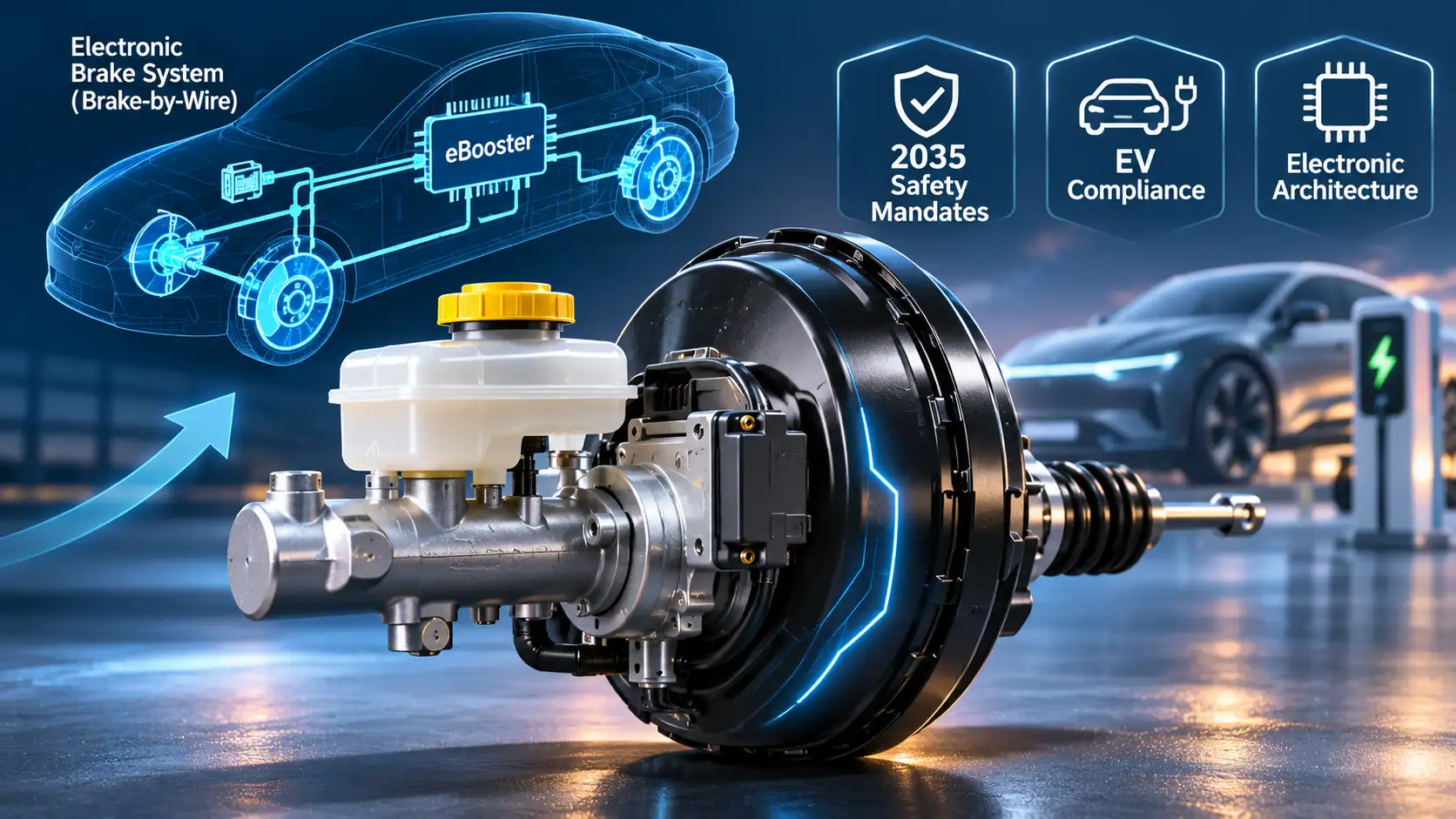
Vehicle manufacturers are replacing pneumatic canisters with electro-mechanical brake boosters (such as two-box mechatronic boosters) or fully integrated electro-hydraulic "one-box" brake-by-wire units.
In a one-box architecture, the pedal simulator, master cylinder, electronic stability control (ESC) valve block, and hydraulic pressure generation are consolidated into a single compact assembly actuated by an integrated brushless DC motor.
| System Architecture | Pressure Generation Method | Primary Application Platforms | Aftermarket Service Complexity |
|---|---|---|---|
| Pneumatic Vacuum Servo + TMC | Engine manifold vacuum / mechanical pump | Legacy ICE passenger cars, light commercial vehicles | Low (mechanical bench bleed, direct bolt-on) |
| Electro-Mechanical Booster (Two-Box) | Electric motor + gear drive actuating TMC | Early-generation EVs, select modern ICE/PHEVs | Medium (requires diagnostic interface for stroke sensor calibration) |
| Integrated Brake-by-Wire (One-Box) | High-dynamic electric motor + linear actuator | Modern BEVs, software-defined vehicles, Level 2+ ADAS | High (software pairing, automated pressure bleeding routines) |
Regulatory Drivers: UNECE and AEB Mandates
The market expansion documented by IndexBox correlates directly with statutory vehicle safety frameworks. Under European Union General Safety Regulation II (Regulation EU 2019/2144) and equivalent UNECE regulations, advanced driver assistance systems including AEB are mandatory for new vehicle registrations.
In the United States, the National Highway Traffic Safety Administration (NHTSA) published Federal Motor Vehicle Safety Standard (FMVSS) No. 127, mandating standard AEB on all passenger cars and light trucks by 2029.
Mechanical vacuum boosters typically achieve full emergency braking pressure in 300 to 500 milliseconds. By contrast, electro-hydraulic and electronic booster assemblies generate peak hydraulic line pressures (exceeding 150 bar) in under 150 milliseconds. This hydraulic response differential is essential to satisfy active pedestrian and vehicle collision mitigation standards at higher initial velocities.
REIFTEIL Trade Analysis: Implications for Importers and Parts Distributors
While the IndexBox study frames this transition from a global manufacturing and revenue perspective, REIFTEIL identifies immediate operational and procurement implications for independent aftermarket (IAM) distributors, parallel importers, and fleet maintenance operations.
1. Bifurcation of Aftermarket Stock Keeping Units (SKUs)
Importers serving developing markets and mixed commercial fleets face a prolonged split-inventory cycle. While demand for standard vacuum boosters (typically 7-inch to 10-inch single/tandem diaphragms under HS Code 8708.30) will remain stable across regions with high vehicle parc ages (such as parts of Africa, Latin America, and Eastern Europe), OE supply chains are heavily reallocating Tier-1 manufacturing capacity toward mechatronic modules.
Importers must guard against inventory over-commitment on slow-moving vacuum servos while monitoring the rising failure rates of first-generation electronic boosters now entering independent workshop channels.
2. Hydraulic Fluid Specification Tightening
Electro-hydraulic master cylinders and high-speed ABS/ESC modulators operate with tighter valve clearances and faster cycling frequencies. Standard DOT 3 and conventional high-viscosity DOT 4 fluids are increasingly unsuitable for these assemblies due to excessive kinematic viscosity at low temperatures.
Parts distributors must align master cylinder replacement sales with low-viscosity brake fluids conforming to ISO 4925 Class 6 (DOT 4 LV) or DOT 5.1. Supplying legacy high-viscosity fluids into electronic booster platforms risks sluggish valve retraction, ABS modulation delay, and premature failure of master cylinder secondary seals.
3. Customs Classification and Component Handling Risks
Electro-hydraulic one-box master cylinder assemblies contain electronic control units (ECUs), high-output permanent magnet motors, and sensitive stroke sensors.
Unlike cast-iron or stamped-steel mechanical vacuum servos, these units are vulnerable to electrostatic discharge (ESD) and moisture ingress. Consignments shipped via ocean freight (FCL/LCL) require certified desiccants and shock-resistant packaging.
Furthermore, customs documentation must precisely capture integrated mechatronic parts under subheadings of HS 8708.30 to avoid classification disputes regarding whether the assembly is entered as a hydraulic part or an electrical controller.