The decision is rarely as simple as "one bad tyre equals four new tyres." Replacing four tyres when two are still in excellent condition is a waste of money; but replacing only two incorrectly can compromise your vehicle's wet emergency stability or destroy an all-wheel-drive transfer case.
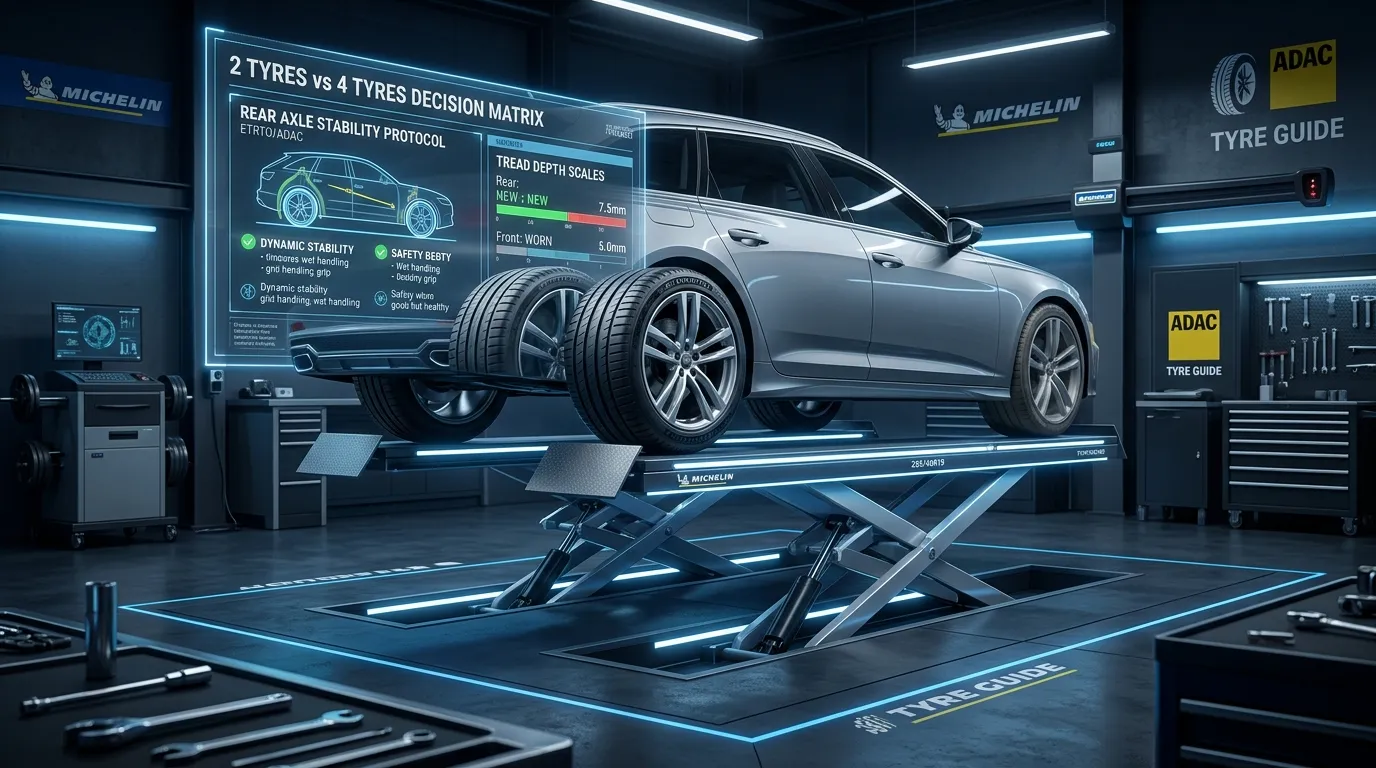
Axle-Pair Tyre Replacement Architecture: New High-Tread Tyres Mounted on Rear Axle (Right), Healthy Existing Tyres Transferred to Front Axle (Left), adhering to ETRTO & ADAC standards.
Replace 1, 2, or All 4?
Replace 1 Tyre
Strict Exception Only
Only if opposite tyre has <1.5 mm wear, is undamaged, under 2 yrs old, and exact model is available.
Replace 2 Tyres
Most Common & Sensible
When one axle is worn (2.5mm) but the other has 5.5mm+ healthy tread, no cracks, and <5 years old.
Replace All 4
Mandatory for AWD / Age
When all tyres are <3mm, >6 years old, AWD with large tread delta, or changing seasonal compound.
Two vs Four Tyres: Scenario Guide
| Vehicle & Tyre Situation | Recommended Action | Technical Rationale |
|---|---|---|
| 1 tyre punctured, other 3 have 7.0 mm (<6 months old) | Replace 1 (or 2) | Tread difference is negligible (<1 mm). Exact model match works safely. |
| Front pair at 2.4 mm, Rear pair at 5.5 mm (3 yrs old) | Replace 2 (Rear Axle) | Cost-effective. Put new tyres on rear; move 5.5 mm rears to front. |
| Front pair at 2.4 mm, Rear pair at 2.8 mm | Replace All 4 | Both axles are near the legal limit. Replacing 2 now means another visit in 3 months. |
| All 4 tyres have 4.5 mm tread but are 7 years old | Replace All 4 | Aged, oxidized rubber has hardened, drastically lengthening wet braking distances. |
| All-Wheel Drive (AWD) with 4 mm tread delta between axles | Replace All 4 | Circumference variance causes transfer case clutch slippage & overheating. |
| Switching from Summer to All-Season tyres | Replace All 4 | Seasonal compounds must never be mixed between axles. |
1. When Does Replacing Two Tyres Make Perfect Sense?
On the vast majority of front-wheel-drive passenger vehicles, the front tyres wear out at roughly double the speed of the rear tyres because they simultaneously transmit drive power, steer the car, and handle over 70% of braking force.
The "Healthy Pair" Criteria Checklist
Replacing only two tyres is fully endorsed by both the European Tyre and Rim Technical Organisation (ETRTO) and ADAC, provided the remaining pair meets all five conditions:
- Healthy Used Tire Tread Depth: What Wholesale Buyers Should Know" class="internal-link font-semibold text-blue-600 hover:text-blue-800 hover:underline decoration-blue-300 decoration-2 underline-offset-2 transition-colors" data-inlink="true">Tread Depth: The remaining pair has at least 5.0 mm to 6.0 mm of even tread remaining.
- Acceptable Age: The remaining pair is under 5 years old (verified via the 4-digit DOT code).
- Zero Structural Flaws: No sidewall bulges, ozone cracking, or shoulder feathering from misalignment.
- Matching Seasonal Type: New tyres are the exact same season (Summer + Summer, or 3PMSF + 3PMSF).
- Drivetrain Approval: The vehicle is 2WD (FWD/RWD) or an AWD system permitting tread deltas.
2. Why the New Tyres MUST Go on the Rear Axle
The single biggest mistake motorists make when buying two new tyres is insisting: "My car is front-wheel drive, so put the new tyres on the front."
In sudden heavy rain or standing water, the front tyres will hydroplane first because they have slightly less tread.
The front tyres bite through standing water, but the worn rear tyres hydroplane and lose all lateral traction.
ADAC, Michelin, Continental, Goodyear, and ETRTO all universally mandate fitting the best pair on the rear axle.
3. When Should You Replace All Four Tyres?
While replacing two tyres saves money in specific situations, replacing the full set of four is often the smartest, safest long-term investment:
1. Advanced Age (>6 Years)
Tyres harden and oxidize over time. Even if 4 mm of tread remains, a 6-year-old tyre has drastically reduced wet braking friction compared to fresh rubber.
2. All-Wheel Drive Systems
On AWD systems (Quattro, xDrive, 4MATIC), tread differences greater than 2 mm cause differential clutch slip, leading to thousands of Euros in gearbox repair bills.
3. Long-Term Value
Four matching tyres provide uniform handling, simplify future rotation cycles, and eliminate multiple workshop visits within a single season.
Legal Limits vs ADAC Practical Replacement Points
Under German StVZO § 36, the legal minimum tread depth is 1.6 mm. However, a tyre worn down to 1.6 mm has lost over 85% of its water-displacement capability:
Full water evacuation, maximum grip, factory braking performance.
Recommended replacement point: 3 mm for Summer, 4 mm for Winter & All-Season.
Severe aquaplaning risk in moderate rain. Replacement is urgently overdue.
The 4-Question Quick Decision Test
Are the other two tyres still in good condition (>5 mm tread, <5 years old)?
If YES → Replacing only two tyres is safe and sensible.
Are the other two tyres approaching 3.0 mm or older than 6 years?
If YES → Replace all four tyres together.
Is your vehicle All-Wheel Drive (Quattro / xDrive / 4MATIC)?
If YES → Check manufacturer handbook; replace all four if delta exceeds 2 mm.
Are you switching seasonal categories (e.g. Summer to All-Season)?
If YES → You must replace all four tyres to prevent seasonal compound clashes.
Frequently Asked Questions
Do I have to replace all four tyres at the same time?
No. If two tyres remain in good condition with healthy tread depth (e.g. 5–6 mm) and are under 5 years old, replacing only the worn pair by axle is safe, legal, and cost-effective for standard two-wheel-drive cars.
Can I replace just one tyre?
Only if the other tyre on the same axle is virtually brand new (less than 1 to 1.5 mm of wear) and the exact same brand, model, and specification is available. Otherwise, replacing the pair on that axle is strongly recommended to avoid braking instability.
Should new tyres go on the front or rear axle?
Always install the newer tyres with deeper tread on the rear axle, regardless of whether your car is front-wheel drive, rear-wheel drive, or all-wheel drive. Rear-axle grip provides essential lateral stability during wet emergency braking and prevents sudden oversteer spin-outs.
Why should new tyres go on the rear of a front-wheel-drive car?
While front tyres wear faster and handle steering, rear tyres prevent the vehicle from fishtailing. If worn tyres are left on the rear in wet weather, the rear axle will hydroplane first, causing uncontrollable oversteer that electronic stability control (ESP) cannot recover without rear traction.
Can I replace two tyres with a different brand?
Yes, as long as the two tyres on the same axle are identical to each other, meet the vehicle's required load and speed ratings, and share the same seasonal type as the other axle.
Can I replace two summer tyres with two all-season tyres?
No. Mixing seasonal types across axles produces incompatible rubber compound behavior at different temperatures. Always use the same seasonal specification (all summer, all winter, or all all-season) across all four wheels.
What should I do if I drive an All-Wheel Drive (AWD) vehicle?
Check your vehicle manufacturer's handbook carefully. Many AWD systems (Audi Quattro, BMW xDrive, Subaru AWD) permit a maximum tread depth difference of only 2 mm between axles. Exceeding this difference causes central transfer case overheating and expensive mechanical failure.
What is the legal minimum tread depth in Germany?
Under StVZO Section 36, passenger car tyres must have at least 1.6 mm of tread depth across the main grooves. However, ADAC strongly recommends replacing summer tyres at 3.0 mm and winter/all-season tyres at 4.0 mm for aquaplaning safety.
What if my existing tyres are 6 years old but still have 5 mm of tread?
Replacing all four is usually the better choice. Rubber hardens, loses elasticity, and develops micro-cracks over 6 years due to UV exposure and oxidation, drastically lengthening wet stopping distances even with adequate tread.
Is replacing all four tyres always better?
Four matching new tyres provide the ultimate consistency in grip, braking distance, and handling predictability. However, throwing away two nearly new, undamaged tyres is an unnecessary expense. The right decision depends on complete tyre condition.
What if my car has a staggered fitment (different front and rear sizes)?
On staggered fitments (e.g. 225/45 R18 front and 255/40 R18 rear), tyres cannot be rotated between axles. You must replace them in axle pairs with the exact homologated size for each axle.
Final Verdict
You don't automatically need four new tyres just because one axle is worn out.
The Golden Summary:
- 1. Replace Two: If the remaining pair has >5 mm tread, is undamaged, and <5 years old
- 2. Mount on Rear: Always place the newer pair on the rear axle for wet stability
- 3. Replace All Four: When tyres are >6 years old, <3 mm, or on sensitive AWD systems
Taking into account tread depth, compound age, vehicle drivetrain, and axle positioning ensures you maximize your tyre budget without ever compromising road safety.
Premium Passenger & Commercial Tyres with REIFTEIL
Looking for container-load wholesale supply of premium and quality-budget PCR, SUV, and fleet tyres? Connect with our international export department today.