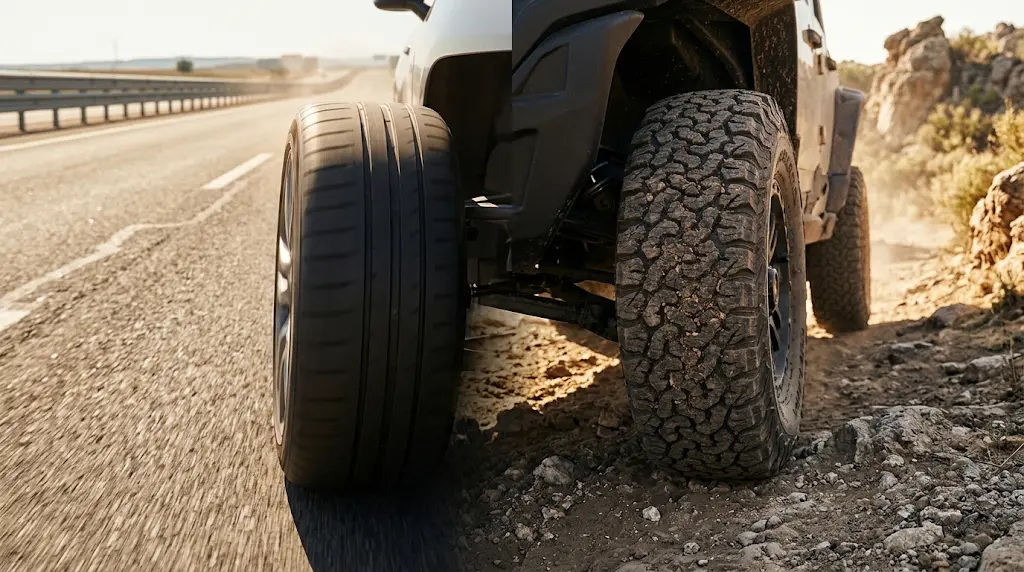
This distinction is crucial if you are buying tyres for year-round driving in Germany, the UK, or other European countries where seasonal weather and strict road safety regulations govern winter tyre compliance.
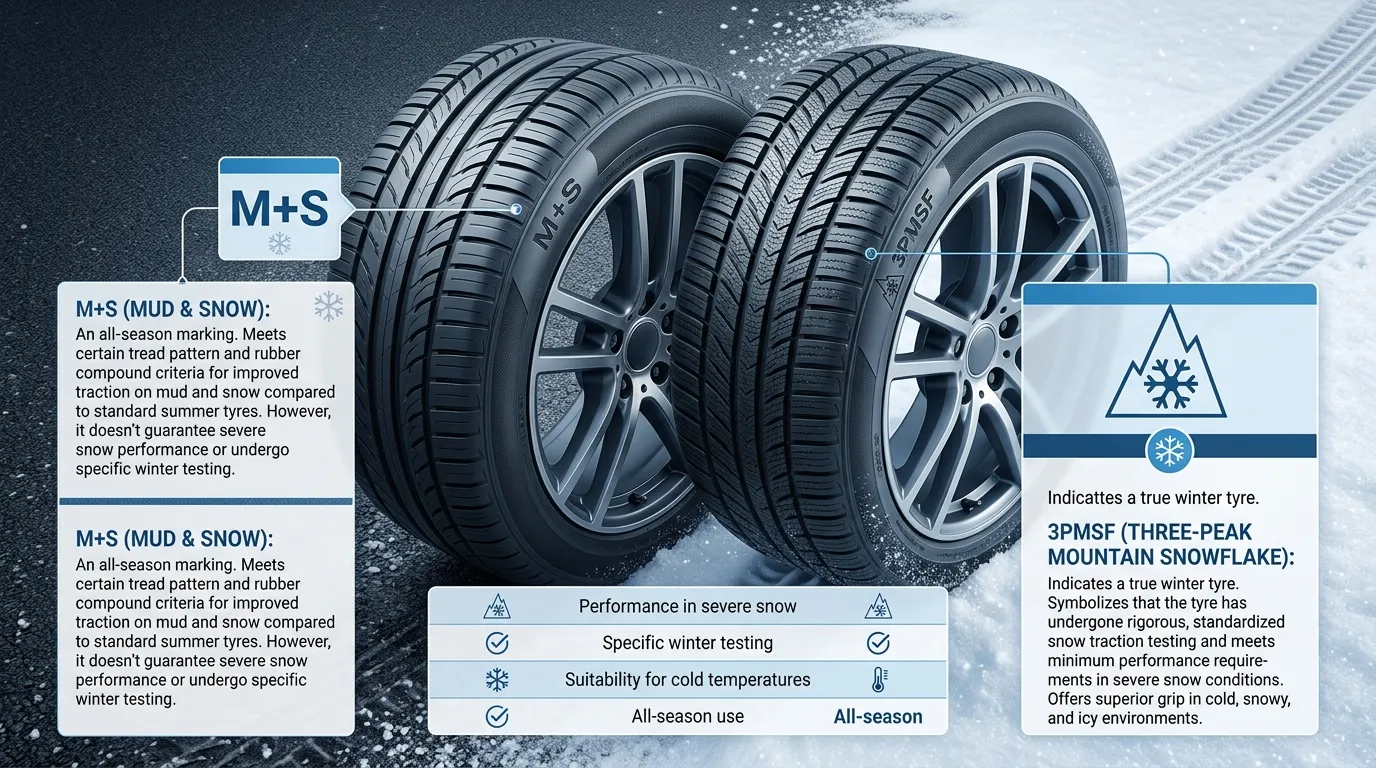
Sidewall Markings Decoded: M+S indicates Mud + Snow tread design; 3PMSF (Alpine Symbol) proves certified snow performance testing.
The 10-Second Summary
Stands for Mud + Snow. It is a manufacturer declaration of tread geometry. It does not require standardized snow testing.
Stands for Three-Peak Mountain Snowflake. Proves the tyre has passed a defined, regulated physical braking/traction test on compacted snow.
Quick Comparison at a Glance
Compare the two markings across definition, regulatory test requirements, legal status, and what buyers should know:
| Marking | Meaning | Snow Performance Test? | What Should Buyers Know? |
|---|---|---|---|
| M+S | Mud + Snow | No 3PMSF test | Does not by itself prove a certified snow-performance level. Manufacturer-declared tread characteristics only. |
| 3PMSF 🏔️❄️ | Three-Peak Mountain Snowflake | Yes (Certified) | Meets standardized snow traction requirement under UNECE R117. Required for winter driving compliance in Germany. |
| Alpine Symbol | Mountain + Snowflake | Yes | Another official and common name used interchangeably for the 3PMSF marking across Europe. |
Swipe horizontally on mobile devices to view the complete comparison.
What Does M+S Mean on a Tyre?
M+S stands for Mud and Snow (sometimes written as M&S or M/S).
Historically, the M+S marking was introduced by tyre manufacturers to indicate that a tyre's tread pattern had wider grooves, deeper tread blocks, and rubber compound characteristics intended to provide better starting traction in mud or fresh snow compared to a standard summer tyre.
Where Will You Commonly See M+S?
The Critical Limitation of M+S
M+S alone does not tell you that the tyre has passed a standardized winter performance test. Any manufacturer could place M+S on a tyre if its geometric void-to-rubber ratio met general guidelines, regardless of its real-world cold-weather braking capability on hard-packed snow or ice.
Does M+S Mean the Tyre Is a Genuine Winter Tyre?
Not necessarily. An M+S marking can appear on a wide range of tyre designs—from mild highway all-seasons to heavy-duty off-road tyres that perform poorly in sub-zero freezing temperatures.
For example, an all-season tyre might be marked 195/65 R15 95H XL M+S while also carrying the 3PMSF symbol. The M+S marking alone should never be your sole criteria for true winter safety.
What Is 3PMSF (The Alpine Symbol)?
3PMSF stands for Three-Peak Mountain Snowflake. It is widely known throughout Europe as the Alpine Symbol, Alpine Marking, or Mountain Snowflake.
Visual Symbol
3-Peak Mountain + Snowflake Inside
Standard Test
UNECE R117 Snow Braking / Traction
Legal Status
Mandatory for Winter in Germany (StVZO)
What Makes 3PMSF Different?
This is the key point: a tyre manufacturer cannot simply mould the 3PMSF marking onto a tyre sidewall at will.
The European Commission and UNECE regulations require tyres carrying the Alpine symbol to undergo rigorous physical testing on compacted snow. The tyre must demonstrate a minimum of 25% better traction or braking performance compared to a standardized European reference test tyre (SRTT).
Where Will You Find the 3PMSF Symbol?
When buying tyres online or inspecting your vehicle, look for the mountain-with-snowflake logo in:
Real-World Example: Tyre A vs Tyre B
To understand why this distinction matters when shopping for tyres, imagine comparing two tyres with identical dimensions and speed ratings:
195/65 R15 95H XL M+S
- Width: 195mm | Aspect: 65% | 15" Rim
- Load Index: 95 (690 kg) | Speed: H (210 km/h)
- XL Reinforced carcass construction
- No certified 3PMSF snow test
195/65 R15 95H XL M+S 3PMSF
- Width: 195mm | Aspect: 65% | 15" Rim
- Load Index: 95 (690 kg) | Speed: H (210 km/h)
- XL Reinforced carcass construction
- Certified 3PMSF snow traction test passed
The dimensions, load capacity, and speed rating are identical. But Tyre B gives you verified technical proof of snow capability, making it the safer, fully certified choice.
Is 3PMSF Better Than M+S in Every Way?
For verifiable snow traction, yes, 3PMSF provides far more meaningful performance assurance.
However, it does not mean: "Every 3PMSF tyre is superior to every M+S tyre in every possible driving condition."
What 3PMSF Does NOT Automatically Tell You:
Evaluated separately via EU Tyre Label wet grip class (A to E).
Determined by tyre rolling resistance (EU Label class A to E).
External rolling noise measured in decibels (dB) on the label.
Tested in independent consumer magazine tyre reviews.
Compound durability and wear resistance over 30,000+ km.
Covered by a separate ISO ice-grip pictogram (Nordic winter tyres).
Crucial Distinction: Snow Performance vs Ice Performance
3PMSF tests performance on compacted snow. It is not an overall guarantee for sheer ice. The EU tyre labelling system introduced a dedicated Ice Grip Pictogram (a jagged mountain of ice) for specific Nordic soft-compound passenger car tyres meeting ISO 19453 ice braking standards.
What Does This Mean for Driving in Germany?
This distinction is especially vital for motorists driving in Germany. Germany enforces a situational winter tyre requirement (*Situative Winterreifenpflicht* - StVZO § 2 Abs. 3a).
When Do Winter Tyre Rules Apply in Germany?
Rather than fixed calendar dates, the legal requirement applies whenever winter road conditions exist:
Does 3PMSF Make an All-Season Tyre a Winter Tyre?
Not exactly. An all-season tyre remains an engineered compromise designed to operate across a broad temperature window (typically -10°C to +35°C).
3PMSF All-Season Tyre
- Meets certified snow traction standards
- Usable all 12 months without seasonal swaps
- Saves wheel storage fees & bi-annual garage visits
- Balanced compromise between summer & winter traits
Dedicated Winter Tyre
- High-silica compound stays soft below 7°C
- Thousands of 3D sipes for biting grip on snow
- Maximum braking safety in severe alpine conditions
- Requires seasonal swap in spring (wears fast in heat)
5 Common Mistakes When Buying Winter & All-Season Tyres
Avoid these frequent pitfalls when evaluating tyre markings and specifications:
Assuming M+S Means "Fully Tested Winter Tyre"
M+S is a self-declared design pattern by the tyre manufacturer. It does not certify that the tyre has passed standard snow deceleration or traction tests.
Assuming Every "All-Season" Tyre Has 3PMSF
Do not rely on the marketing name alone (such as "4Seasons" or "All-Weather"). Always look for the physical 3PMSF mountain snowflake symbol on the sidewall and technical label.
Confusing 3PMSF With Ice Performance
3PMSF certifies traction on compacted snow. Pure ice performance is a distinct engineering metric represented by the separate Ice Grip pictogram on EU tyre labels.
Choosing a Tyre Based Solely on the Marking
A 3PMSF marking is a baseline qualification. You must also evaluate wet braking class, rolling resistance, noise rating, load index, and speed ratings.
Ignoring Legal Requirements When Driving Abroad
Transit countries like Germany, Austria, and France have mandatory winter equipment laws. Entering winter zones without 3PMSF tyres risks severe roadside penalties and liability in accidents.
Buyer's 6-Point Checklist for All-Season & Winter Tyres
Use this comprehensive checklist before ordering your next set of tyres:
1. Correct Tyre Size
e.g. 195/65 R15 — match your vehicle manufacturer's homologated dimensions.
2. Minimum Load Index
e.g. 91 (615kg) or 95 XL (690kg) — never fit a lower index than approved.
3. Speed Rating
e.g. H (210 km/h) or V (240 km/h) — ensure compatibility with top vehicle speed.
4. 3PMSF Alpine Symbol
Essential for legal compliance and certified snow performance across Europe.
5. EU Tyre Label Ratings
Compare Wet Grip (A-E), Rolling Resistance (A-E), and External Noise (dB).
6. Tyre Model Performance
Review independent tests (ADAC, AutoBild, Tyre Reviews) for compound quality.
Frequently Asked Questions
What does M+S mean on a tyre?
M+S means Mud and Snow. It is a tyre marking commonly found on winter, all-season, and SUV tyres, indicating a tread pattern designed to provide enhanced traction in mud and soft snow compared to a standard summer tyre.
What does 3PMSF mean?
3PMSF stands for Three-Peak Mountain Snowflake (the Alpine symbol). It identifies tyres that have passed standardized, regulated physical testing on compacted snow under UNECE Regulation 117.
Is M+S the same as 3PMSF?
No. They represent different standards. 3PMSF requires passing a defined, physical snow-performance test, whereas M+S is a manufacturer declaration of tread geometry without certified performance testing.
Is 3PMSF better than M+S?
For certified snow traction and severe winter performance, yes. 3PMSF provides reliable, verified proof of performance. However, other parameters like wet braking, rolling resistance, and dry handling must be evaluated individually.
Can an all-season tyre have 3PMSF?
Yes. Most modern high-quality all-season tyres carry both M+S and 3PMSF markings, ensuring they meet the technical requirements for winter road use.
Can an all-season tyre have M+S without 3PMSF?
Yes. Certain budget, older, or non-European market all-season tyres only carry M+S. Always verify the mountain-and-snowflake symbol before buying.
Is 3PMSF required by law in Germany?
Yes. Under current German traffic regulations (StVZO § 2 Abs. 3a), tyres used in situational winter conditions (ice, snow, slush, frost) must carry the Alpine 3PMSF symbol. M+S-only tyres are no longer compliant.
Does M+S mean the tyre is suitable for snow?
The marking indicates designed Mud and Snow characteristics, but M+S alone does not prove that the tyre has passed standardized snow deceleration or grip tests.
Does 3PMSF mean the tyre is good on ice?
No. 3PMSF specifically relates to compacted snow performance. Ice performance is a separate characteristic and is identified on the EU tyre label by an Ice Grip pictogram for specialized Nordic tyres.
Are 3PMSF all-season tyres as good as dedicated winter tyres?
A 3PMSF all-season tyre satisfies standard snow traction tests and provides year-round flexibility, but a dedicated winter tyre is specifically optimized with softer compounds and high sipe density for severe freezing temperatures and alpine roads.
Should I choose an M+S or 3PMSF all-season tyre?
If you are buying tyres for year-round driving and may encounter freezing conditions, wet slush, or occasional snow, you should always choose an all-season tyre with the 3PMSF Alpine symbol.
Final Verdict
The difference between M+S and 3PMSF is simple to understand once you know the engineering distinction:
The Golden Rules to Remember:
- M+S → Mud + Snow tread design declaration (untested)
- 3PMSF → Certified, regulated snow performance test passed
- M+S + 3PMSF → Standard dual marking on high-quality winter & modern all-season tyres
For drivers looking for an all-season tyre that can handle winter conditions safely and legally across Germany and Europe, a 3PMSF-certified tyre is the only choice you should make.
Source 3PMSF Winter & All-Season Tyres with REIFTEIL
Looking for container-load wholesale pricing on certified 3PMSF passenger, SUV, and commercial tyres from top Tier-1 and quality brands? Connect with our German-UK export team today.