Some tyres become dangerous after only a few years due to high mileage, misalignment, or internal impact damage. Others look almost new with 6 mm of tread, yet have hardened into slippery, unsafe rubber after years of chemical oxidation.
In Germany and throughout the European Union, the statutory minimum Used Tire Tread Depth: What Wholesale Buyers Should Know" class="internal-link font-semibold text-blue-600 hover:text-blue-800 hover:underline decoration-blue-300 decoration-2 underline-offset-2 transition-colors" data-inlink="true">tread depth for passenger-car tyres is 1.6 mm across the central three-quarters of the tread. However, 1.6 mm is a legal cliff-edge—not a safety recommendation. Wet braking distance and aquaplaning risks surge dramatically long before reaching the legal limit.
The 3 Pillars of Tyre Lifespan
1. Tread Depth
- 1.6 mm: Legal minimum in Germany
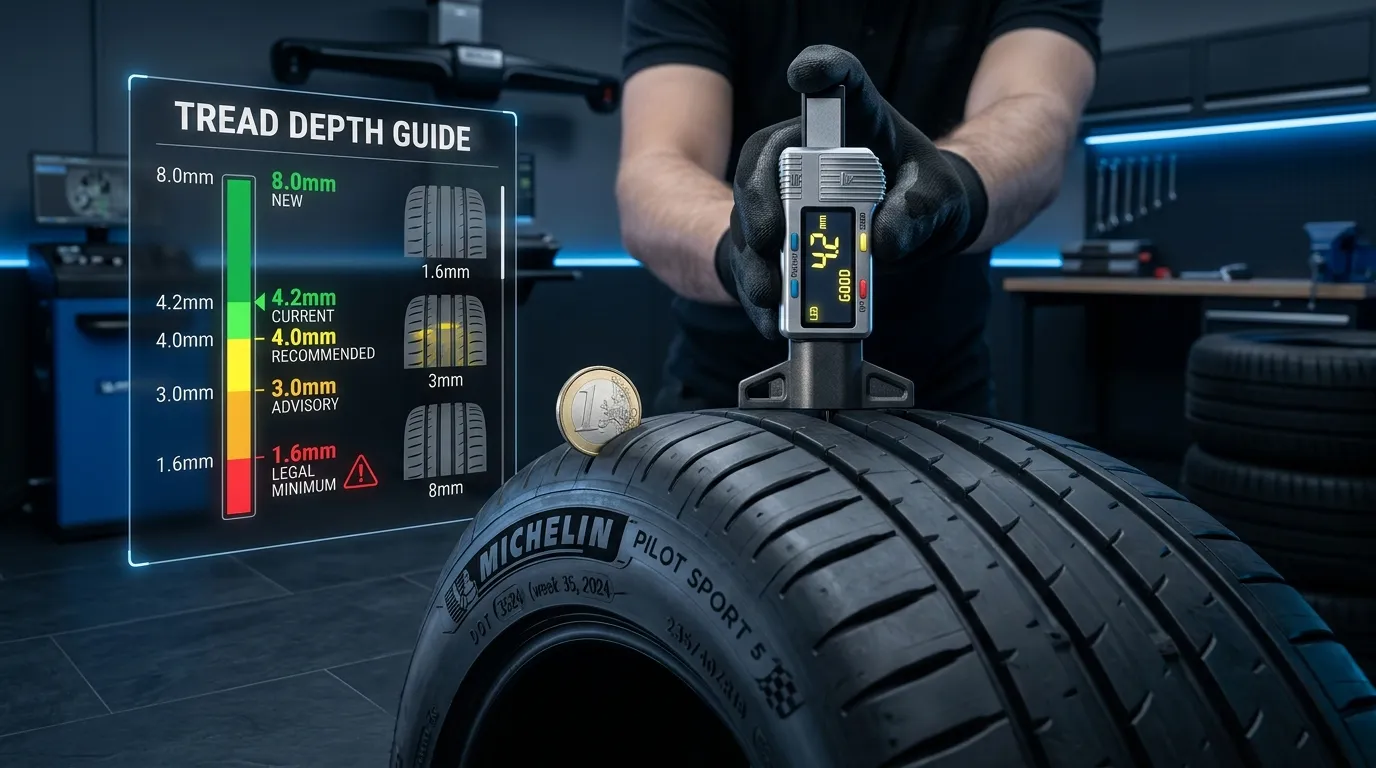
- 3.0 mm: ADAC Summer replacement threshold
- 4.0 mm: ADAC Winter and All-season replacement threshold
2. Tyre Age (DOT)
- 6 Years: Maximum winter tyre lifespan before rubber hardens
- 8–10 Years: Absolute maximum age limit for any tyre
- 2 Years: Maximum warehouse storage age for factory-new tyres
3. Physical Health
- Sidewall bulges: Replace immediately (high blowout risk)
- Deep cracks / cords: Structurally unsafe
- Uneven wear: Check wheel alignment and suspension
Golden Rule: Never judge tyre safety by tread depth alone or age alone. Tread Depth + DOT Age + Physical Condition gives you the complete, accurate assessment.
Tread Depth: Legal Limits vs Safety Thresholds
Tread grooves channel water away from the contact patch to maintain mechanical friction with the road. As tread wears down, water evacuation volume drops exponentially:
| Tread Depth | Status | Performance & Safety Implications |
|---|---|---|
| 6.0 – 8.5+ mm | Brand New | Full aquaplaning resistance, deep siping for maximum snow traction and dry grip. |
| 4.0 – 6.0 mm | Good Condition | Excellent wet handling, reliable snow displacement, normal braking distances. |
| 3.0 – 4.0 mm | Advisory Zone | Winter/All-season threshold: 3D sipes begin to close. ADAC recommends replacing winter tyres at 4 mm. |
| Below 3.0 mm | Replacement Recommended | Summer threshold: Wet braking distances increase by up to 40%. Floatation speed on standing water drops significantly. |
| 1.6 mm | Legal Minimum (StVZO) | Absolute minimum allowed by law in Germany and the EU. Wet grip is severely degraded; high aquaplaning hazard. |
| Below 1.6 mm | Illegal & Prohibited | Vehicle is unroadworthy (Flensburg penalty point, fines up to €90+, failed TÜV/HU, loss of insurance coverage). |
Why the ADAC Recommends 3 mm / 4 mm: Independent testing by the ADAC (German Automobile Club) proves that at 1.6 mm tread depth, a car braking on a wet road at 80 km/h takes roughly 20 metres longer to stop than the same car on new tyres. Winter tyre sipes lose their biting edges completely below 4 mm.
3 Easy Ways to Check Your Tread Depth
You don't need to visit a workshop to inspect your tyres. Use any of these three reliable methods:
1. Tread Depth Gauge
The most accurate tool. Insert the sliding probe into the deepest groove and read the exact millimeter measurement on the digital or analog scale (accuracy: ±0.1 mm).
2. Built-In TWI Bars
Locate the small "TWI" letters or triangle symbols on the sidewall. Look inside the main grooves for small raised rubber bars (1.6 mm). If the tread is flush with the bar, replace immediately.
3. The 1-Euro Coin Test
The gold brass rim of a 1-Euro coin is exactly 3 mm wide. Insert the coin into the tread groove. If the gold border is visible, your tread is under 3 mm and summer tyres should be replaced.
Never Check Just One Spot: A tyre almost never wears completely uniformly. Always measure in at least three distinct positions across the tyre width (inner shoulder, center, and outer shoulder) as well as around the circumference. If the center reads 4.5 mm but the inner shoulder is worn down to 1.5 mm, the tyre is illegal and dangerously compromised.
Uneven Tyre Wear Diagnostics
Abnormal wear patterns are early warning signs of suspension, alignment, or inflation problems. Replacing tyres without fixing the underlying mechanical fault will quickly ruin your new set:
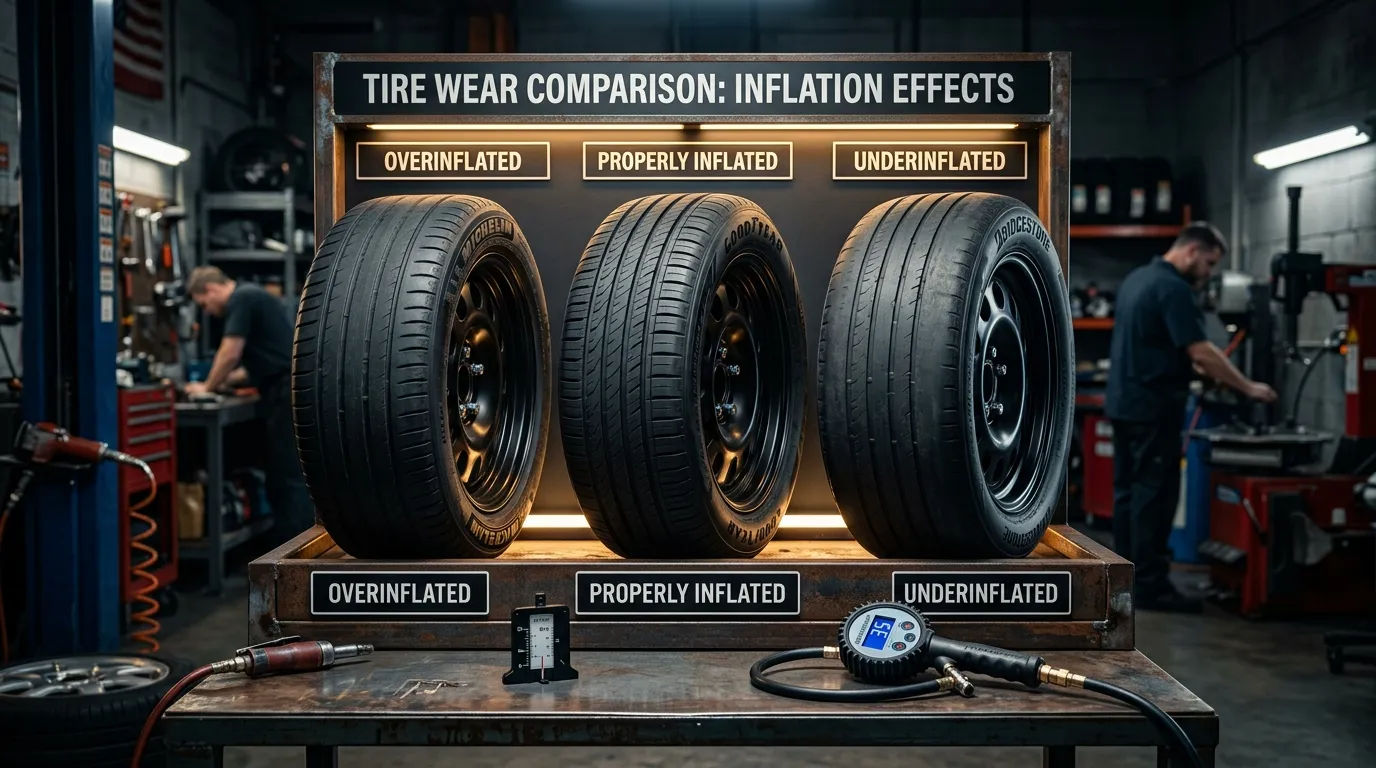
- Both Shoulders Worn (Under-inflation): The tyre sags in the middle and rides heavily on the outer edges, causing overheating and rapid shoulder degradation.
- Center Tread Worn (Over-inflation): Excessive air pressure balloons the center of the tyre, shrinking the contact patch and causing harsh ride quality.
- One Edge Worn Inner/Outer (Wheel Misalignment): Wheels are pointing inward/outward or tilting excessively (toe/camber issue), scraping the tyre sideways across the road.
- Cupping & Scalloped Patches (Worn Dampers / Unbalanced Wheels): The tyre bounces rhythmically down the road, creating scooped dips in the tread blocks.
Tyre Age: The Hidden Danger of Hardened Rubber
Rubber is an organic polymer that degrades continuously through chemical oxidation, UV exposure, and ozone contact, even when parked in a garage.
How to Read the DOT Production Date Code
Look at the 4-digit code at the end of the DOT marking on the sidewall (for example, DOT 3524):
- First Two Digits (35): Production Week (Week 35 = late August / early September).
- Last Two Digits (24): Production Year (2024).
Essential Age Benchmarks
- The 6-Year Winter Tyre Rule (ADAC): Winter tyres rely on soft, highly flexible silica compounds to grip freezing asphalt. After 6 years, these plasticizers evaporate. The rubber becomes rigid and glassy, losing over 50% of its cold-weather braking performance even if 5 mm of tread remains.
- The 2-Year Rule for Newly Purchased Tyres: Under industry guidelines (BRV / ADAC), tyres stored under optimal conditions (cool, dry, dark) may be sold as "brand new" up to 2 years from production. If you buy tyres online, verify that the DOT date is within acceptable freshness thresholds.
Structural Damage: When to Stop Driving Immediately
Certain tyre faults represent immediate blowout hazards. Do not continue driving if you detect any of these critical red flags:
- Sidewall Bulge or Bubble: Caused by severe pothole or curb impact tearing the internal cord ply. Pressurized air pushes directly against the outer rubber skin. High risk of sudden explosive blowout at motorway speeds.
- Deep Cracks or Carcass Separation: Fissures on the sidewall or inside groove valleys that expose cords or show structural rubber delamination.
- Exposed Metallic or Textile Cords: When tread wears so excessively that steel belts or nylon breaker plies show through. Immediate total failure imminent.
- Vibration or Pulling Following a Heavy Impact: Can indicate bent rim flanges, broken internal steel belts, or slipped ply layers even if external damage isn't immediately visible.
Replacing Two vs Four Tyres: The Rear-Axle Rule
Front tyres on front-wheel drive (FWD) cars typically wear at twice the rate of rear tyres because they transfer drive torque, handle 70% of braking load, and steer the vehicle.
If replacing only two tyres, motorists instinctively want to put them on the front axle for traction and steering. This is dangerous.
- New Tyres on Rear (Recommended): Maintains rear tracking stability. In wet emergency braking or sudden lane changes, the car remains stable and tracks straight.
- Worn Tyres on Rear (Dangerous): The rear loses lateral grip first during wet braking, leading to violent, unrecoverable oversteer spin-outs (fishtailing).
5-Minute Inspection Routine & Action Matrix
Replace Immediately
- Tread below 1.6 mm
- Sidewall bulge or bubble
- Exposed metal or textile cords
- Deep cracks reaching the carcass
- Chronic unrepairable leak
Replace Soon
- Summer tyre approaching 3 mm
- Winter or all-season tyre near 4 mm
- Winter tyre over 6 years old
- Pronounced uneven edge wear
- Noticeable loss of wet grip
Continue Monitoring
- Tread above 4–5 mm
- Even wear across all shoulders
- DOT code under 4–5 years
- Correct cold inflation pressure maintained
- Clean sidewalls without fissures or bulges
Frequently Asked Questions
How many years do car tyres last?
There is no single statutory expiration date. Driven moderately and stored correctly, tyres typically last 3 to 6 years. The ADAC advises that winter tyres should be replaced after 6 years due to rubber hardening, and no tyre should remain in service past 8–10 years regardless of tread depth.
What is the legal minimum tread depth in Germany?
Under German StVZO § 36, passenger-car tyres must have a minimum tread depth of 1.6 mm across the central three-quarters of the tread.
Should I replace tyres at 1.6 mm?
No, you should replace them earlier. The ADAC recommends replacing summer tyres at 3 mm and winter or all-season tyres at 4 mm to prevent dangerous aquaplaning and extended wet braking distances.
How do I know how old my tyres are?
Look at the 4-digit code at the end of the DOT marking on the sidewall. The first two digits are the production week and the last two are the year (e.g. 3524 = Week 35 of 2024).
Do tyres expire if they have never been used?
Tyres do not have a legal expiration date, but rubber compounds age through oxidation even in storage. The ADAC advises that brand new tyres should not exceed 2 years from their DOT production date at the time of purchase.
Why should winter tyres be replaced after six years?
Winter rubber contains high concentrations of silica and polymers engineered for cold flexibility. Over 6 years, these compounds harden, causing significant grip loss on ice and cold wet roads regardless of remaining tread depth.
Can I drive with cracked tyres?
Minor superficial surface crazing is common, but deep cracks on the sidewalls or groove valleys indicate structural degradation and risk sudden failure. They must be professionally assessed.
What does TWI mean?
TWI stands for Tread Wear Indicator. These are 1.6 mm high cross-bars molded into the main grooves to visually indicate when tread has reached the statutory minimum limit.
Can I check tyre tread with a 1-Euro coin?
Yes. The gold brass edge of a 1-Euro coin is exactly 3 mm wide. When inserted into a main groove, if the gold border is hidden, you have at least 3 mm of tread remaining.
Should all four tyres have the exact same tread depth?
Front tyres normally wear faster on front-wheel drive cars. Moderate differences between axles are normal, but significant differences on all-wheel drive (AWD) vehicles can strain center differentials.
When replacing only two tyres, should they go on the front or rear?
Always fit the new tyres on the rear axle. Rear grip ensures directional tracking and prevents catastrophic oversteer skids during high-speed emergency braking.
Final Verdict
Knowing when to replace your tyres is never about waiting for a single magic number:
- Tread Depth: 1.6 mm legal limit | 3 mm summer ADAC | 4 mm winter/all-season ADAC
- DOT Age: Maximum 6 years for winter compounds | Maximum 8–10 years for summer
- Structural Condition: Zero tolerance for bulges, deep cracks, or cord exposure
Take 5 minutes every month to inspect your tread depth, check for uneven shoulder wear, and verify cold tyre inflation pressure.
Wholesale Tyre Supply with REIFTEIL
Looking for certified PCR, SUV, and commercial TBR container supply with verified fresh DOT dates across Europe and worldwide? Contact our international tyre logistics specialists today.