A tire manufactured several years ago is not automatically unsafe. Equally, a tire with deep tread and no visible damage is not automatically safe. The difference depends on how the tire was stored, whether it has been used, its physical condition, the manufacturer's recommendations and the regulations applicable to its market.
For B2B buyers, understanding these factors helps prevent overpaying for aging inventory, negotiate more accurately with suppliers and maintain a responsible product-quality policy.
This guide explains how to read a tire's manufacturing date, distinguish factory-new from older stock, evaluate storage conditions, manage inventory by age and make better wholesale purchasing decisions.
At a Glance: The Four Tire Age Milestones
The following framework is a practical inventory-management guide, not a set of universal legal age limits.
| Tire age | General interpretation | Recommended commercial approach |
|---|---|---|
| 0–3 years | Recent production; potentially factory-fresh | Standard new-tire sales, subject to condition and warranty terms |
| Over 3–5 years | Older unused stock; may still qualify as new under applicable industry guidance | Verify storage, disclose age where appropriate and negotiate based on buyer requirements |
| Over 5–10 years | Older inventory requiring greater scrutiny | Obtain professional assessment and confirm manufacturer guidance before sale or fitting |
| 10 years and older | Reaches a major precautionary replacement milestone for many passenger-car tires | Follow manufacturer recommendations; do not assume the tire is suitable for continued service |
Important distinction: These age bands are not universal legal categories. In Germany, the Bundesverband Reifenhandel und Vulkaniseur-Handwerk (BRV) distinguishes between a tire that is fabrikneu (factory-new, up to three years under proper storage) and neu (new, up to five years under proper storage).
The ADAC also explains that there is no general statutory age limit for ordinary car tires in Germany. Specific exceptions and manufacturer requirements may apply.
1. Understanding Tire Age: Manufacturing Date vs. Service Life
Every tire has a manufacturing date, but that date alone cannot determine its remaining useful life.
Two tires produced in the same week may have very different conditions today. One might have spent years in a cool, dark, properly managed warehouse. The other may have been exposed to sunlight, excessive heat, ozone-producing equipment or damaging handling conditions.
A useful assessment separates three concepts:
- Chronological age: How much time has passed since manufacturing.
- Storage and service history: The environmental conditions and mechanical stresses experienced by the tire.
- Physical condition: Whether the tire shows damage, deformation, cracking or other signs of deterioration.
For wholesale buyers, these factors should be considered together rather than relying exclusively on the DOT date.
How to read the DOT manufacturing date
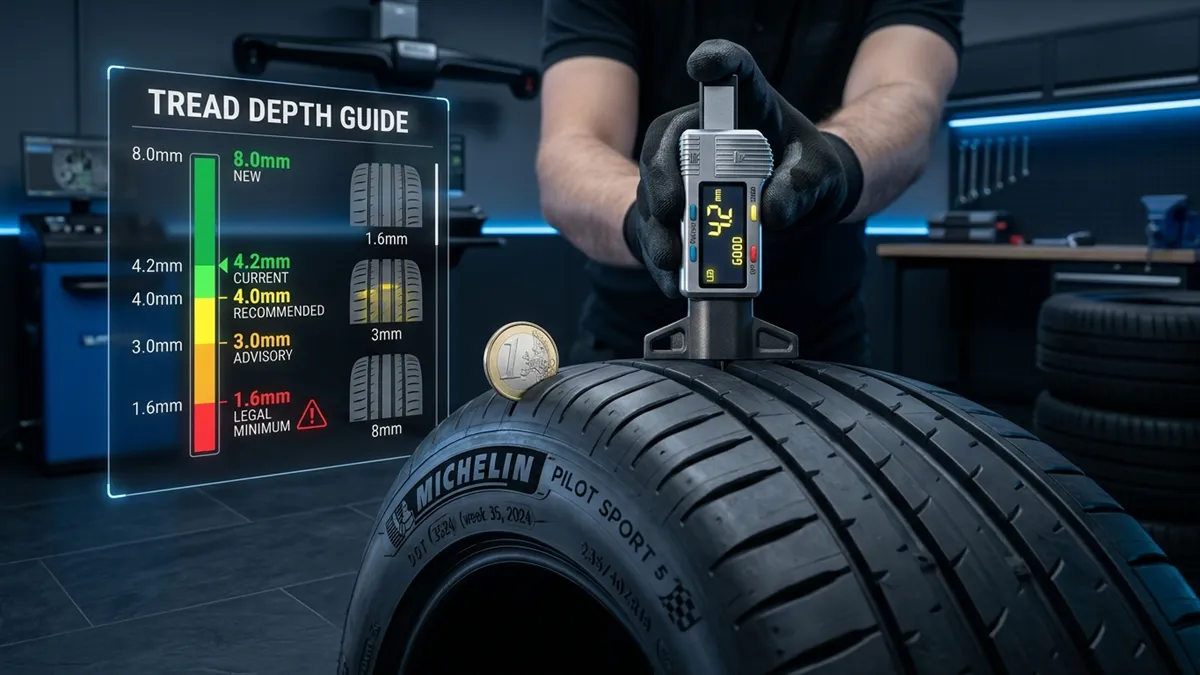
The last four digits of the date code on a tire marked with the DOT identification identify the week and year of manufacture.
For example:
- 2424: Manufactured in week 24 of 2024.
- 1025: Manufactured in week 10 of 2025.
- 3526: Manufactured in week 35 of 2026.
The first two digits indicate the production week; the last two indicate the year.
A date code is evidence of when the tire was manufactured. It does not, by itself, prove that the tire has been stored correctly, remained unused or retained its original performance.
When Used Tires for Tire Dealers: Profitability & Business Models" class="internal-link font-semibold text-blue-600 hover:text-blue-800 hover:underline decoration-blue-300 decoration-2 underline-offset-2 transition-colors" data-inlink="true">buying tires internationally, ask suppliers for the date codes on the actual stock being offered. A product catalogue or quotation showing a brand and size is not necessarily confirmation of the manufacturing dates of the tires that will be shipped.
2. The 0–3-Year Window: Recent Production and Factory-Fresh Stock
Tires within their first three years are generally attractive to retailers seeking recent production dates, provided that they have been stored correctly and meet all applicable product requirements.
This age band is particularly relevant for premium brands, seasonal tire changes, customers who specifically request recent production and distributors supplying buyers with strict stock-age requirements.
Why recent production can be commercially valuable
Recent stock can help a retailer:
- Meet customer requests for recently manufactured tires.
- Reduce concerns about long periods of prior storage.
- Maintain a consistent stock-age policy across multiple branches.
- Support premium positioning where freshness is part of the sales proposition.
- Reduce the risk of slow-moving inventory becoming progressively older.
However, recent production does not automatically justify full retail pricing. Market demand, tire model, season, size availability, competing offers and purchase cost still determine the achievable selling price.
Similarly, an unused tire in this age band should not automatically be described as having a particular warranty. Warranty coverage depends on the manufacturer's terms, the product, the market and applicable consumer law.
Wholesale buying recommendation
When purchasing recent-production stock, ask for:
- The actual DOT date range.
- Confirmation that the tires are unused and undamaged.
- Storage and handling information.
- Applicable manufacturer warranty terms.
- Confirmation of product specifications, markings and documentation.
For large orders, agree on the acceptable production-date range before payment and dispatch.
3. The 3–5-Year Window: When Older Stock Can Still Be New
This is one of the most important distinctions for tire wholesalers.
Under BRV guidance in Germany, a properly stored tire can be described as fabrikneu up to three years after manufacture and as neu up to a maximum of five years. Continental likewise states that properly stored, unused tires can be sold as new up to five years after manufacture, subject to applicable local regulations.
That does not mean every tire under five years old is automatically suitable for sale. Proper storage, condition, product requirements and truthful sales descriptions remain essential.
Why do tires remain in warehouses for several years?
Tire manufacturers produce a wide range of sizes, load indexes, speed ratings, patterns and seasonal variants. Demand for each specification fluctuates, so production and distribution do not always align perfectly with immediate retail demand.
A tire can remain unsold because:
- It is a less common size or specification.
- A distributor purchased more stock than the market required.
- Seasonal demand changed.
- A retailer reduced its inventory.
- A wholesaler is liquidating surplus stock.
None of these circumstances automatically makes a tire defective. They do, however, create an opportunity for buyers to negotiate more effectively.
How should wholesalers price three- to five-year-old stock?
There is no universal discount mandated by tire age. A reduction should reflect the actual commercial circumstances.
Consider:
- The age of the tires and the buyer's maximum acceptable age.
- Whether storage conditions are documented.
- Remaining manufacturer warranty and its applicable terms.
- Current market prices for the same brand, model and specification.
- Expected time to resale.
- Whether the buyer has to disclose the production date.
- The likelihood that the stock will remain unsold for another season.
For example, a wholesaler offering an older batch of a popular premium tire may have little reason to discount heavily if supply is limited. An uncommon size approaching the buyer's age limit may need a much larger reduction to remain commercially attractive.
Practical rule: Negotiate on the specific batch, not just the age category.
Before accepting an offer, compare the supplier's price against the current replacement cost of equivalent stock, the expected resale price and the cost of holding the inventory.
4. The 5–10-Year Window: Increased Scrutiny and Condition Assessment
As unused tires become older, the commercial decision becomes more dependent on the manufacturer's guidance, documented storage conditions and a competent assessment of their physical condition.
This is not a universal legal category or an automatic declaration that every tire in this age range is unsafe. It is a signal for greater caution.
What happens as tires age?
Tire compounds contain rubber and other materials whose physical and chemical properties can change over time. Heat, oxygen, ozone, sunlight and inappropriate storage conditions can accelerate deterioration.
Potential changes include:
- Reduced flexibility in the rubber compound.
- Surface cracking or other visible signs of aging.
- Deterioration associated with prolonged exposure to heat or ozone.
- Damage caused by deformation, impact or improper handling.
- Changes in performance that cannot be reliably assessed from tread depth alone.
The speed and extent of these changes vary. Age alone cannot establish an exact percentage of lost grip, a particular increase in braking distance or the remaining service life of an individual tire.
What should a buyer inspect?
For older inventory, check the following before agreeing to a purchase:
Sidewalls: Look for cracks, cuts, bulges, unusual deformation and evidence of damage.
Tread and grooves: Examine the tread surface and groove bases for cracking, damage and irregularities.
Bead area: Check for damage, distortion or other signs that could compromise mounting and sealing.
Storage history: Ask whether the tires were kept away from sunlight, heat sources, ozone-producing equipment, chemicals, fuels and lubricants.
Product identification: Verify the tire's size, load and speed ratings, markings and manufacturing date.
Professional assessment: If the tires are old, their history is uncertain or any damage is suspected, seek an assessment from a qualified tire specialist or follow the manufacturer's instructions.
A visual inspection cannot reliably establish every aspect of a tire's internal condition. Likewise, a single rubber-hardness measurement is not a universal pass-or-fail test for roadworthiness.
Commercial decision
Before buying older inventory, calculate whether the expected margin compensates for the additional uncertainty, potential inspection costs, reduced customer demand and any applicable sales restrictions.
If the supplier cannot substantiate the condition or storage history, the safest commercial decision may be to reject the batch rather than rely on a low purchase price.
5. The 10-Year Milestone: Manufacturer Recommendations vs. Legal Requirements
Ten years is an important precautionary milestone in passenger-car tire guidance, but it should not be described as a universal European statutory scrap threshold.
Michelin recommends replacing tires that have reached ten years from their manufacturing date, even if they appear serviceable and retain tread. Continental also recommends replacing tires more than ten years old.
These are manufacturer safety recommendations, not proof that every tire becomes unusable on its tenth anniversary under a single Europe-wide law.
For a retailer or wholesaler, the distinction matters: the correct decision should follow applicable law, manufacturer instructions, product-specific requirements and a professional assessment where necessary.
What about tires that still have deep tread?
Tread depth measures the remaining tread material. It does not independently establish the condition of the rubber compound, carcass or other internal components.
A tire may have considerable tread remaining but still require replacement because of age, damage or other safety concerns.
Conversely, the age of a tire does not establish its exact physical condition without considering its history and construction.
For ordinary passenger-car tires, Germany's general minimum tread-depth requirement is 1.6 mm in the principal grooves. That minimum is not a guarantee of good performance in wet or winter conditions, and it does not override age-related replacement recommendations.
Are there special legal age limits?
Yes, particular applications can have specific requirements. For example, Germany requires tires on certain trailers and caravans approved for speeds up to 100 km/h to be replaced after six years for the 100 km/h approval to remain valid.
This is an application-specific requirement, not a general six-year replacement rule for all car tires.
For commercial vehicles, buses, trucks, trailers and export markets, check the applicable rules and manufacturer recommendations for the exact tire type and use.
For wholesalers: Do not use a single age policy for every product category without checking whether the rules differ for passenger cars, commercial vehicles, trailers, motorcycles or specialized applications.
6. Does a Tire Age Faster on a Vehicle Than in a Warehouse?
Tire storage conditions matter significantly, but the statement that one year on a vehicle equals 17 years in a warehouse should not be used as a universal scientific conversion.
There is no reliable, universal multiplier that converts a tire's service life into warehouse years. The aging process depends on multiple variables, including temperature, sunlight, ozone, compound formulation, mechanical stress, inflation pressure and the duration of exposure.
Why tires in service face different stresses
A tire fitted to a vehicle can experience:
- Repeated deformation as it rolls.
- Heat generated by flexing and operating conditions.
- Changes in pressure and temperature.
- Exposure to ultraviolet radiation and ozone.
- Loads, impacts, braking and cornering forces.
- Environmental conditions such as rain, snow, road debris and chemicals.
A correctly stored, unused tire avoids many of these operational stresses. Nevertheless, it is not immune to aging.
What constitutes good tire storage?
Professional tire storage should generally be:
- Cool: Avoid excessive temperatures and direct heat sources.
- Dry and clean: Protect tires from damaging contamination and unsuitable environmental conditions.
- Dark: Keep tires away from direct sunlight and strong artificial light.
- Ozone-controlled: Avoid storage near equipment that generates ozone.
- Chemically separated: Prevent contact with solvents, fuels, lubricants and other damaging chemicals.
- Mechanically appropriate: Avoid unnecessary compression, deformation, tension or damage during storage and handling.
The correct position and support arrangement depend on whether tires are mounted on rims, their type, storage duration and the manufacturer's instructions.
Proper storage helps preserve the tire's characteristics; it does not make an old tire equivalent to a freshly manufactured tire in every respect.
7. How Tire Age Affects Wholesale Profit Margins
Tire age becomes particularly important when inventory is purchased in bulk. A small reduction in the selling price per unit can have a substantial effect on a large order.
However, the age of the tire is only one factor. The buyer must consider the price paid, market demand, storage costs, transport costs, warranty exposure and the time required to sell the stock.
Example: Comparing fresh and older inventory
Imagine a wholesaler is considering two otherwise comparable batches of 100 tires.
| Cost or selling assumption | Recent stock | Older stock |
|---|---|---|
| Purchase price per tire | €70 | €60 |
| Expected selling price per tire | €90 | €82 |
| Gross profit per tire | €20 | €22 |
| Total gross profit if all 100 sell at target price | €2,000 | €2,200 |
In this simplified example, older stock offers a €2 higher gross profit per tire at the target selling price.
But this does not automatically make it the better purchase. Suppose the older batch requires additional inspection, takes longer to sell or has a greater risk of price reductions. Those costs can eliminate the apparent advantage.
The figures above are illustrative only and do not represent current market prices.
Calculate the margin that actually matters
Use the following calculation:
Realized gross profit = sales revenue − purchase cost − directly attributable costs
Depending on the transaction, directly attributable costs may include freight, handling, inspection, customs duties, non-recoverable taxes, disposal and other costs necessary to deliver the goods.
For a bulk purchase, also estimate the cost of stock that remains unsold, the price reductions needed to clear it and the financing tied up in inventory.
A practical age-based purchasing policy
Rather than applying an automatic discount to every older tire, establish buying rules:
- Set a maximum acceptable DOT age for each customer segment.
- Require documented storage and condition information.
- Apply lower purchase-price ceilings when uncertainty increases.
- Prioritize fast-moving sizes and models.
- Agree on acceptable date-code ranges before ordering.
- Reassess the stock's value as it approaches customer age limits.
- Reject tires that fail safety, condition, documentation or legal requirements regardless of their purchase price.
This approach allows wholesalers to manage margin without treating age as a substitute for quality control.
8. FIFO Inventory Management: Preventing Stock From Becoming Too Old
FIFO stands for First In, First Out. Under this method, inventory received earliest is normally dispatched first.
FIFO can reduce the risk of older stock remaining in the warehouse while newer stock is sold. However, it does not guarantee that the oldest tires are always the oldest by manufacturing date.
For example, a new shipment received today might contain tires manufactured earlier than tires received last month. For tire-age control, warehouses should track the actual production date as well as the receipt date.
How to implement effective tire-age control
- Record the DOT date at goods-in. Capture the production week and year for each batch, ideally at SKU and batch level.
- Set stock-age alerts. Establish internal alerts at milestones such as 12, 24, 36 and 48 months, adjusted to your purchasing policy and customer requirements.
- Track customer requirements. Record maximum acceptable tire age, required date-code ranges and any contractual specifications.
- Review slow-moving stock. Identify uncommon sizes, seasonal products and models that are not selling at the expected rate.
- Separate exceptions. Hold stock with uncertain dates, damaged packaging, questionable condition or missing documentation until the issue has been resolved.
- Keep dispatch traceability. Record the batch and date codes supplied to each customer where operationally feasible.
- Review stock regularly. Use the data to adjust purchasing volumes, promotional activity and replenishment.
A documented system helps a wholesaler explain what was supplied, demonstrate stock rotation and identify potential issues quickly.
9. How Tire Age Affects Warranty and Customer Liability
Warranty claims are another reason to distinguish manufacturing age from the date of sale.
A tire's manufacturing date does not automatically establish when a manufacturer's warranty expires. The applicable warranty may depend on the brand, product, territory, terms of sale, proof of purchase and nature of the defect.
Similarly, statutory consumer rights should not be confused with a manufacturer's commercial warranty. Selling a tire does not remove a seller's legal responsibilities merely because the product was manufactured several years earlier.
What should a wholesale buyer confirm?
Before purchasing a batch, establish:
- Whether the manufacturer's warranty applies to the product and destination market.
- When warranty coverage starts and what evidence is required.
- Whether any age-related exclusions apply.
- How defects must be reported and investigated.
- Whether the seller offers a separate contractual guarantee.
- How returns, claims, inspection and transport costs are handled.
If the supplier describes tires as having a “full five-year warranty,” ask for the actual terms and confirmation of which products and territories are covered.
Do not assume that all premium manufacturers offer identical warranty periods or that all coverage expires on the same schedule.
Reduce disputes through accurate descriptions
For older unused stock, transparent communication is important. State the production-date range where relevant, explain any agreed limitations and avoid implying that the tires have a warranty or condition status that cannot be substantiated.
Clear terms agreed before shipment can reduce disputes and protect long-term B2B relationships.
10. Spare Tires: Why Low Mileage Does Not Eliminate Age Risk
A spare tire may remain unused for years, but low mileage does not mean that its materials have remained unchanged.
Spare tires stored in a boot, beneath a vehicle or on an exterior carrier can experience heat, moisture, temperature fluctuations and environmental exposure. Some may also remain unnoticed until an emergency.
For this reason, spare tires should be included in routine vehicle inspections.
Check the manufacturing date, inflation pressure where applicable, visible damage and the vehicle manufacturer's instructions. Follow the tire manufacturer's age-related recommendations and replace tires when required.
For fleet operators, inspecting spare tires is a simple way to reduce the risk of discovering an unsuitable tire only after a puncture or roadside breakdown.
11. Common Signs of Tire Deterioration
An older tire deserves closer attention when it shows visible abnormalities.
| Warning sign | Why it matters |
|---|---|
| Cracks in the sidewall | May indicate rubber deterioration or other damage |
| Cracks at the base of tread grooves | Can indicate aging or deterioration requiring assessment |
| Bulges or localized deformation | May indicate structural damage |
| Cuts, exposed cords or significant impact damage | May compromise the tire's integrity |
| Bead damage | May affect mounting and air retention |
| Persistent vibration or unusual vehicle behavior | May indicate a tire or wheel problem requiring investigation |
These signs are not an exhaustive diagnostic checklist. Their absence does not prove that a tire is safe, and their presence should not be dismissed because the tread remains deep.
Do not rely on color changes, surface appearance alone or a single rubber-hardness reading to certify an older tire as suitable for road use.
If there is doubt about structural integrity, take the tire out of service pending a competent assessment.
12. A Wholesale Buyer's Checklist Before Ordering Tires
Before committing to a large tire order, use this checklist to reduce uncertainty.
- Confirm the exact brand, model, size, load index and speed rating.
- Request the actual DOT manufacturing-date range.
- Establish whether the stock is new, unused and undamaged.
- Ask about storage conditions and available traceability records.
- Confirm the applicable warranty terms for the destination market.
- Check the legal and technical requirements for the intended application.
- Compare the quoted price with current market alternatives.
- Calculate freight, handling, duties and other attributable costs.
- Agree on acceptable DOT dates and quality criteria in writing.
- Establish the process for reporting discrepancies or damaged stock.
- Confirm packaging, palletization, quantities and dispatch arrangements.
- Estimate how long the inventory will take to sell.
For container orders, consider requiring batch-level date information before loading. If a purchase contains multiple age groups, agree in advance whether mixed dates are acceptable and how each group will be priced.
Frequently Asked Questions
How old can a tire be and still be sold as new?
There is no single universal legal age limit for ordinary car tires across Europe. In Germany, BRV guidance distinguishes factory-new tires up to three years old from new tires up to five years old, assuming proper storage. Continental also recognizes properly stored, unused tires up to five years old as saleable as new, subject to local regulations.
A seller must still ensure that the product is suitable, correctly described and compliant with the rules that apply to the transaction.
Are three-year-old tires safe to use?
A properly stored, unused tire may remain suitable for service at this age. However, age alone cannot establish safety. The tire must be in good condition, appropriate for the vehicle and compliant with manufacturer instructions and applicable requirements.
Should five-year-old unused tires be discarded?
Not automatically. The decision depends on storage history, physical condition, the tire manufacturer's recommendations and the applicable rules. In Germany, properly stored tires up to five years old can fall within BRV's definition of new tires. Older tires warrant additional scrutiny rather than an automatic decision based on age alone.
Must all tires be replaced at ten years?
Michelin and Continental recommend replacing tires at ten years from manufacture as a precaution. This should not be confused with a universal statutory scrap threshold applying to every tire category in every European country. Check the applicable manufacturer's instructions and any product-specific rules.
Does warehouse storage stop tires from aging?
No. Proper storage slows unnecessary deterioration but does not stop the passage of time or every chemical and physical aging process.
Can a tire with deep tread still be unsafe?
Yes. Tread depth does not reveal every form of age-related deterioration or structural damage. A tire may require replacement even when it has substantial tread remaining.
Is a newer DOT date always better?
A recent production date can be desirable, especially for buyers with strict freshness requirements. Nevertheless, storage history, physical condition, suitability, warranty terms and purchase price must also be considered.
How can I verify the age of tires before a wholesale shipment?
Request the manufacturing-date range for the actual stock being offered. For large orders, ask for batch-level records or date-code photographs where feasible, and include acceptable age ranges in the purchase agreement.
How should tire wholesalers manage aging stock?
Use batch-level age tracking, FIFO stock rotation, regular reviews of slow-moving products, agreed age limits and transparent communication with buyers. The aim is to prevent avoidable depreciation without compromising product suitability or safety.
Final Verdict: Manage Tire Age as a Quality and Commercial Risk
Tire age should be treated as one component of a wider inventory-quality system, not as a stand-alone measure of roadworthiness.
The key principles are straightforward:
- 0–3 years: A useful target for recent-production inventory, subject to proper storage and condition.
- 3–5 years: Potentially saleable as new under applicable industry guidance when storage and condition requirements are satisfied.
- 5–10 years: Requires greater attention to manufacturer guidance, storage history, physical condition and market requirements.
- 10 years and older: Follow applicable manufacturer replacement recommendations and any stricter product-specific requirements; do not assume that remaining tread makes an old tire suitable for continued use.
For wholesale buyers, the objective is to purchase stock that meets customer expectations, maintain transparent product descriptions, avoid unnecessary inventory depreciation and protect the business from preventable disputes.
A well-managed tire-age policy can support all four goals without relying on arbitrary age-based discounts or unsupported claims about tire lifespan.
Source Fresh Tire Inventory with REIFTEIL
For tire retailers, distributors and importers, the right wholesale supplier should provide clear product specifications, transparent stock information and dependable fulfilment.
REIFTEIL supports B2B tire sourcing across passenger-car tires, SUV and van tires, and truck and commercial-vehicle categories.
When requesting a wholesale quotation, specify your required tire sizes, brands, quantities, destination, preferred DOT-date range and any warranty or documentation requirements. This allows the offer to be evaluated against your actual inventory and customer needs.
Explore the REIFTEIL wholesale tire catalogue and contact the team to discuss availability, bulk quantities and production-date requirements.