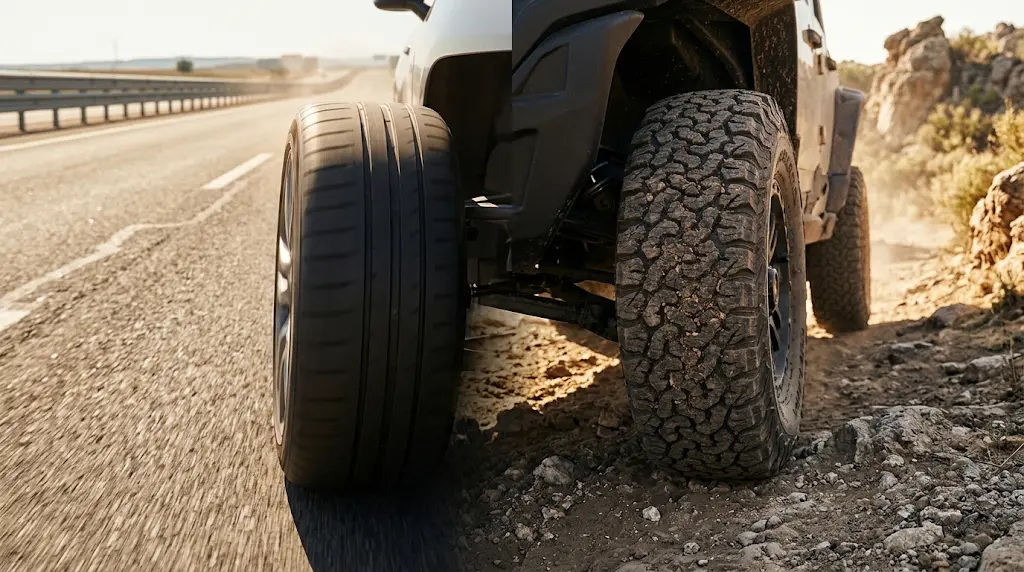
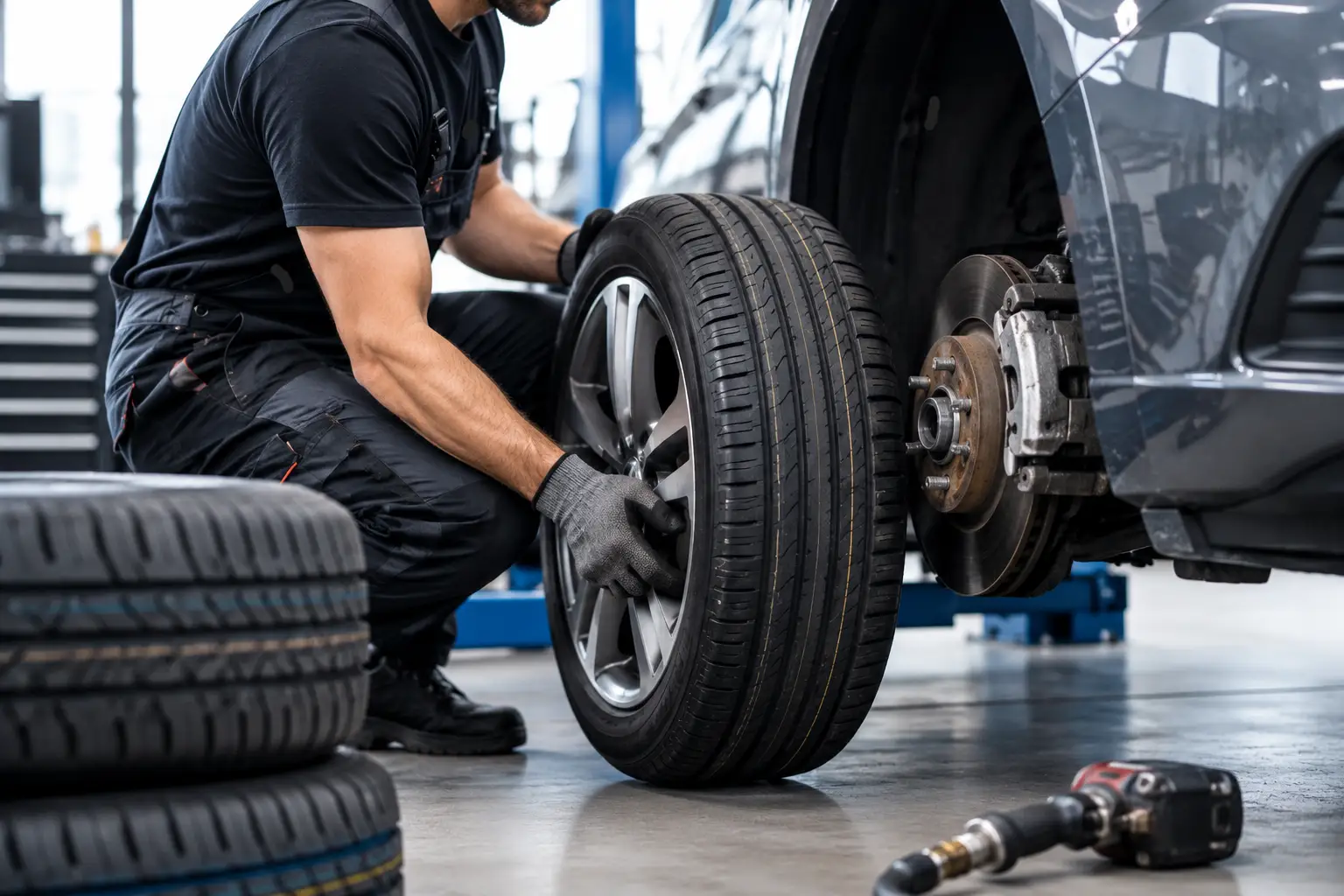
The fundamental question is: Is that alternative size legally approved for your specific car? Just because a tyre physically fits on your rim and doesn't rub against the fender liner during a stationary test does not make it safe, legal, or compatible with your electronic stability systems.
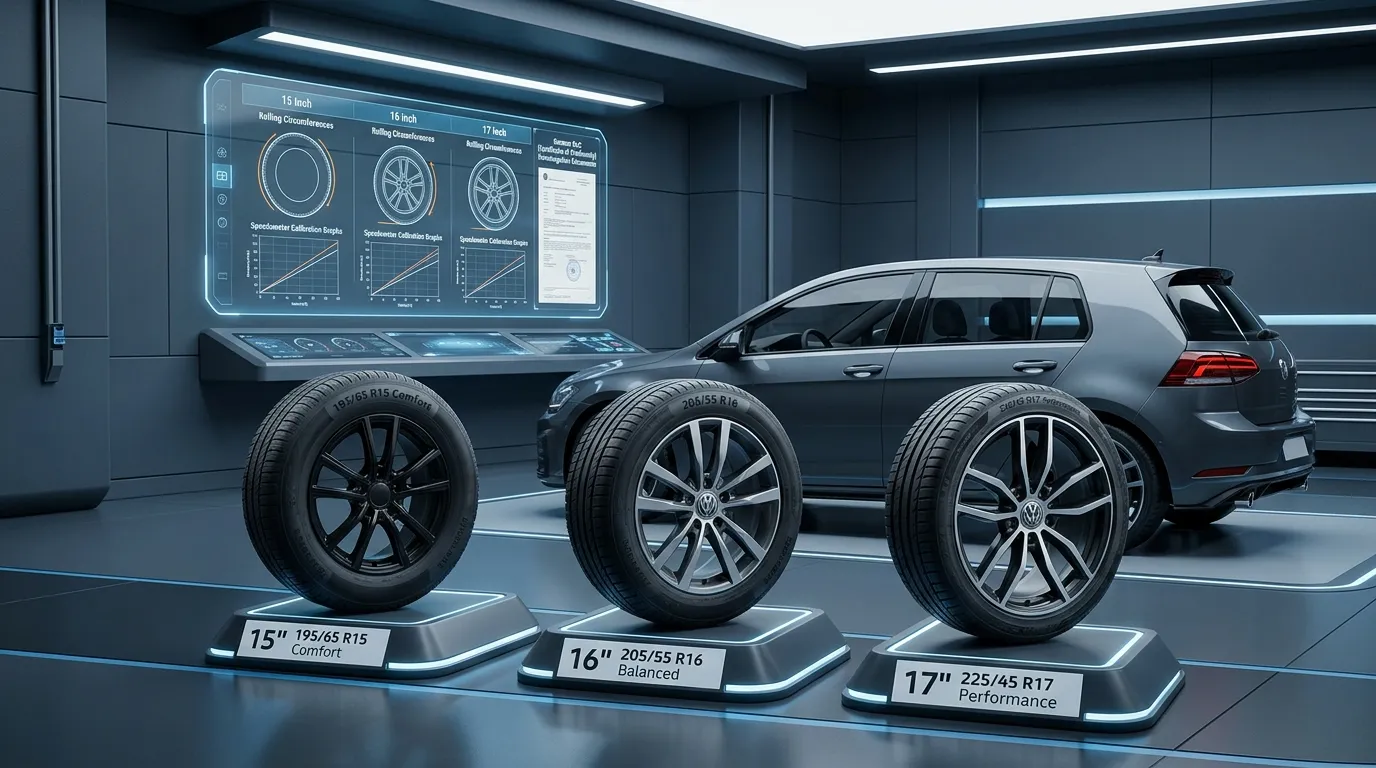
Tyre Size Upsizing Spectrum: 15-inch Comfort Setup (195/65 R15), 16-inch Balanced Setup (205/55 R16), and 17-inch Performance Setup (225/45 R17) sharing identical rolling circumferences.
Physical Fitment ≠ Legal Approval
CoC Listed Sizes
100% Legal & Plug-and-Play
Dimensions listed under Sections 32 & 50 in your Certificate of Conformity. No TÜV entry needed.
Aftermarket ABE
Certified Wheel Package
Wheel manufacturer provides an official ABE report with approved tyre dimensions for your chassis.
Individual TÜV (§21)
Custom Assessment
Unlisted custom sizes require speedo verification, clearance tests, and official registration entry.
1. Decoding the Numbers on Your Sidewall
Before changing sizes, you need to understand how the dimensions work together. Take a standard benchmark size: 195/65 R15:
Cross-sectional width of the tyre from sidewall to sidewall.
Sidewall height is exactly 65% of width (195 × 0.65 = 126.75 mm).
Radial internal ply structure (standard for modern vehicles).
Diameter of the wheel rim (15 inches = 381 mm).
2. How Rolling Circumference & Diameter Are Calculated
When upsizing wheels (e.g. from 15" to 16" or 17"), the tyre sidewall must decrease proportionally so the overall rolling diameter remains constant. Here is the mathematical proof:
The Calculation Formula:
Total Diameter = (Tyre Width × Aspect Ratio ÷ 100 × 2) + (Rim Inches × 25.4 mm)
Sidewall: 126.75 mm
Rim: 381.0 mm
Total: 634.5 mm (≈ 635 mm)
Sidewall: 112.75 mm
Rim: 406.4 mm
Total: 631.9 mm (≈ 632 mm)
Sidewall: 101.25 mm
Rim: 431.8 mm
Total: 634.3 mm (≈ 634 mm)
Notice that the diameter variance between all three sizes is less than 3 mm (<0.4%)! This is why car manufacturers homologate all three sizes for the same chassis.
3. The Performance Trade-Off Matrix: Upsizing vs Downsizing
In comprehensive ADAC comparative testing across identical vehicles fitted with 15", 16", and 17" wheels, every size demonstrated distinct strengths and trade-offs:
| Driving Criterion | 15" (195/65 R15) | 16" (205/55 R16) | 17" (225/45 R17) |
|---|---|---|---|
| Ride Comfort & Bump Damping | ⭐⭐⭐ Superior (127mm sidewall) | ⭐⭐ Good (113mm sidewall) | ⭐ Firm / Jarring (101mm sidewall) |
| Steering Precision & Cornering | ⭐ Noticeable sidewall flex | ⭐⭐ Direct & Balanced | ⭐⭐⭐ Razor-sharp response |
| Dry Braking Distance | ⭐ Standard contact patch | ⭐⭐ Shorter | ⭐⭐⭐ Shortest (Wide rubber patch) |
| Aquaplaning Float Speed | ⭐⭐⭐ Floats at 82 km/h (Safest) | ⭐⭐ Floats at 78 km/h | ⭐ Floats at 73 km/h (Disperses more water) |
| Snow & Slush Traction | ⭐⭐⭐ Cuts into slush better | ⭐⭐ Balanced | ⭐ Tends to ride on top of snow |
| Fuel Economy & Rolling Resistance | ⭐⭐⭐ Lowest weight & drag | ⭐⭐ Moderate | ⭐ Higher unsprung mass (+2–3 kg) |
| Pothole & Curb Rim Protection | ⭐⭐⭐ Deep rubber cushion | ⭐⭐ Good | ⭐ High risk of rim bend/crack |
4. Where to Find Legal Approved Sizes in Germany
German road traffic regulations (StVZO) and TÜV inspections require your tyres to be certified. Here is how to find your options:
1. Zulassungsbescheinigung Teil I
Look at fields 15.1 (Front Axle) and 15.2 (Rear Axle). Warning: Since October 2005, the vehicle registration document only prints one baseline factory size. The absence of other sizes here does NOT mean they are illegal!
2. The CoC (Certificate of Conformity)
The manufacturer's EG-Übereinstimmungsbescheinigung lists every single factory-homologated wheel and tyre combination under Section 32 and Section 50 (Remarks). Any size listed here is 100% legal with zero TÜV inspection required.
5. Speedometer Accuracy, ABS & Snow Chain Restrictions
ECE R39 Speedometer Law
By European law, your speedometer may never indicate a lower speed than you are actually traveling (0% negative tolerance), and may read at most 10% + 4 km/h higher. If an unapproved tyre has a larger diameter, the car travels faster than the speedometer indicates, failing TÜV inspection.
Snow Chain Wheel Arch Clearance
Wider and larger wheels fill the wheel arch tightly. On many vehicles (e.g. VW Golf, BMW 3-Series), snow chains are strictly prohibited on 17" or 18" wheels due to strut collision risk. If you drive in Alpine regions, verify your winter size allows chain fitting.
The 9-Point "Can I Fit This Size?" Checklist
1. Legal Homologation
- ☐ Listed in Fahrzeugschein
- ☐ Listed in CoC (Sec 32/50)
- ☐ ABE wheel report present
2. Wheel & Ratings
- ☐ Wheel diameter matches
- ☐ Rim width (J) compatible
- ☐ Load & Speed rating met
3. Practical Clearance
- ☐ Rolling delta under ±1.5%
- ☐ Brake caliper clearance
- ☐ Snow chains permitted
Frequently Asked Questions
Can I put a wider tyre on my car?
Yes, but only if the wider size and wheel combination are officially approved in your CoC document or certified with an aftermarket ABE certificate. Never fit wider tyres purely because they physically clear the bodywork.
Can I change from 15-inch to 16-inch or 17-inch wheels?
Yes, provided the larger wheel and lower-profile tyre size maintain an identical rolling circumference (e.g. 195/65 R15 to 205/55 R16 or 225/45 R17) and are listed in your CoC.
Where can I find all approved tyre sizes for my car in Germany?
The German vehicle registration document (Zulassungsbescheinigung Teil I) only lists one basic size in fields 15.1 and 15.2. All additional factory-approved dimensions are listed in your Certificate of Conformity (CoC) under sections 32 and 50.
Does a bigger wheel make the car faster?
No. Larger wheel packages increase unsprung mass and rotational inertia, which can slightly reduce acceleration and increase fuel consumption. They improve steering directness and cornering grip, not acceleration.
Are wider tyres better in the rain?
Not necessarily. While wider tyres offer strong wet braking on damp roads, they must disperse significantly more water volume in standing water, causing them to aquaplane at lower speeds than narrower tyres.
Are narrower tyres better in snow and slush?
Yes. Narrower tyres exert higher surface contact pressure per square centimeter, allowing the tread to cut through surface slush and compact snow into the sipes for superior winter traction.
What is the difference between 195/65 R15, 205/55 R16, and 225/45 R17?
All three sizes share virtually identical outer diameters (~632 to 635 mm). The 15-inch setup offers maximum comfort and pothole cushioning with a 127 mm sidewall; the 16-inch offers balanced all-round dynamics with a 113 mm sidewall; and the 17-inch delivers sharp, sporty steering with a 101 mm low profile.
Does changing tyre size affect the speedometer or ABS/ESP?
If the outer rolling circumference changes by more than -1.5% to +1.5%, your speedometer will give inaccurate readings, and wheel-speed harmonics can disrupt ABS, ESP, and electronic differential systems.
Can I fit snow chains on larger or wider wheels?
Often no. Larger and wider wheel packages reduce the clearance between the tyre and internal suspension struts or wheel arch liners. Always check vehicle CoC notes for snow-chain compatibility restrictions.
Can I use different tyre sizes on the front and rear axles?
Only if your vehicle is specifically engineered and homologated for a staggered fitment (common on sports cars like BMW M, Porsche, and Mercedes-AMG). You must never create a custom staggered setup on a car designed for equal sizes.
What happens if I fit a tyre size not listed in the CoC?
Fitting an unlisted size invalidates your vehicle's operating license (Betriebserlaubnis) and insurance coverage unless the setup has an official ABE parts certificate or is individually inspected and approved by TÜV/Dekra.
Final Verdict
Choosing the right tyre size is all about aligning dimensions with your driving priorities:
The Golden Summary:
- Want Comfort & Pothole Safety? → Choose an approved 15" or 16" taller-sidewall setup
- Want Sporty Steering & Aesthetics? → Choose an approved 17" or 18" low-profile setup
- Always Check the CoC Document → To verify homologated sizes before spending money
The best tyre size isn't necessarily the largest or most expensive one—it is the exact approved dimension engineered for your vehicle and driving environment.
Source Complete Dimensions in PCR, SUV & Fleet with REIFTEIL
Looking for container-load wholesale supply of passenger, SUV, and commercial tyres in all homologated dimensions (15" to 22")? Connect with our German logistics center today.