For European tyre wholesalers and importers, the change is significant because the additional duty can materially alter the landed cost of Chinese tyres and therefore the economics of importing them into the EU.
What happened?
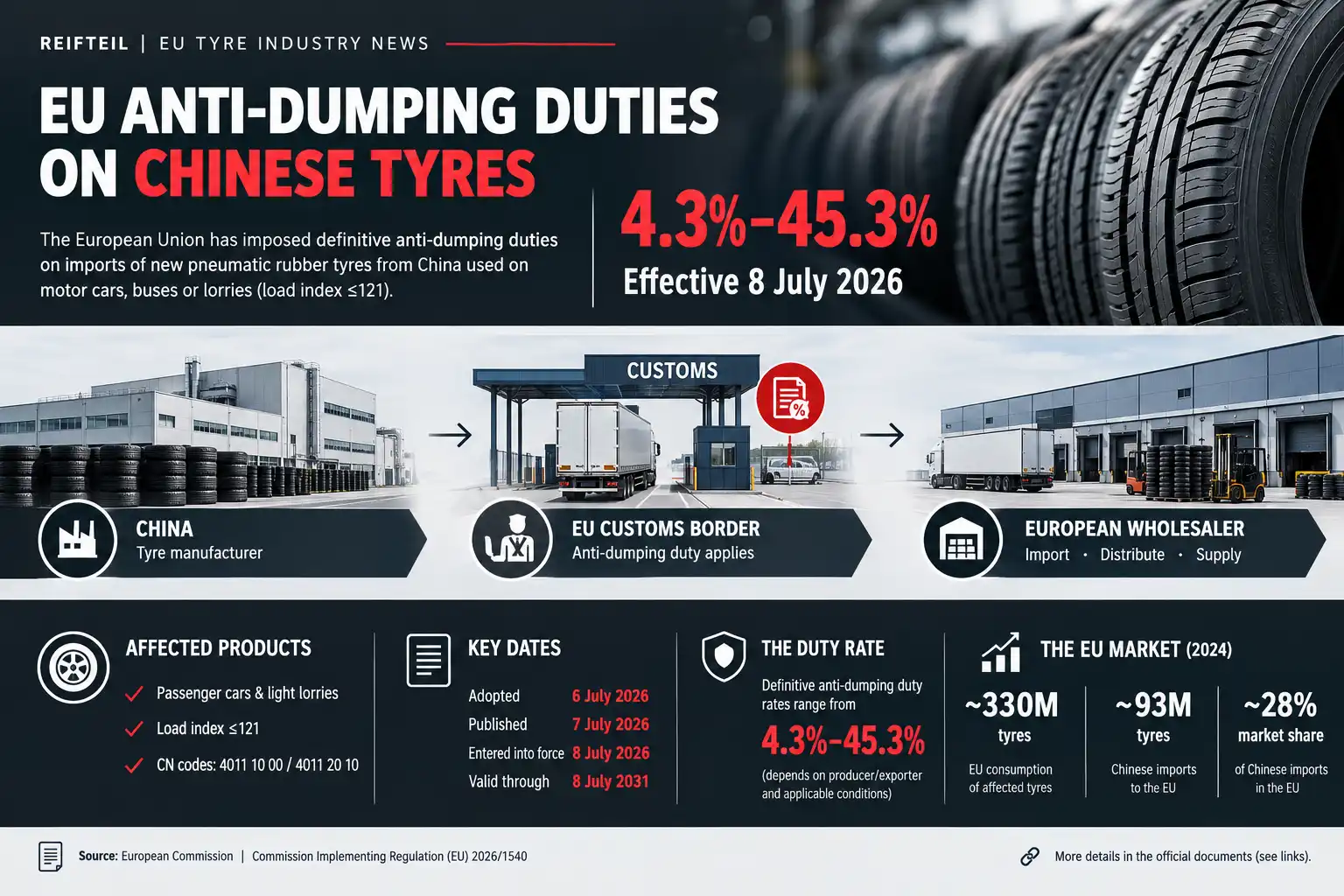
The European Commission has imposed definitive anti-dumping duties on imports of new pneumatic tyres for passenger cars and light lorries, with a load index of 121 or below.
The measure was adopted through Commission Implementing Regulation (EU) 2026/1540, dated 6 July 2026 and published in the Official Journal of the European Union on 7 July 2026.
The investigation was launched in May 2025 following a complaint from representatives of the EU tyre industry. The Commission subsequently concluded that the investigated Chinese imports were being sold at dumped prices and that this was causing material injury to the Union tyre industry.
The definitive anti-dumping rates are:
| The definitive anti-dumping rates are: | Anti-dumping duty |
|---|---|
| Hankook Group | 4.3% |
| Shandong Yongsheng Rubber Group | 45.3% |
| Other cooperating companies | 24.4% |
| All other Chinese imports | 45.3% |
These rates are applied to the relevant net, free-at-Union-frontier price before duty.
The measure is scheduled to remain in force for five years, unless changed or terminated in accordance with EU trade-defence rules.
What does the official EU source say?
According to the European Commission, the investigation covered a substantial part of the EU passenger-car and light-lorry tyre market.
In 2024:
- EU consumption of the affected tyres was approximately 330 million units
- The market was worth more than €18 billion
- Imports from China reached almost 93 million units
- Chinese imports represented approximately 28% of the EU market
The Commission says its investigation found dumping and resulting injury to the EU tyre industry.
The underlying regulation applies to tyres currently classified under:
- CN 4011 10 00 — certain new pneumatic tyres for motor cars
- CN 4011 20 10 — certain new pneumatic tyres for buses or lorries
The relevant tyres have a load index not exceeding 121.
Importantly, the regulation does not impose one universal duty on every Chinese tyre. The rate depends on the producer/exporter and whether the importer can establish that the tyres were manufactured by a company covered by an individual rate.
For example, the individual Hankook rate is only available where the required commercial invoice and manufacturer information are provided to customs. Otherwise, the regulation provides for the 45.3% rate applicable to all other imports.
Which businesses are affected?
The regulation is particularly relevant to businesses importing affected Chinese tyres into the EU.
Directly affected
This includes:
- EU tyre importers
- Wholesale Tyre distributors
- Automotive parts distributors importing tyres
- Online tyre retailers importing directly from China
- European businesses purchasing Chinese tyres for resale
- Trading companies importing tyres into the EU
- Companies arranging customs clearance for affected tyres
The impact is greatest where the business is importing new PCR and light-lorry tyres from China falling within the regulation's product scope.
Potentially affected indirectly
European wholesalers buying from another European distributor should also pay attention to the origin and customs status of the tyres.
A tyre being purchased from a supplier in Germany, Belgium, the Netherlands or another EU country does not necessarily mean the tyre is EU-origin. The relevant question for the anti-dumping measure is whether the product falls within the scope of the regulation and originates in China.
Not every tyre is covered
The regulation has a defined product scope. It should therefore not be interpreted as a blanket 45.3% tariff on every tyre manufactured in China.
Businesses should check the CN code, load index, product characteristics and country of origin before applying the measure to a particular product.
When does it take effect?
The regulation was:
- Adopted: 6 July 2026
- Published: 7 July 2026
- Entered into force: 8 July 2026
- Duration: generally five years, subject to the EU's trade-defence rules
There were no provisional anti-dumping duties imposed during the investigation. The Commission specifically decided not to impose provisional measures before the definitive decision.
This distinction is important for importers: the current measure is a definitive anti-dumping duty, not a temporary provisional tariff.
What should tyre wholesalers and importers do?
The most important step is to stop treating the supplier's quoted price as the final import cost.
For affected Chinese tyres, wholesalers should calculate their fully landed EU cost before deciding whether a deal is commercially viable.
1. Confirm the tyre's CN code
Ask the supplier or customs broker to confirm the applicable CN classification.
For this measure, the regulation identifies 4011 10 00 and 4011 20 10.
2. Confirm the country of origin
Do not confuse:
Supplier location → country of origin
A Chinese-produced tyre sold by a European trading company remains a Chinese-origin product for purposes of the relevant trade-defence measure.
3. Identify the actual manufacturer
Ask suppliers for:
- Manufacturer legal name
- Factory location
- Country of origin
- CN code
- Applicable TARIC additional code
- Commercial invoice documentation
- EU type-approval/E-mark information
This is particularly important where the supplier claims that an individual anti-dumping rate applies.
4. Recalculate landed cost
For example, if the relevant customs value were €50 per tyre, a 45.3% anti-dumping duty would represent approximately €22.65 per tyre before considering other applicable import costs.
That means a supplier quotation of €50 does not necessarily mean an EU landed product cost of €50.
The exact customs calculation should be confirmed with the customs broker because customs value, ordinary customs duty, VAT and other costs must be considered separately.
5. Review existing supplier contracts
For purchase orders already negotiated before the new duty took effect, wholesalers should check:
- Who bears additional import duties?
- Is the price fixed?
- Is the supplier responsible for customs costs?
- Which Incoterm applies?
- Which country is the declared origin?
- Who is the importer of record?
6. Compare alternative sourcing countries
The new duty changes the relative economics of different supply origins.
Wholesalers may therefore want to compare:
China → EU landed cost
against
Turkey / Serbia / Vietnam / Thailand / Malaysia / other origins → EU landed cost
However, the applicable trade measures and origin rules need to be checked individually for each product and origin.
What this means for REIFTEIL's industry context
For a B2B tyre business such as REIFTEIL, this development is particularly relevant because the affected product segment overlaps with the types of products commonly traded in the European wholesale market:
- Passenger-car tyres
- SUV tyres
- Light-truck/van tyres
- Budget tyres
- Mid-range tyres
- Premium tyres
The new duties make supplier transparency and landed-cost calculation increasingly important.
For example, when evaluating a new Chinese supplier, REIFTEIL should not only compare the supplier's quoted price.
A more useful purchasing model is:
Supplier price
- freight
- customs duty
- anti-dumping duty where applicable
- port/handling costs
- customs clearance
- transport within the EU = true landed cost
That landed cost can then be compared with alternative European or non-Chinese supply sources.
An important distinction for used-tyre businesses
This measure concerns new tyres within the specified product scope. It should not automatically be applied to used-tyre business simply because the used tyres may originally have been manufactured in China.
The regulation specifically defines the product concerned as new pneumatic tyres falling within the specified CN codes and product scope.
Therefore, new and used tyre purchasing should be treated as separate regulatory questions.
Original official documents
For businesses making purchasing or customs decisions, the official EU documents should take precedence over summaries published by tyre websites or industry media.
European Commission — announcement of the definitive measures
European Commission: Anti-dumping duties on Chinese passenger-car and light-lorry tyresEUR-Lex — Commission Implementing Regulation (EU) 2026/1540
Official EU Regulation 2026/1540 on EUR-LexWhat wholesalers should take away
The important point is not simply that "the EU has put a 45.3% tariff on Chinese tyres." That would be an oversimplification.
The actual situation is:
“The EU has imposed definitive anti-dumping duties on specified new Chinese passenger-car and light-lorry tyres, with rates ranging from 4.3% to 45.3% depending on the producer/exporter and applicable conditions.”
The measure has applied since 8 July 2026, and importers should now verify the product scope, CN code, origin, manufacturer and applicable TARIC/additional code before calculating the profitability of Chinese tyre imports.
There is also a separate EU anti-subsidy investigation covering the same general product scope, which the Commission says is ongoing and is expected to be concluded in December 2026. This could therefore be another important development for tyre importers later this year.